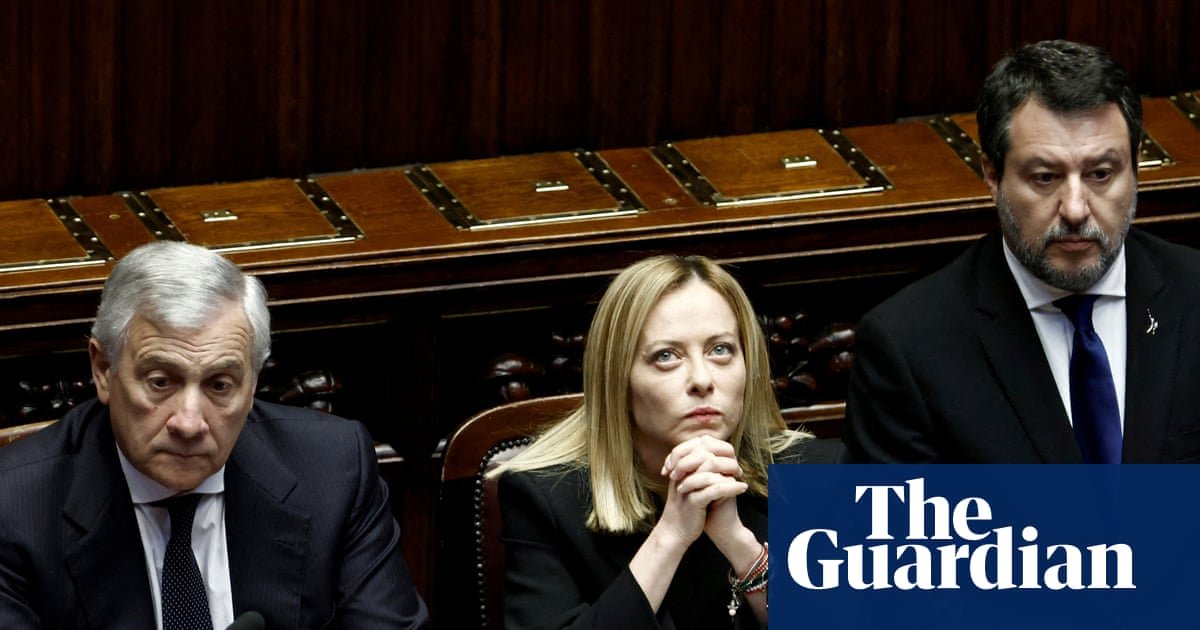
Italy’s parliament has delayed debate on landmark legislation that would define sex without consent as rape amid divisions within the ruling coalition.
The measure, the result of a rare compromise between the far-right Prime Minister, Giorgia Meloni, and her main political rival, the center-left leader, Elie Schlein, passed the lower house last week and was expected to gain final approval in the Senate this week.
But the debate has been unexpectedly blocked by the far-right coalition partner League, led by Deputy Prime Minister Matteo Salvini, who argued that the law would “clog the courts” and be used as revenge.
The bill states that anyone who engages in sexual acts without the express consent of another person can be sentenced to six to 12 years in prison. The measure aims to make it easier for victims to report and prosecute rape.
In Italy, sexual violence is defined as forcing someone to perform sexual acts through threats, physical force or abuse of authority. But the Criminal Code does not explicitly recognize the absence of consent as a sufficient basis for bringing charges.
Salvini said that although he supports the law in principle, the current draft “leaves too much open to individual interpretation” and risks escalating conflict rather than reducing violence.
“This leaves room for women and men to use an ambiguous law for personal vendetta without any abuse,” he told reporters.
The postponement came as Italy’s parliament this week gave final approval to a bill making femicide a separate crime, punishable by life in prison. Both measures were planned to be passed to mark the International Day for the Elimination of Violence against Women on 25 November.
Figures on the left have speculated that the setback was caused by the failure of the Meloni coalition to score significant victories in regional elections in Campania and Puglia this week. Both southern regions remained with the left following the strong victory of the coalition led by Schlein’s Democratic Party, which the group hopes to oust Meloni from power in the 2027 elections.
Schlein told reporters that he had spoken to Meloni about delaying the bill, “precisely to ask him to respect the agreement (on this)”, but did not disclose Meloni’s response. She said “it would be a serious thing” if the delay was the result of a post-election reaction within the ruling majority, for which “women will have to pay the price”.
Schlein has been invited to Atrezu, the annual festival organized by the Meloni Brothers of Italy party, in December and said she would go on the condition that she would debate one-on-one with the Prime Minister on this issue and other issues.
Government ministers tried to play down the controversy. Family Minister Eugenia Roxella said that “it would be better to take more time” and “pass a concrete bill”, while Justice Minister Carlo Nordio said that the delay was needed due to technical issues and that it would still be approved.
The Senate debate is now expected to take place in January.
<a href