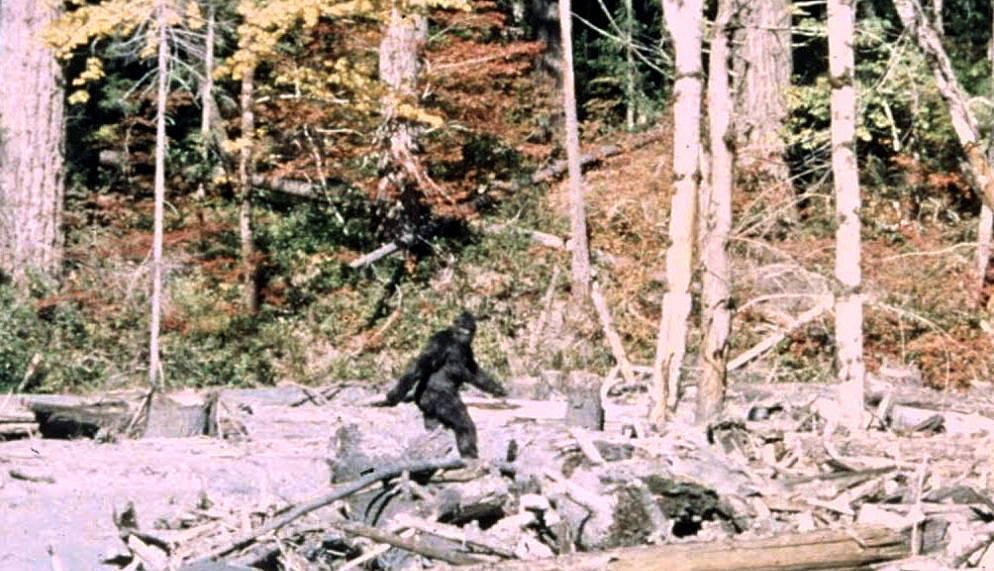
It was this image that launched a cultural icon. In 1967, in the forests of Northern California, a 7-foot-tall, ape-like creature covered in black fur was captured on camera walking upright, at one point turning around to look directly down the lens. The image has been copied endlessly in popular culture – it has even become an emoji. But what was it? a hoax? a bear? Or a real-life example of a mysterious species called Bigfoot?
The film has been analyzed and reanalyzed countless times. Although most people believe that it was some type of hoax, there are some who argue that it has never been definitively ruled out. A group of people, called Bigfooters, are so curious that they have ventured into the forests of Washington, California, Oregon, Ohio, Florida, and beyond in search of evidence of this mythical creature.
But why? Sociologists Jamie Lewis and Andrew Bartlett wanted to highlight this. They were curious to understand what motivates this community to spend precious time and resources searching for an animal that is highly unlikely to exist. During lockdown, Lewis began interviewing over 130 Bigfooters (and some academics) about their views, experiences and practices, culminating in the duo’s recent book “Bigfooters and Scientific Inquiry: On the Borderlands of Legitimate Science”.
Here, we talk to him about his academic investigations.
What was it about the Bigfoot community that you found so interesting?
Lewis:It started when I was watching a show called Discovery Channel or Animal Planet finding bigfoot Was advertised. I was really curious to know why this program was being scheduled on what was certainly at the time a nominally serious and sober natural history channel. The initial plan was to analyze these television programs, but we felt this was not enough. It was lockdown and my wife was pregnant and bedridden due to illness, so I needed to fill my time.
Bartlett: When Jamie and I shared an office in Cardiff one of the things I worked on was a sociological study of marginal physicists. These are mostly people outside of academic institutions who are trying to pursue science. I was interviewing these people, going to their conferences. And that led to a relatively easy entry into Bigfoot, but it was Jamie’s interest in Bigfoot that brought me to the area.
How big is this community?
Lewis:It’s very difficult to put a number on this. There is certainly a divide between those called “apes”, who believe that Bigfoot is a primate unknown to science, and those perhaps more pejoratively called “woo-woo”, who believe that Bigfoot is some kind of inter-dimensional traveller, some kind of alien. We are talking to thousands of people. But there are a few hundred really serious people, of whom I’ve probably interviewed at least half.
Many people support him. A recent YouGov poll conducted in November 2025 showed that at least a quarter of Americans believe Bigfoot either definitely or probably exists.
Were the interviewers suspicious of your intentions?
Lewis: I think there was definitely a concern that he would be caricatured. And I was often asked, “Do I believe in Bigfoot?” I had a standard answer that Andy and I agreed on, which was that mainstream, institutional science says there is no solid evidence for the existence of Bigfoot. We have no reason to disagree with that consensus. But what exists as sociologists is a community (or communities) of Bigfooting, and that is what we are interested in.
<a href