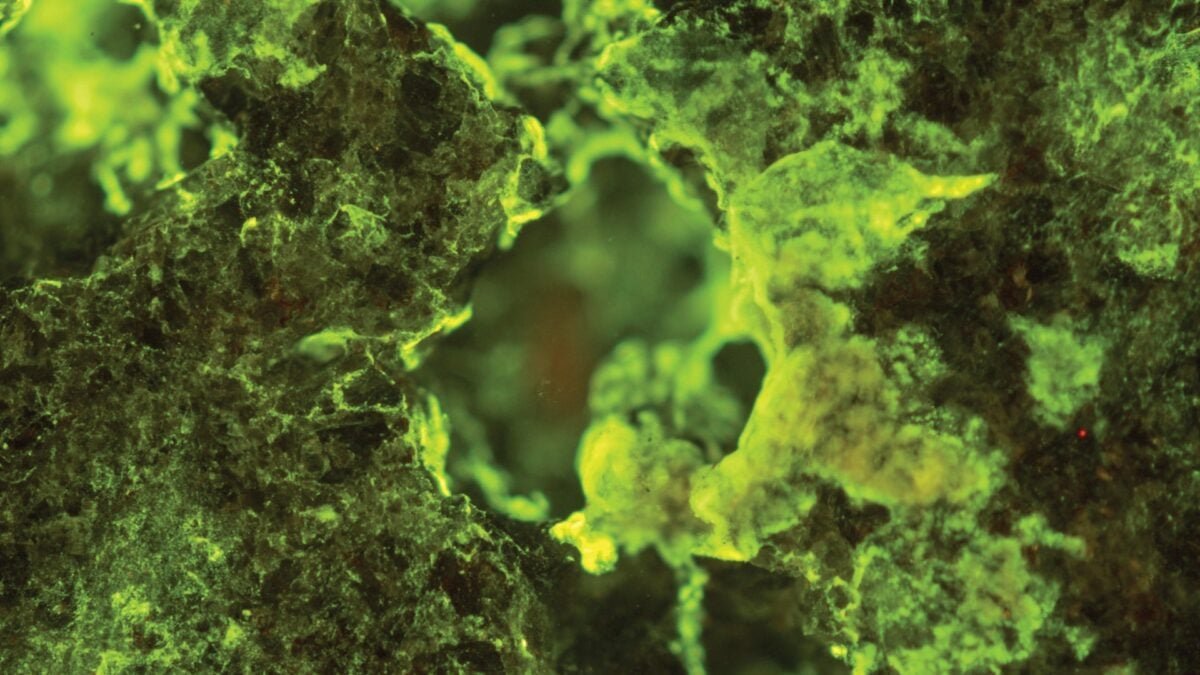

A recent experiment found that the ability of microbes to extract precious metals from asteroids remains unchanged by microgravity environments, proving that microorganisms would make ideal passengers for future space missions. The findings, published in NPJ Microgravity, support the use of a cost-effective, low-energy alternative to launching instruments and heavy machinery into space to exploit natural resources found in the universe.
Microbial Biomining
Humanity’s plans to explore the Solar System depend largely on our ability to extract natural resources from space to resupply missions. Instead of relying on traditional methods for mining materials, scientists are developing microbes to extract valuable elements from asteroids and other space rocks.
This process, known as biomining or bioleaching, relies on the ability of microorganisms to oxidize metals from mineral ores. Microorganisms used in the mining process, usually bacteria or fungi, release organic acids to dissolve rocks and extract elements such as iron, zinc or copper.
The Bioasteroid Project, developed by researchers at the University of Edinburgh, launched to the International Space Station (ISS) on December 6, 2020. The experiment is designed to investigate how gravity affects the interactions between microbes and rock.
Using two biomining reactors, the researchers set out to observe how microorganisms develop biofilms on the surface of meteorite samples in low gravity conditions. The samples returned to Earth in 2021, and researchers began analyzing how the microorganisms fared in space.
little helpers
The team of researchers behind the recent study found that microgravity increased microbial metabolism, especially for fungi. P. simplicissimum. Increased microbial metabolism resulted in greater production of carboxylic acids, which play an important role in biomining. Microorganisms produce carboxylic acids, which facilitate the release of metals.
The experiment resulted in the successful extraction of 18 out of 44 tested elements from the asteroid material. In contrast, nonbiological leaching, which uses a solution without microbes to leach out elements, was less effective in space than on Earth.
“In these cases, the microbe itself does not improve extraction, but it keeps extraction at a stable level, regardless of gravity conditions,” Rosa Santomartino, a professor of biological and environmental engineering at Cornell University and lead author of the paper, said in a statement.
He said, “Bacteria and fungi are all so diverse, one from another, and the space situation is so complex that, at present, you cannot give a single answer.” “I don’t mean to be too poetic, but to me, it’s a little bit of beauty. It’s very complex. And I love that.”
<a href