A report published last week by Human Rights Watch (HRW) highlighted the expulsion of 32,000 Palestinians from their homes into three refugee camps alone this year. HRW said the Israeli crackdown that began in January in the Jenin, Nour Shams and Tulkarem refugee camps led to the largest mass displacement of Palestinians in the West Bank since 1967.
Recommended Stories
4 item listend of list
These displacements come as Israeli violence has escalated in the West Bank, where more than 1,000 Palestinians have been killed by Israelis since October 7, 2023, the beginning of Israel’s genocidal war on Gaza, and Israelis living in illegal settlements have launched increasingly violent attacks on Palestinians.
In Area C, the part of the occupied West Bank that is not under even symbolic Palestinian administrative control, the United Nations reported in early November that more than 1,000 Palestinians were displaced when Israel demolished their homes, with more than 500 left homeless in occupied East Jerusalem. Israel cited a lack of permits for demolition, but it is extremely difficult for Palestinians in those areas to obtain building permits.
Israel has so far faced few consequences for its actions in the occupied West Bank, even as reports from human rights organizations have called for an investigation of senior Israeli military and political officials into the actions of Israeli forces in West Bank refugee camps and the ongoing displacement of civilians.
Yuli Novak, executive director of the Israeli human rights group B’Tselem, said on Friday, “We are witnessing a complete abandonment of Palestinian life. Israel has already shown that it is capable of far greater violence than we are seeing in the Gaza Strip.” “The situation in the West Bank is deteriorating day by day and will get worse, as there is no internal or external mechanism to restrain Israel or its ongoing policy of ethnic cleansing. The international community must end Israel’s impunity and hold those responsible for crimes against the Palestinian people accountable.”
What are Israel’s objectives for the occupied West Bank?
According to several senior Israeli government figures, its aim is to capture the West Bank.
In October, Israel’s parliament gave preliminary approval to a bill that would extend Israeli sovereignty over the occupied West Bank, an action widely considered a gross violation of international law.
Israel’s hardline finance minister, Bezalel Smotrich – who lives in an illegal settlement – has been clear in his intentions towards the occupied West Bank.
Speaking at a meeting of his Religious Zionism party last year, Smotrich told colleagues he was “establishing the facts on the ground to make Judea and Samaria (the West Bank) an integral part of the State of Israel”.
“We will establish sovereignty… first on the ground, and then, through law. I intend to legalize the young settlements (illegal outposts),” Israeli newspaper Haaretz quoted Smotrich as saying, “The mission of my life is to thwart the establishment of a Palestinian state.”
More than 700,000 Israelis live in illegal settlements on Palestinian lands in the occupied West Bank and East Jerusalem.
In August, Smotrich announced the construction of a new “E1” settlement, consisting of the construction of 3,000 homes separating occupied East Jerusalem from the West Bank, as part of a project the finance minister said would “bury the idea of a Palestinian state”.

Has Israel said why it is displacing so many Palestinians?
In the areas of the occupied West Bank it controls, Israeli officials usually cite planning laws, or claim that Palestinian homes are built on “closed military areas”: land designated for use by the Israeli state, its security services, or for settlement.
According to the United Nations Office for the Coordination of Humanitarian Affairs (OCHA), it is “almost impossible” for a Palestinian to obtain a building permit from Israeli authorities.
In the case of Jenin, Nur Shams and Tulkarem refugee camps, Israel claimed that it displaced residents as part of “Operation Iron Wall”, which aimed to eradicate resistance to its occupation from within the camps. However, months after Israeli forces first entered the camps in late January, residents have been prevented from returning, and bulldozers have destroyed many of their homes.
According to Israel’s military spokesman, the demolition was carried out out of “operational necessity”, and residents were allowed to submit objections and petitions to Israel’s Supreme Court.
All such petitions, including those claiming that Israel’s actions violate international humanitarian law, have been rejected.

What about Israeli settler violence toward Palestinians?
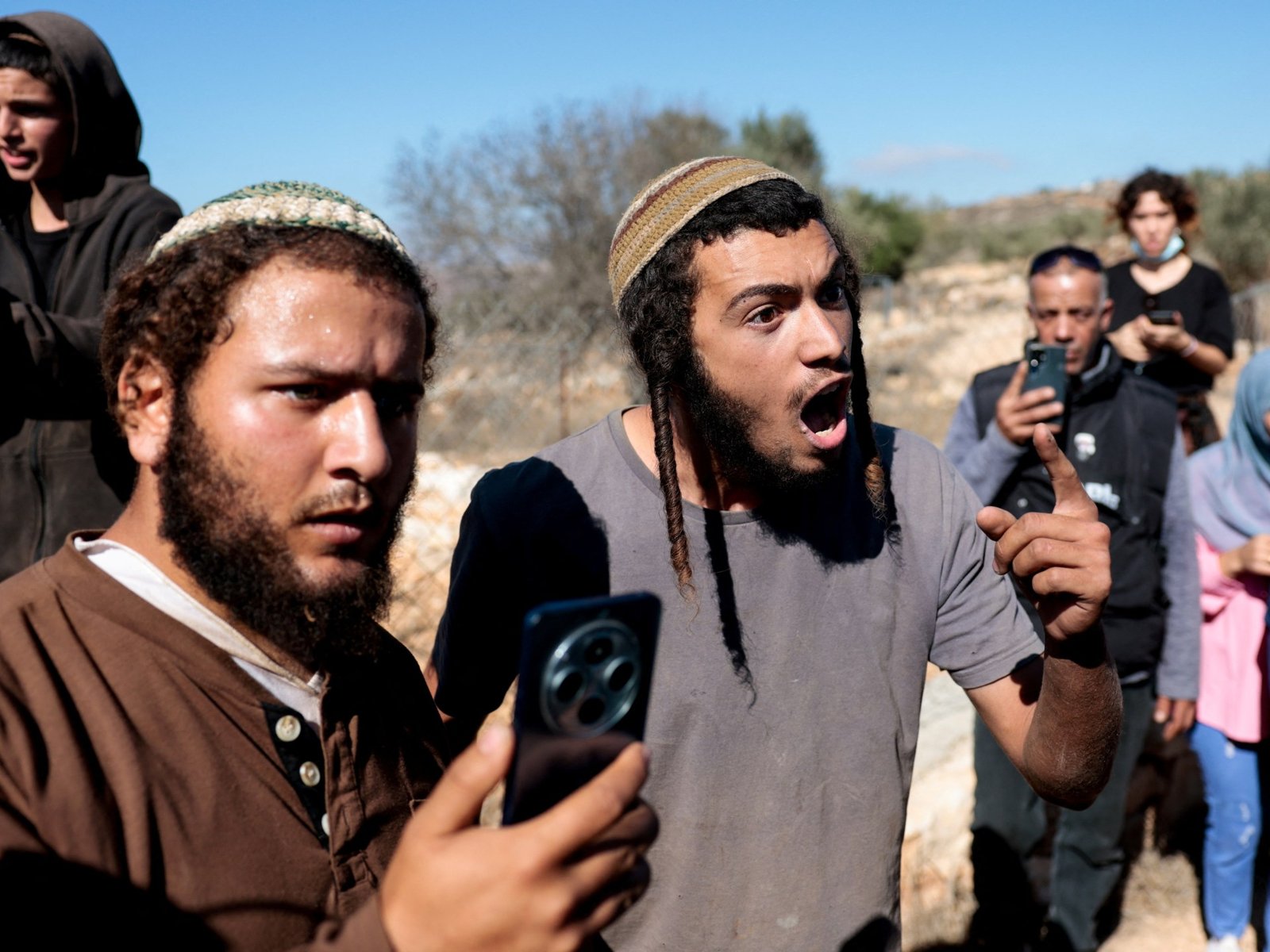
Violence by settler groups – Israelis who have illegally built their homes within the occupied Palestinian territory – is increasing, perhaps encouraged by fellow settlers holding some of the highest positions in the Israeli state. In October, OCHA recorded more than 260 attacks that resulted in casualties, property damage, or both. That’s an average of eight incidents per day: the highest number since the agency began collecting data in 2006.
During the olive harvest season, Israeli settlers unleash a barrage of violence on Palestinians while Israeli soldiers watch.
According to the Palestinian Farmers Union (PFU), the most recent attacks are “not accidental, but deliberate attempts to undermine Palestinian rural life”.
Palestinians say the attacks are part of an effort by settlers to make life unbearable for the natives and eventually drive them out.
<a href