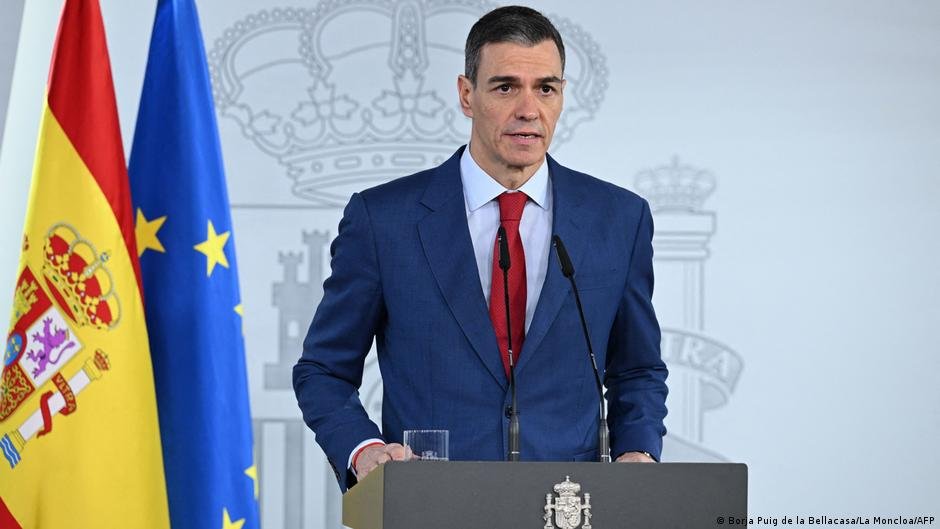
This is because Spain has opposed an attack on Iran from the beginning and has expressed this view more vociferously than any other European country.
While Meraz referred to the American and Israeli air strikes on Iran as a legal “dilemma”, Spanish Socialist Prime Minister Pedro Sánchez condemned the attacks as a gross violation of international law. His government then banned the US from using two jointly operated military bases in Andalusia, southern Spain, to wage war on Iran.
Sanchez published a video message shortly after Trump doubled down on his anti-war stance, telling viewers that “we say no to violations of international law, which protects us all, especially civilians.”
He said that anyone who acts like America is “playing Russian roulette with the fortunes of millions of people.”
Spanish PM enjoys public support
The Prime Minister’s strong words appear to have resonated with many of his compatriots.
“I think our government is just being consistent in its foreign policy – we should not just surrender to the US,” Gladys Gbegnedji, a project manager in Madrid, told DW.
Francisco Huesca, a teacher from Seville, similarly supports his government. He told DW that he does not fear negative consequences as a result of the decline.
“How can it be that European countries that call themselves democratic only support attacks that violate international law?” Huessa asked in an interview with DW.
He also expressed deep disappointment over Germany’s role in the current conflict.
Huessa and many other Spaniards who watched Trump’s scathing criticism couldn’t help but notice that their guest, Chancellor Merz, did not speak up in defense of Spain at any point. On the contrary: Merz assured Trump that Spain would be persuaded to provide more funding for NATO in the future. Merz told journalists shortly after the meeting that the EU would react to any punitive US measures against Spain.
This prompted Spain’s Foreign Minister Jose Manuel Alberes to criticize the German leader, saying: “When we were in government, we have seen three German chancellors: Merkel, Scholz and now Merz – and under Merkel and Scholz, there was a clearly pro-European sentiment.”
Will the war cause a rift in Europe?
While Spanish political scientist Rafael Calduch Cervera is concerned that the Iran war is deepening divisions within the EU, he is also critical of Prime Minister Sánchez. Cervera says the Spanish leader finds himself under domestic pressure from his leftist coalition partners, which is why he now resorts to such assertive foreign policy rhetoric. Cervera says this rhetoric is indeed aimed at the domestic Spanish population, but it has unnecessarily put Spain in an awkward position on the global stage.
Despite Trump’s threats, Cervera does not expect economic ties between Spain and the US to break.
“Trade policy is the responsibility of the EU, not a matter for national governments,” Cervera told DW.
Any punitive measures, he said, would consequently provoke European retaliatory measures, which the US certainly knows.
That’s why Cervera regards Trump’s threats against Spain as a “serious warning,” but he does not expect relations to deteriorate further.
This article was translated from German
<a href