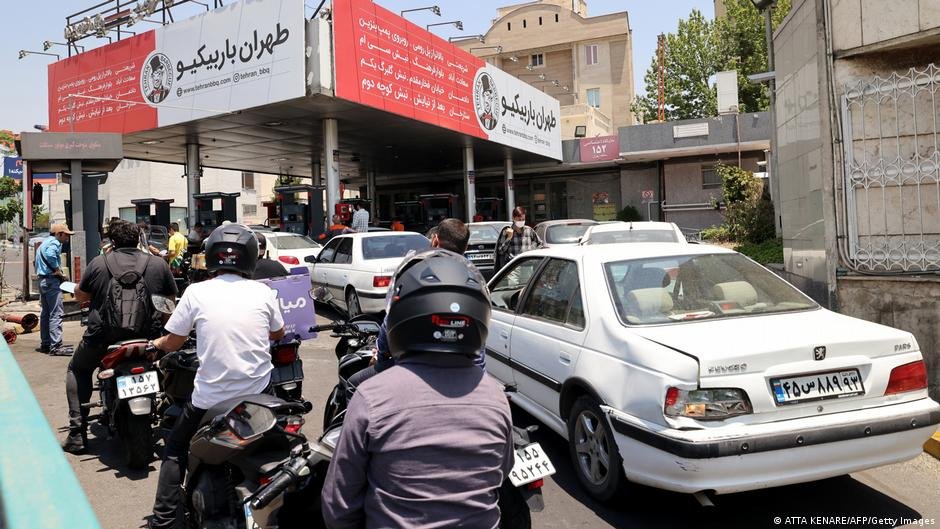
Fossil fuels are heavily subsidized in Iran, where gasoline delivered to consumers is among the cheapest globally. The Middle Eastern country also has the world’s fourth largest oil reserves and second largest natural gas reserves.
For consumers, the price paid for the first 60 liters (about 63 quarts) per month will remain unchanged at 15,000 riyals (1.3 US cents) per liter and for the next 100 liters at 30,000 riyals per liter. In future, each additional liter will cost the consumer 50,000 riyals.
This step has been taken amid pressure to reduce fuel subsidy.
The Iranian economy has been in deep turmoil for years, made worse by chronic mismanagement, corruption and tough international sanctions over its controversial nuclear program.
Iran’s economy is beset by structural problems
Jamshid Asadi, an expert on the Iranian economy, said the price increase is “objectively understandable”.
“The production cost of fuel in Iran is 20 times higher than the price set by the state. Subsidies lead to excessive domestic consumption and rampant smuggling,” he told DW.
Gasoline smuggling into neighboring Afghanistan and Pakistan remains a booming business due to the huge price difference in these countries.
In those countries, the price of a liter of gasoline is about 80 to 90 cents, much higher than the price in Iran. According to estimates, 20 to 30 million liters of gasoline is smuggled from Iran every day.
Assadi, who lives in France, says the price increase is long overdue, given high government spending on subsidies and a chronic budget deficit. However, he insists the government is using this measure to cover up structural problems.
“Decades of political tensions with the West, resulting sanctions, low investment in the oil industry and the Revolutionary Guards’ monopoly-like grip prevent competition and efficient price and production controls,” the expert said.
In recent decades, Iran’s Islamic Revolutionary Guard Corps (IRGC) has massively expanded its economic influence and become closely linked with the country’s oil and gas industry.
Asadi warned, “As long as these problems remain unresolved, the state will continue to burden the population without implementing any far-reaching reforms.”
Public dissatisfaction is increasing
In Iran, the price of gasoline is considered the “mother of all inflation”, meaning that when fuel prices rise, transportation and production costs increase, causing a domino effect on all prices.
In 2019, price hikes triggered massive protests across the country, which were brutally suppressed. According to Amnesty InternationalAt least 304 people were killed – other sources say up to 1,500 were killed. At that time, the price was suddenly increased by 50%.
This time, after discussion in Parliament and months of reporting, the increase is being implemented in phases. Still, Assadi said, mass protests once again cannot be ruled out.
“Given the high inflation rate of more than 40% and rising poverty, social tensions are entirely possible,” he stressed.
A day after the price increase was announced, government spokesman Fatemeh Mohajerani said in an interview with Radio Goftogo that the goal was to “ensure fair fuel prices and prevent waste of state resources”.
More than 80% of personal fuel card users will not see any changes to their quotas or prices, he said, adding that refueling only through gas station cards will be increased to 50,000 riyals per litre.
Poor management and organized smuggling networks
While the Iranian government aims to curb fuel smuggling and control consumption by raising prices, energy policy expert Omid Shokri of George Mason University in Virginia, US, remained skeptical.
“The Iranian government has so far been unable to stop fuel smuggling due to a number of structural reasons,” he said, pointing to weak governance, lack of monitoring systems and systemic corruption.
Weak border controls and a large price gap between Iran and other countries in the region also contribute to the problem, he said.
All these factors favor organized smuggling networks, Shokri said, so price increases alone will not solve the underlying problems. “Although the living conditions of the population are inadequate and social discontent is looming, the government justifies this measure with the aim of reducing the budget deficit.”
This article was originally written in German.
<a href