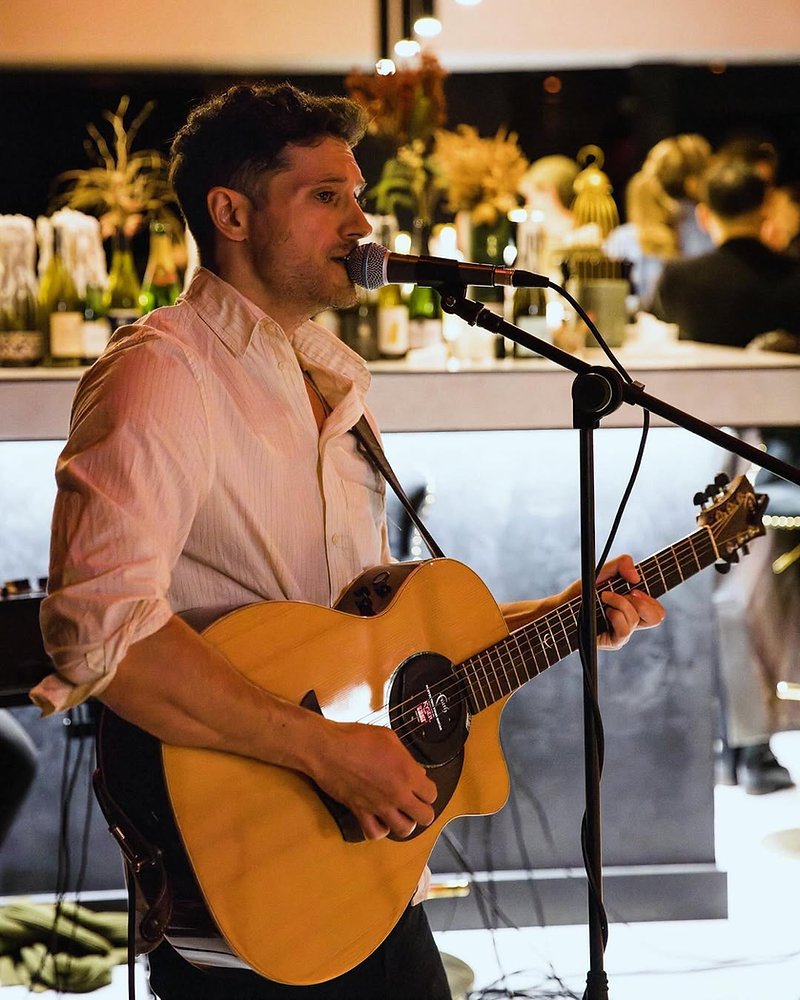
Miguel Brooking doesn’t just release songs – he highlights entire chapters of his life. his new single “That’s my company” It comes as the culmination of a nine-year cycle, a track born in the crack-guitar chaos of East London and ultimately completed in the creative electricity of Melbourne. Brookings speaks as clearly in the images as he writes them: melted-wax flats above the pub, ticket inspectors who feel like villains, acting auditions that drain the soul, and the small, stubborn spark that keeps a young artist alive long enough to grow old.
Now, with the song finally released into the world, Brookings is remembering the decade that shaped it — the frustration, the speed, the wandering, the near-misses, and the long search for a sense of home that was never tied to geography. In his own words, here’s the story behind it “That’s my company.”
1. “She’s My Company” took almost a decade to complete – what kept this song alive for you all these years, and what made it finally open in Melbourne after debuting in East London?
Do you remember the movie ‘Castaway’? Tom Hanks remains stranded on the island for years, until one day conditions are finally right for him to jump onto his life raft and attempt a nearly impossible escape. Packages from a crashed FedEx plane aid his survival; Wilson’s volleyball as his only companion – an ice skate shaped like a spear; He leaves one open for his entire time on the island. The optimistic prospect of delivering that package to its rightful owner maintained his survival instincts against all odds. I was very confused when I wrote the first verse of ‘She’s My Company’. My guitar is a metaphorical life-raft in a moment of spiritual bankruptcy – like my Wilson volleyball, but it would talk to me instead of staring blankly. That unfinished song served as my closed package, encapsulating that moment as I moved toward a future in which everything was fine. Melbourne 2024 The moment has come to set sail for life. The conditions were excellent. I was wandering around the city, met my producer, suddenly met my photographer and found out I was playing with the best band in town. The song had no choice but to raise its head and here we are. Package received. You followed your heart, baby and it was really worth it.
2. This song feels like a bridge between two versions of you – the broke, sofa-surfing actor in Shadwell and the artist you’ve become. How do you hear that change in music or lyrics today?
It’s two different people meeting on the bridge 9 years on – but some things remain the same… I get fined on a Melbourne tram instead of the London Overground! The truth is, I can’t stand on a high platform and sing unless it’s coming from a place of real truth. When I wrote the first poem I had no intention of sharing it and my external pursuit of music was very limited. I now sing this song on the back of 9 years of experience; Backed by musicians who have mastered and expressed what it is, a beautiful approach. As long as I don’t forget that Miguel who first sowed the seed in London, who didn’t have a penny to rub, I will be able to make a living demonstration of it. When I escape the limits of happy hour beers and late bill payments; When I eat dinner three times a week without taking a second glance at the check – that’s probably when I’ll have a hard time singing, and honestly – that’s probably the goal of this whole thing. I’m waiting for the time when you’ll ask me how I sing when money is no longer an issue!
3. You write with complete honesty about disappointments – with industry, with money, with the “lie of success.” How important is anger or disillusionment to you as creative fuel?
To be completely honest, negative sources excite me a lot but they need time to simmer and ripen. This is why outlets are so important – especially in moments surrounded by negative energy, because they provide you with an opportunity to create something positive. That’s what songwriting became for me. I remember my acting teacher and surrogate mother, Anna Niland, once said to me, ‘I need you to make Miguel angry,’ and at the time I didn’t understand what she meant. When you have a responsibility on your shoulders, you conduct yourself differently in life and on stage. And if you’re lucky enough to have a guitar lying around – you’ll have a tune or two when you come out the other side.
4. The imagery in your story – the candlelit rooms, the broken guitars, the ticket fines, the fleeting connections – has a cinematic quality. Do you think your acting background influences the way you write or conceive of songs?
I see acting as more of a cathartic pursuit than an artistic one. Having said that, ‘Fish Bowl Souls’ was inspired by a character I played in Terrence Rattigan’s ‘Deep Blue Sea’ – which was directed by Nancy Medina. That play gave me a platform to assess human relationships in a unique way. I wrote a poem ‘In Character’ and it became ‘Fish Bowl Souls’. Playing that role shed light on latent parts of the younger self that had waited years for it to come out.
Sometimes the depth of work required to play a character provides a perspective or palette that was previously out of reach.
5. You describe the song as “a realization that home is not a physical place.” After so many years and travels, do you think you’ve found a sense of home – or is the search itself part of the art?
Carl Jung said that life is merely a revolution around itself, and so until you reach a certain closeness of self-awareness, you will never feel at home. Songs make me feel like I understand myself and I feel most at home when I am engaged in creative expression and progressively refining it. The more I understand myself the more I can connect with others and I’ve found that the more I refine that process the more I attract the people I want into my ‘home’.
<a href=