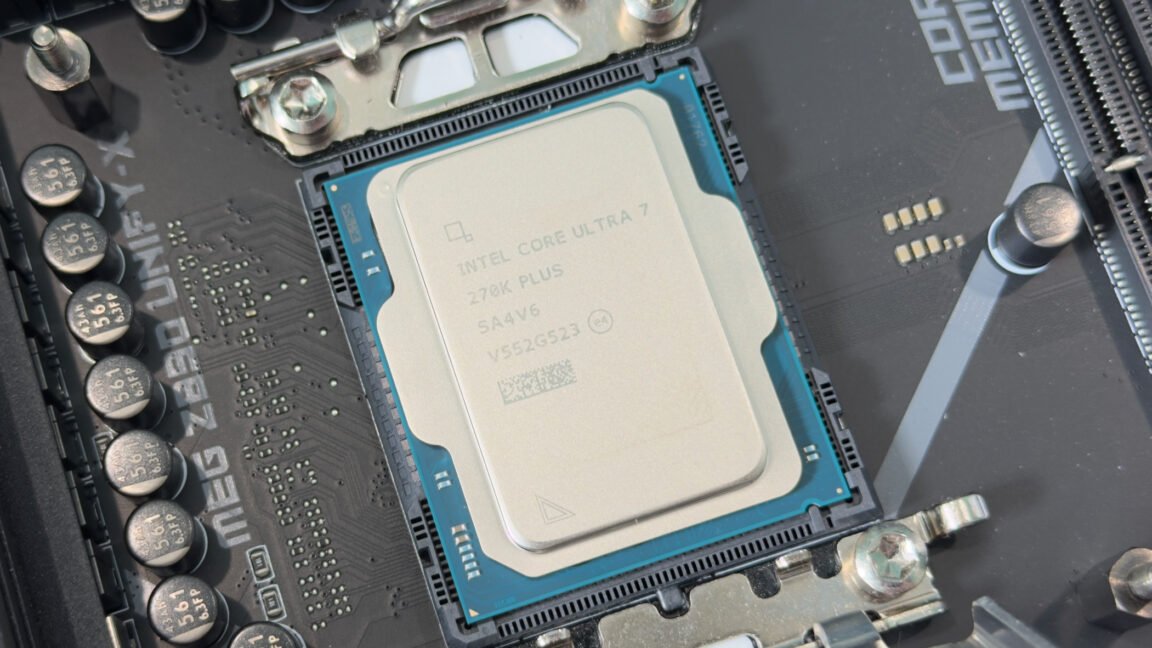
But keep in mind Intel’s pricing here – at $199 and $299, these CPUs’ most direct competition is AMD’s 6- and 8-core non-X3D processors, specifically the Ryzen 9600X, 7700X, and 9700X. We don’t have one to test, but the Ryzen 7600X3D also sits around $300 and could be an option if game performance is more important to you than any other type of performance.
We generally stuck to the default power settings for all chips, although we did use the high-performance 105 W power setting for the Ryzen 9700X.
The fresh Arrow Lake chips are respectable upgrades over the older chips, and despite the Core Ultra 7 branding, the 270K generally beats the older Core Ultra 9 285K by a small amount in most of the tests we ran, making it effectively Intel’s flagship desktop CPU.
Multi-core tests like the Cinebench benchmark and the Handbrake video encoding test show particularly big advantages for the Core Ultra 5 250K relative to the older 245K, thanks to the extra cluster of e-cores. And it runs circles around the 7700X and 9700X, which currently sell for $50 and $100 more than their MSRP. It completely outperforms the Ryzen 9600X, which is selling for around $200 more.
The Core Ultra 7 270K’s multi-core performance puts it ahead of both the Ryzen 7950X and 9950X, chips that sell for well over $300. Compared to previous generation Intel chips, the 270K and 250K are certainly faster than their 14th and 13th generation counterparts in multi-core performance tests, but the more significant improvements are still temperatures and power efficiency under load. While both the 270K and 250K consume more power under load than the 285K and 245K, they are still far more efficient (and run cooler) than the 13th and 14th generation chips during heavy multi-core workloads and gaming.
<a href