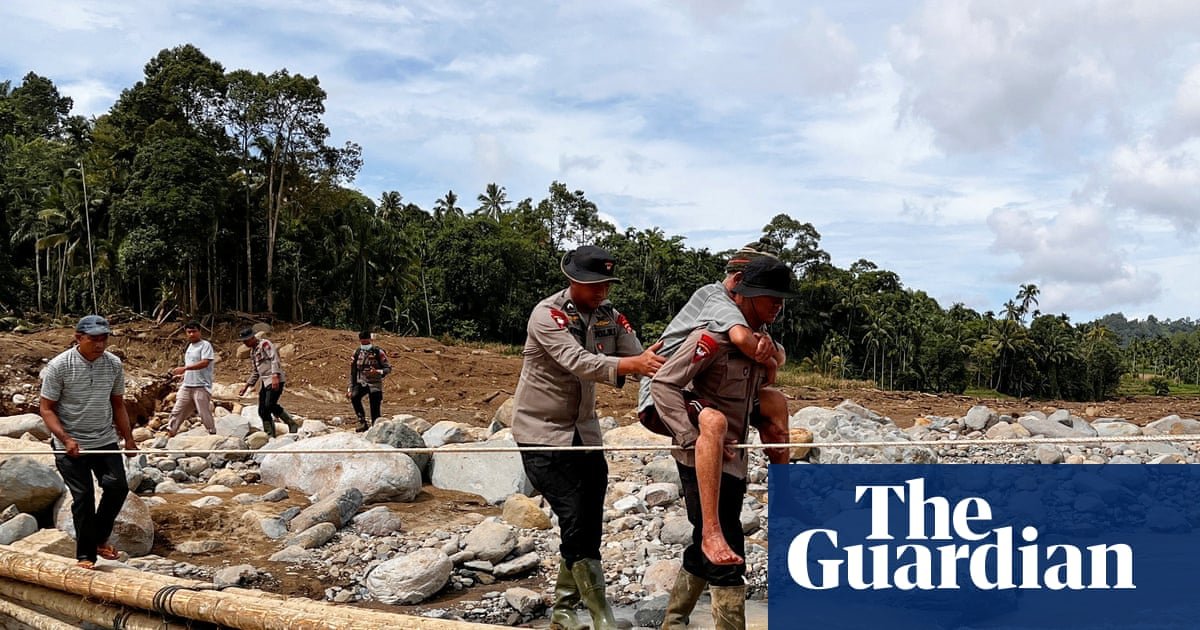
Indonesian and Thai officials are racing to clear debris and search for hundreds of missing people as they say more than 600 people have been killed in devastating floods and landslides in Southeast Asia.
Heavy monsoon rains have lashed parts of Indonesia, Thailand and Malaysia in recent days, leaving thousands stranded without shelter or vital supplies.
In Indonesia, officials said more than 442 people were killed, hundreds were injured and 402 were missing, as authorities attempted to reach some of the hardest-hit areas on the island of Sumatra, where thousands were stranded without vital supplies.
“The water just rose into the house and we were scared, so we ran away. Then we came back on Friday, and the house was gone, destroyed,” Afrianti, 41, who goes by only one name, told Reuters in Padang, the capital of West Sumatra, where she was taking refuge.
He and his family of nine had built a tent shelter near the only remaining wall of their house. “My house and business are gone, my shop is gone. Nothing is left. I can only live near this wall that is left,” she said.
At least two areas on the island of Sumatra were still inaccessible on Sunday and officials said they had deployed two warships from Jakarta to deliver aid.
The Associated Press reported that some residents were struggling to find food and water after the floods caused landslides, damaged roads and collapsed communication lines. Videos on social media showed people wading through broken barricades, flooded roads and broken glass to get food, medicine and gas. Some people waded through waist-deep flood waters to reach damaged convenience stores.
Ferry Walintukan, a police spokesman, told the AP there were reports of people vandalizing shops on Saturday evening and regional police were deployed. “The looting took place before logistics support arrived,” Walintukan said. “(Residents) didn’t know there would be aid and were worried they would starve to death.”
Rescue efforts were also hampered by weather conditions and lack of heavy equipment. There have been delays in aid reaching the worst-hit city of Sibolga and central Tapanuli district in North Sumatra.
In the village of Sungai Nyalo, about 60 miles (100 km) from Padang, flood waters had largely receded on Sunday, leaving homes, vehicles and crops covered in thick brown mud. Residents told Agence France-Presse that authorities had not yet begun clearing the streets, and no outside aid had arrived.
“Most villagers chose to stay here; they didn’t want to leave their homes,” said Idris, 55.
Across the island towards the northern coast, an endangered Sumatran elephant was buried in thick mud and debris near damaged buildings in the town of Meurudu. In northern Tapanuli, survivors waved frantically to helicopters carrying aid. Meanwhile, four Navy ships stopped at a port to assist in aid distribution.
In Thailand, where at least 162 people died in the worst floods in a decade, authorities continued to deliver aid and repair damage. Relief measures initiated by the Thai government include compensation for families who have lost family members. But there is growing public criticism of Thailand’s flood response and two local officials have been suspended over their alleged failures.
The annual monsoon season, which typically occurs between June and September, often brings heavy rains, causing landslides and flash floods. A tropical storm has worsened conditions, and the death toll from floods in Indonesia and Thailand is among those countries’ highest in recent years.
The climate crisis has affected hurricane patterns, including the duration and intensity of the season, causing heavy rainfall, flash floods and strong windstorms.
Elsewhere, low-lying areas of the Sri Lankan capital were flooded on Sunday after a powerful cyclone brought heavy rains that triggered landslides across the island, killing at least 212 people and leaving many missing. About 148,000 people have been displaced and are living in temporary shelters.
The extent of the damage in the worst-hit central region was revealed as rescue workers cleared roads blocked by fallen trees and landslides, officials said.
Selvi, 46, a resident of Colombo suburb, emerged from her flooded house on Sunday carrying four bags of clothes and valuables. “My house is completely flooded. I don’t know where to go, but I hope there will be a safe shelter where I can take my family,” she told Agence France-Presse.
Decreasing water levels have revealed widespread devastation in the town of Manampitiya, 155 miles north-east of Colombo. “Manampitiya is a flood-prone town, but I have never seen this amount of water,” said S Sivanandan, a 72-year-old resident.
He told the local news center portal that businesses and property were extensively damaged. He told that a car had overturned in front of his shop.
A woman in central Wellawaya said she heard a loud noise and went outside to look at stones falling from a hill before stopping near her home. “I saw trees falling and stones being shaken. We are afraid to go back to our homes,” he told reporters after moving to a shelter.
Officials say Cyclone Ditvaha, which developed in the sea east of Sri Lanka, is likely to move towards the southern coast of India on Sunday.
With reporting from Reuters, the Associated Press and Agence France-Presse
<a href