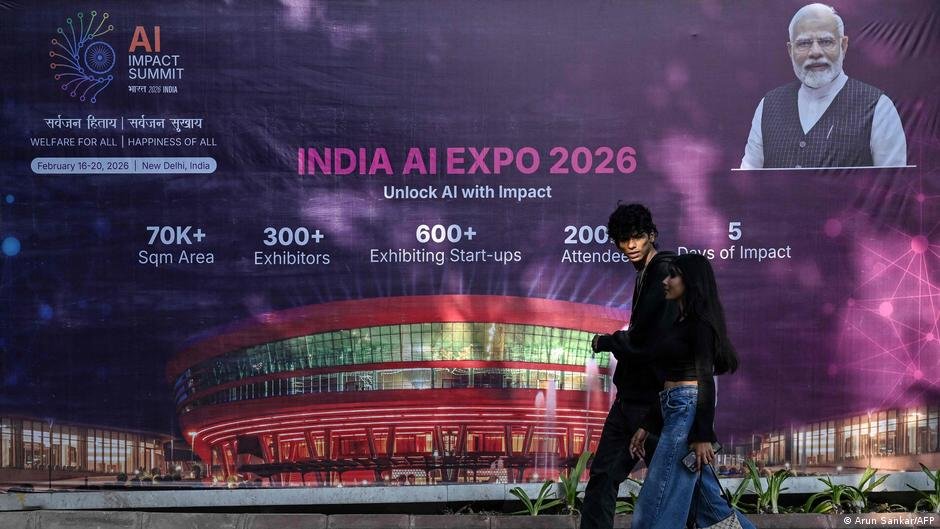
Prime Minister Narendra Modi is hosting the summit starting on Monday afternoon.
The annual summit will be the fourth of its kind, with previous meetings held in France, South Korea and the UK. This is the first time that it is being hosted by a developing country.
According to the calculations of Stanford University researchers, India has climbed rapidly in the AI competitiveness category and has come in third place after the US and China last year.
France’s Macron and OpenAI’s Altman will attend
The India AI Impact Summit 2026 is expected to host over 250,000 visitors with 20 national leaders, including French President Emmanuel Macron and Brazil’s Luiz Inácio Lula da Silva, and 45 ministerial-level delegations planning to participate.
The guest list also includes technology CEO Sam Altman of OpenAI and Google’s Sundar Pichai.
India’s IT Ministry has said, “The summit will shape a shared vision for AI that will truly serve the many, not just the few.”
“The AI Impact Summit will enrich the global discussion on diverse aspects of AI, such as innovation, collaboration, responsible use and much more,” Modi said at the X on Monday ahead of the summit.
“From digital public infrastructure to a vibrant startup ecosystem and cutting-edge research, our progress in AI reflects both ambition and responsibility,” he said.
Delhi summit focuses on AI risks
The meeting in New Delhi is taking place amid growing security concerns over AI-generated misinformation, disinformation and deepfakes.
Just last month, Elon Musk’s AI tool Grok saw a global backlash over creating erotic images of real people using simple text prompts. Most of the images generated were of women, some of children.
In November, India released AI governance guidelines with core principles of “trust,” “security,” “equity” and “innovation over restraint.”
However, in January, the government tightened AI rules for social media platforms, which are now required to clearly label what the government calls “artificially generated information.”
This week’s summit is being held under the slogan “people, progress, planet”, but some critics are skeptical about what can be achieved.
Amba Kak, co-executive director of the AI Now Institute, said industry commitments made at previous events “have largely been narrow ‘self-regulatory’ frameworks that position AI companies to continue to grade their homework.”
Kak, who is attending the summit, said he doubts whether leaders will take any meaningful steps to hold AI giants accountable.
Edited by: Alex Berry
<a href