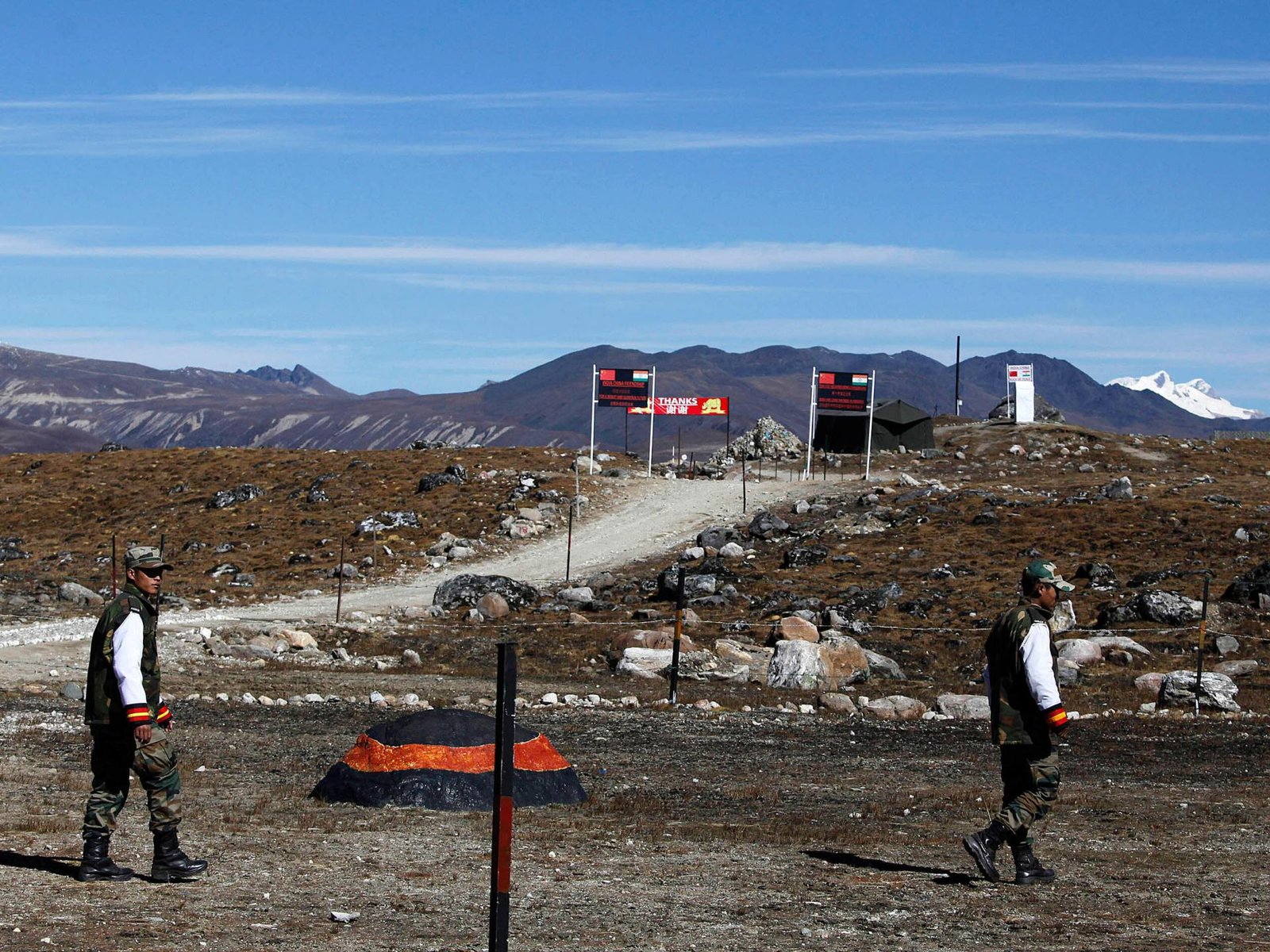
China claims the area of Arunachal Pradesh and calls the region Southern Tibet or Zangnan.
Here’s what happened, what the tensions over Arunachal Pradesh are about and why the new tensions between the world’s two most populous countries matter.
What happened?
Prema Wangjom Thongdok was traveling to Japan on Friday on her Indian passport from the United Kingdom, where she lives. She stopped at Shanghai Pudong International Airport in China for a three-hour layover.
Thongdok alleged that Shanghai airport officials detained and harassed him for 18 hours because his passport listed his place of birth as Arunachal Pradesh.
He said Chinese officials at the airport said his Indian passport was “invalid”, claiming that Arunachal Pradesh was actually part of China.
“I actually crossed the immigration gate. It was the e-gate, so I kept my passport and went to the security gate,” Thongdok told India Today news magazine over videolink from the Thai capital Bangkok.
“One of the officers came and started shouting, ‘India! India!’ With my name on it and singled me out,” she added.
When Thongdok asked the officer why he was being taken out, he said the officer told Thongdok that his Indian passport was not valid because he was born in Arunachal Pradesh. Thongdok said the officer said, “Arunachal is part of China. Your passport is invalid.”
Thongdok said he replied: “Arunachal is part of India. I never heard of it being part of China.”
He said he was stopped at the airport, without saying how long the authorities would detain him.
Other Indian media outlets reported that Thongdok said airport officials had pressured her to buy a new ticket on China Eastern Airlines and indicated that her passport would be returned only if she complied. This caused him to lose money on missed flights and hotel reservations.
She said that with the help of a friend in the UK, she eventually got in touch with the Indian Consulate in Shanghai. Indian officials later flew him out of the city on a late-night flight.
The Indian Express newspaper reported that Thongdok had passed through Shanghai Pudong International Airport in October without any problems. It’s not clear what was different this time.
Have such incidents happened before?
In 2005, Beijing adopted a policy of issuing stapled visas to people coming to China from Arunachal Pradesh. Other Indian residents get a stamped Chinese visa on their passport.
China’s argument: It cannot issue regular visas to the people of Arunachal Pradesh even though it considers them Chinese to begin with.
But India has never accepted Chinese visas stapled to their passports. It says that doing so would be tantamount to accepting that the people of Arunachal Pradesh are not Indians.
In 2013, two archers from Arunachal Pradesh were issued staple visas to travel to Wuxi in eastern China for the Youth World Archery Championships. India stopped him from flying to China.
In July 2023, three martial arts athletes from Arunachal Pradesh were issued staple visas for the World University Games, which took place in Chengdu, China. As a result the entire Indian Wushu team did not go to the Games in Chengdu.
In September 2023, the same three wushu athletes from Arunachal Pradesh were unable to compete at the Hangzhou Asian Games as they were unable to download their accreditation cards, which are supposed to serve as visas to travel to China.
Indian Sports Minister Anurag Thakur canceled his visit to Hangzhou for the opening of the Games in protest.
What is the Arunachal Pradesh dispute about?
Raj Verma, a non-resident scholar at the Sigur Center for Asian Studies at George Washington University, told Al Jazeera that the India-China border dispute over Arunachal Pradesh is a legacy of the British Empire.
In March 1914, the McMahon Line was established during the Simla Convention in India, which involved negotiations between Tibet, China, and the British Empire. The line is named after chief British negotiator Henry McMahon. While Chinese representatives attended the conference, they did not sign the main agreement and did not recognize the McMahon Line.
McMahon nevertheless went ahead and decided on the line with Tibet. China believes that Tibet does not have the right to take unilateral decisions on the border with India, especially since China sent troops to Tibet and annexed it in 1951. Beijing has also turned to old maps, including British ones, which showed the area south of the McMahon Line as belonging to China.
Since gaining independence from Britain in 1947, India has regarded the McMahon Line as its border with China.
Beijing has stressed that India and China need to negotiate and decide their own boundaries rather than relying on the British-era McMahon Line.
For decades, China claimed only a part of Arunachal Pradesh known as Tawang. But in recent years its claim has spread to the entire northeastern Indian state.
Verma said tensions have increased since Chinese President Xi Jinping came to power in 2012 and took a more assertive approach towards Beijing’s regional demands.
Xi said in 2018, “Our stance is firm and clear when it comes to China’s sovereignty and territorial integrity. … We cannot lose even an inch of the territory given to us by our ancestors. Meanwhile, we do not want anything from others.”
China’s relations with many of its other neighbors have also soured over the past decade over territorial disputes, including Beijing’s claims over the entire South China Sea.
“This (China’s stance) is the reason why it is becoming more difficult to resolve the dispute and it will be extremely difficult to resolve this issue in the future also,” Verma said.
In India, Prime Minister Narendra Modi, who has been in power since 2014, has also pursued a more assertive foreign policy, including on border disputes. He once said that he would show China “red eyes” – a metaphor in Hindi meaning to show determination and strength.
How has the Arunachal Pradesh dispute played out historically?
Arunachal Pradesh, India’s least populous state, has long been at the forefront of New Delhi-Beijing tensions.
In October 1962Present-day Arunachal Pradesh became one of two theaters of the India-China war, and Beijing’s troops attacked Indian positions on both banks of the Namka Chu River. Indian troops fled Tawang, although the Chinese People’s Liberation Army returned the area to India after winning the war.
In October 1975Another clash took place at the Tulung La Pass connecting Tibet and Arunachal Pradesh. Each side accused the other of attacking its troops. Four Indian soldiers were killed in the last deadly border clash between the neighbors until the 2020 crisis in Ladakh, in which at least 20 Indian soldiers and four Chinese service members were killed after a face-off.
While the Arunachal Pradesh border has been largely peaceful for half a century, competing Indian and Chinese claims to the region have emerged in other ways.
In 2012China has objected to the scheduled visit of the Dalai Lama to Arunachal Pradesh. Jiang Yu, who was China’s Foreign Ministry spokeswoman at the time, said, “We firmly oppose Dalai’s so-called ‘Arunachal Pradesh’ visit.” The Dalai Lama did not visit the state in 2012.
In December 2022Minor clashes took place on the border in Tawang. Both sides accused each other. While China accused Indian forces of obstructing routine patrolling, India alleged that Chinese troops encroached on Indian territory and tried to “change the status quo”.
In JanuaryChina approved the construction of a dam in Tibet’s Medog County near the Indian border. India hit back by approving the Siang Upper Multipurpose Project in Arunachal Pradesh to mitigate the impact of the Chinese dam and prevent floods. However, the Indian reservoir project risks submerging dozens of indigenous villages in India and Bangladesh.
Why is Arunachal Pradesh important?
Verma said, the state is strategically important for India as it connects the country to Southeast Asia and is also a military district. The state shares an international border with Myanmar in the south-east and is close to Bhutan in the west. Myanmar, in turn, connects India to Thailand, Laos and beyond through the India-Myanmar-Thailand Trilateral Highway Project.
Verma said that this state also holds religious importance for China. In 1683, the sixth Dalai Lama, Tsangyang Gyatso, was born near Tawang.
China insists that Arunachal Pradesh is an extension of Tibet, itself a source of tension between the neighbors: India’s decision to grant sanctuary to the current Dalai Lama after he fled Lhasa during a Chinese crackdown in 1959 has long been viewed by Beijing as a provocation.
In September 2024, India named a previously unknown mountain peak in Arunachal Pradesh after the Sixth Dalai Lama.
China has expressed disappointment over this decision. “I should say more broadly that the area of Zangnan is Chinese territory, and it is illegal and invalid for India to annex the so-called Arunachal Pradesh to Chinese territory. This has been China’s consistent position,” said Chinese Foreign Ministry spokesman Lin Jian at the time.
“Beijing would be extremely reluctant to give up the Arunachal Pradesh and Tawang issues,” Verma said.
How have Chinese and Indian officials responded?
In response to a journalist’s question about Thongdok’s experience at the Shanghai airport, Chinese Foreign Ministry spokesman Mao Ning said on Tuesday, “Zhangnan is China’s territory. The Chinese side has never recognized the so-called Arunachal Pradesh established illegally by India.”
He stressed that Chinese authorities had treated Thongdok “in accordance with laws and regulations.”
Mao said, “Law enforcement was impartial and non-harassing. The legal rights and interests of the person concerned were fully protected. No compulsory measures were taken against him, and there was no so-called detention or harassment. The airline provided him with rest facilities and meals.”
Responding to his Chinese counterpart’s statements, Indian Foreign Ministry spokesperson Randhir Jaiswal said on Tuesday, “Arunachal Pradesh is an integral and inseparable part of India, and this is a self-evident fact. No amount of denial by the Chinese side is going to change this indisputable reality.”
Jaiswal said: “The issue of detention has been raised strongly with the Chinese side. The Chinese authorities have still not been able to explain their actions, which are in violation of multiple conventions governing international air travel. The actions of the Chinese authorities also violate their own rules that allow up to 24 hours of visa-free transit for citizens of all countries.”
What does this mean for India-China relations?
Verma said the latest dispute is a “small setback in bilateral relations” between India and China. “This should not be an issue when it comes to improving India-China relations.”
Relations between New Delhi and Beijing, particularly cold from 2020 to 2024, have thawed in the past year. Both have been hurt by heavy tariffs imposed by United States President Donald Trump, which analysts say have forced them to cooperate.
In 2020, India-China relations hit a low point following the Galwan Valley clash in Ladakh. It was the first deadly border incident in 40 years and resulted in India banning 200 Chinese apps, including TikTok. India’s foreign minister called it “the most difficult phase” in decades.
Since the end of 2024, both countries have sought to re-establish relations. Modi and Xi met in Kazan, Russia during the withdrawal of troops from the Line of Actual Control.
In August, Chinese Foreign Minister Wang Yi visited India, after which Modi praised their “respect for each other’s interests” and “steady progress” in relations. Later that month, Modi made his first visit to China in more than seven years and met Xi for talks.
Yet, Verma pointed out, despite the thaw in relations, “the overall strategy of the two countries towards each other has not changed.”
“Both countries see each other as rivals and the competition and rivalry between the two countries will continue,” he said.
<a href