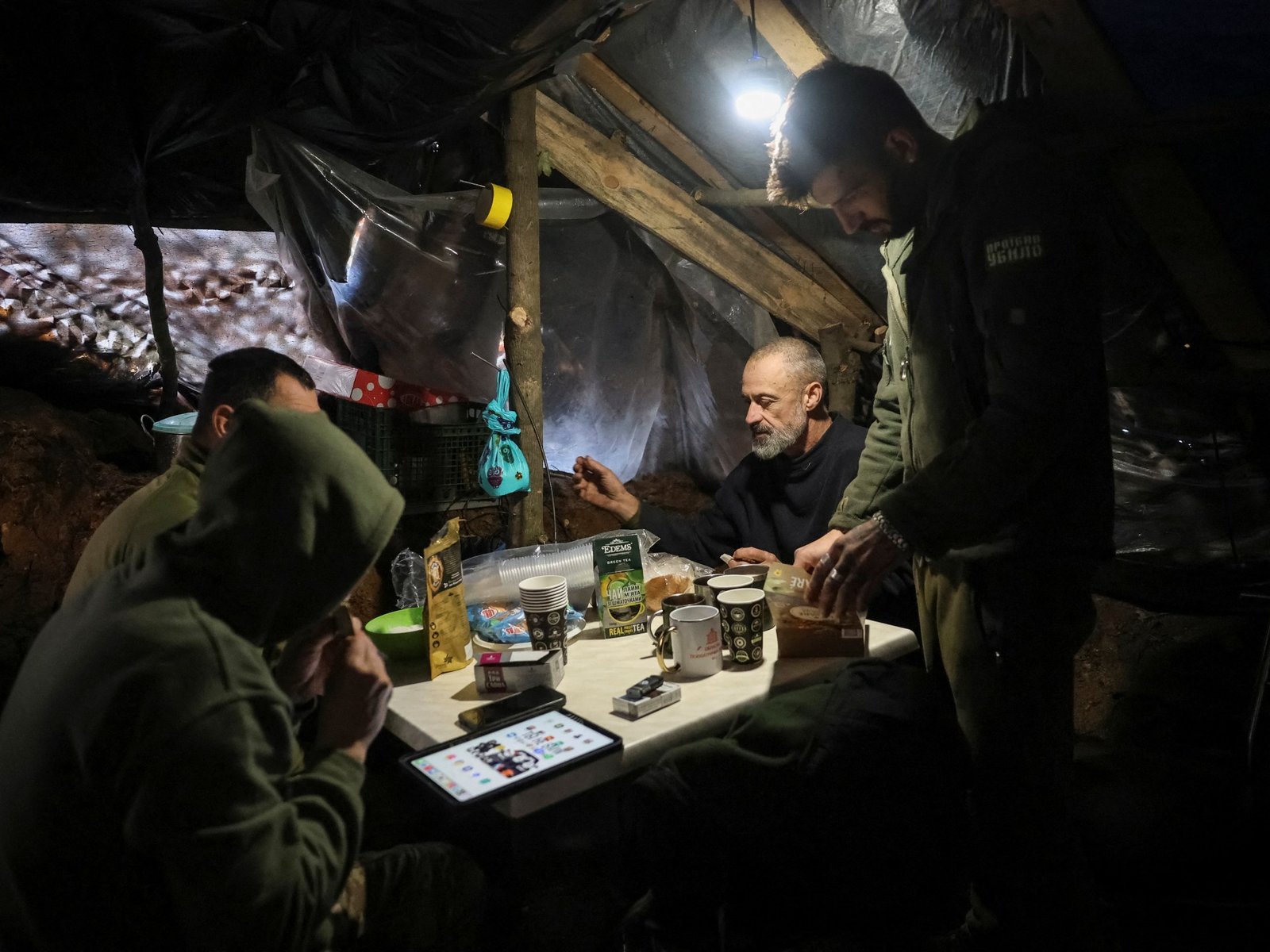
The Russian Defense Ministry said on Monday that its “assault groups of the 2nd Army have completely liberated the Gornyak and Shchersky microdistricts in Pokrovsk.
On Tuesday it said its forces were fighting in the Vostochny and Zapadny districts of Myrnohrad, east of Pokrovsk.
Both cities are within an envelope in Ukraine’s Donetsk region, which the Russian military has gradually tried to close in on. Supplies and reinforcements can currently reach Ukrainian forces only from the west – and Russia claims effective fire control over those supply routes.
Ukrainian officials insisted that the defense of Pokrovsk was still a contest. “Our positions in the center of Pokrovsk are held, the firing battle continues and the enemy fails to unite,” Andriy Kovalenko, head of Ukraine’s counter-disinformation center, said Sunday, referring to the 7th Air Assault Brigade fighting there.
Ukraine has clearly strained its resources to defend the Pokrovsk-Myrnohrad enclave, while the concentration of Russian offensive forces in Pokrovsk has not compromised their ability to strike elsewhere.
During 20–27 November, Russia claimed to have seized Petropavlovka, Novoselievka, Maslyakovka, Yampol, Stavki, Zhvanovka, Petrovskoye, Ivanopolye and Vasyukovka in Donetsk, Tikhoye and Otradnoye in Dnepropetrovsk in Kharkiv, and Novoye Zaporozhye and Zatyshche in Zaporizhia. Have done it.
The Russian army’s recent advance rate has reached about half a dozen villages per week.


But Ukraine denies some of Russia’s claims.
On 20 November, Russian Chief of Staff Valery Gerasimov said that his forces had captured the city of Kupyansk in Ukraine’s northern Kharkiv region, and were preparing to repel Ukrainian units on the left bank of the Oskil River.
But Kovalenko responded on the Telegram messaging service: “Russia did not capture Kupyansk. Gerasimov is just a liar,” and he repeated the claim a week later.
Ukraine has also had successes on the ground, according to its commander-in-chief, Oleksandr Sirsky. “Despite enemy pressure, the Defense Forces of Ukraine managed to retaliate in the Dobroplyya direction from late August to October this year,” he said, referring to a failed Russian maneuver towards a town northwest of Pokrovsk.
“As a result, the units split the enemy offensive grouping and liberated 430 square kilometers (166 sq mi) of territory north of Pokrovsk. Russian losses amounted to more than 13,000 killed and wounded.”
Russia also maintained pressure on Ukraine’s rear, launching 1,169 drones and 25 missiles at its cities during the week of 20–26 November. Ukraine shot down 85 percent of the drones and 14 missiles, but Zelensky called for more short- and medium-range defense.

dubious diplomacy
Europe, Ukraine and members of the US Congress have opposed a 28-point peace plan presented by Donald Trump’s US administration last week, calling it too favorable towards Russia.
In its original form, the plan outlined the key points that Russia demanded. This included a promise by Ukraine never to join NATO and the surrender of almost all of the territory occupied by Russia by force, as well as the remainder of Donetsk. The US and Ukraine’s other Western allies would have to give legal recognition to those mergers.
Ukraine would have to hold elections within 100 days of the plan being signed – a move Russia seems to believe will result in Zelensky being removed from office.
Russia has also demanded that Ukraine effectively disarm. The 28-point plan suggests reducing its armed forces by about a third to 600,000 personnel.
“Right now this is one of the most difficult moments in our history,” Zelensky told the Ukrainian people after seeing the plan, describing it as a choice between “either the loss of our dignity or the risk of losing a major ally.”
Senator Roger Wicker, Republican chairman of the Senate Armed Services Committee, said in a statement: “There are real problems with this so-called ‘peace plan,’ and I highly doubt it will achieve peace.”
Polish Prime Minister Donald Tusk politely said on social media: “It would be nice to know who is the author of the plan and where it was created.”
The Reuters news agency said the plan was largely influenced by a Russian declassification letter handed to the White House in October.
“Trump’s 28-point plan, which we have, establishes the key understandings reached during the Alaska summit,” Russian Foreign Minister Sergei Lavrov told reporters.
“I would say that not all, but many of the provisions of this plan seem quite acceptable to us,” Putin aide Yuri Ushakov told Russian state news agency TASS.
The United Kingdom, France and Germany drafted a counter-proposal on Sunday and a Ukrainian delegation led by former Defense Minister Rustam Umerov met with US negotiators under Secretary of State Marco Rubio in Geneva to discuss both documents.
Europe refused to accept territorial exchanges as a result of the aggression, and suggested that territorial negotiations begin from the contact line without prior Ukrainian concessions. It also suggested that Ukraine maintain a strong army of at least 800,000 men, and receive an effective NATO security guarantee.
Their joint statement on Monday said only that they would “continue intensive work,” adding that the final decision would be taken by Trump and Zelensky.
Much has been done to refine the original 28 points into a workable agreement, Zelensky said. “It may now be possible to list the steps necessary to end the war,” he told Ukrainians somewhat cryptically, adding that the task was “very challenging.”
Ukraine has pushed for a meeting between Zelensky and Trump before December to finalize the plan, but on Tuesday Bloomberg released the transcript of a leaked telephone conversation between Trump confidant Steve Witkoff and Putin aide Yuri Ushakov, in which Witkoff advised Ushakov that Putin call Trump before Zelensky got a chance to meet him. Witkoff suggested that Putin flatter Trump as a peacemaker to win his favor and shape a peace plan directly with him.
That leak emboldened Witkoff to travel to Moscow the following week to discuss the revamped plan with Russian officials. The White House said he would replace General Keith Kellogg, who resigned as mediator for Ukraine after seeing the original 28-point plan.
“It is clear that Witkoff completely sides with the Russians. He cannot be trusted to lead these negotiations. Would a Russian paid agent do less than him?” Republican Congressman Don Bacon wrote on social media.
For those who oppose Russian aggression and want to see Ukraine prevail as a sovereign and democratic country, it is clear that Vitkoff is completely pro-Russian. He cannot be trusted to lead these negotiations. Would any Russian paid agent do less than that? He should be fired from his job. https://t.co/dxMsda0YV5
– Rep. Don Bacon 🇺🇸✈️🏍️⭐️🎖️ (@RepDonBacon) 25 November 2025
In his first comprehensive comments on the peace proposal in Bishkek, Kyrgyzstan, on Thursday, Russian President Vladimir Putin backed away from a deal with Ukraine, saying “it is pointless to sign documents with the Ukrainian leadership,” because Zelensky was a president who had completed his term.
“I believe that the Ukrainian authorities made a fundamental and strategic mistake when they succumbed to the fear of participating in presidential elections,” he said, referring to the spring of 2025, when Zelensky’s four-year term ends.
Zelensky was elected in 2019, and parliament has twice extended his term under a constitutional provision for national emergency.
Putin said the 28 points do not amount to a peace treaty, calling them “a set of questions that were proposed for discussion and final words”.
“In general we agree that this can be the basis for future agreements,” Putin said.

<a href