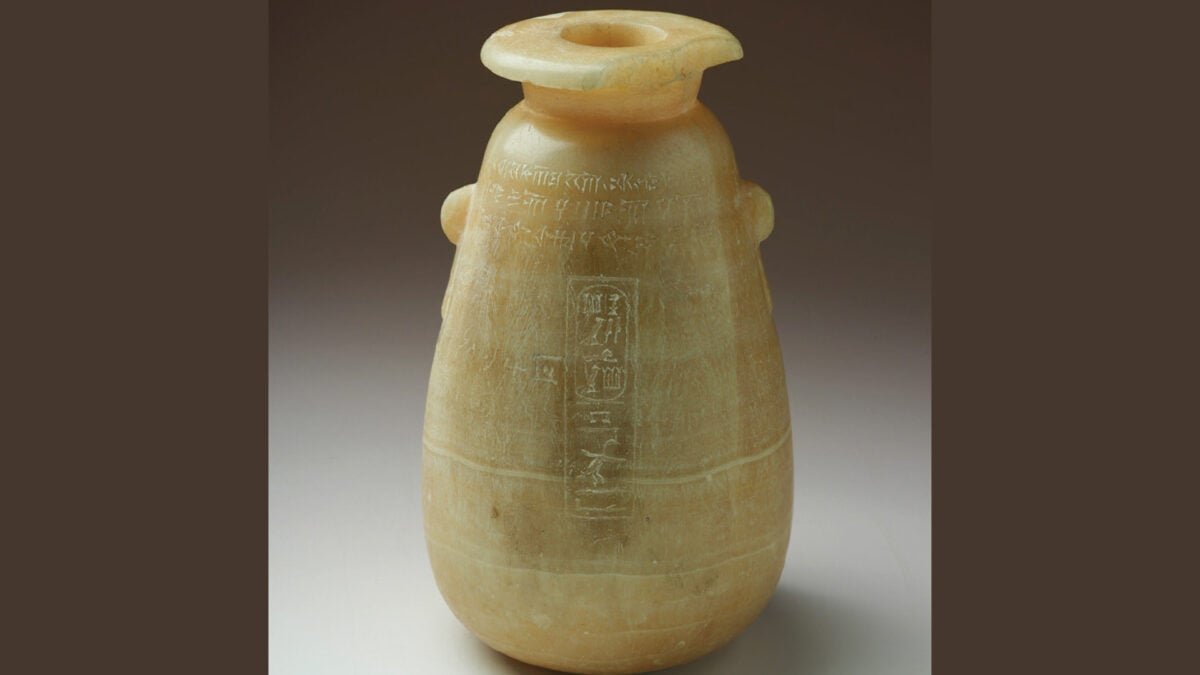
Egyptian alabaster pots may have been the hookahs of the ancient world.
In a study published in September in the Journal of Eastern Mediterranean Archeology and Heritage Studies, researchers identified traces of opiates – natural compounds from poppies such as opium, morphine and heroin – in an ancient alabaster vase in the Babylonian collection of the Yale Peabody Museum. The team argues that, to date, their work represents the clearest comprehensive evidence of the widespread use of opium in ancient Egyptian society.
“Our findings, along with prior research, suggest that opium use in ancient Egyptian cultures and surrounding lands was more than incidental or sporadic and, to some extent, a part of daily life,” Andrew Koh, lead author of the study and archaeologist at the Yale Peabody Museum, said in a statement at Yale University.
multilingual inscription
Four ancient languages are inscribed on the vase – Akkadian, Elamite, Persian and Egyptian – as well as mention of Xerxes I, the Persian king of 486 to 465 BC, known for his invasions of Greece, including the iconic battles of Thermopylae, Salamis and Plataea. At this time Egypt was under the control of Persia.
The vessel also includes an addendum in Demotic, another form of ancient Egyptian writing, stating that the vase could hold approximately 41 US fluid ounces (1,200 ml). The artwork itself is 8.7 inches (22 cm) tall. Intact examples of this type of ship – including the unique quadrangular-carved Egyptian alabaster ships that reference Persian rulers of the Achaemenid dynasty – are exceptionally rare.

Koh and his colleagues analyzed the dark brown aromatic remains inside the ancient vase and found “definite evidence” for noscapine, hydrocotarnine, morphine, thebaine and papaverine, all of which point to opium, according to the statement. These results remind researchers of opiate residues previously found in Egyptian alabaster vessels and a group of Cyprus base-ring juglets from a tomb from the New Kingdom (circa 1570 to 1069 BC), which probably belonged to a merchant family south of Cairo.
Remarkably, these findings indicate that similar alabaster vessels, such as many from the tomb of Tutankhamun, It is possible that he may have also taken opium with him. Tutankhamun was pharaoh from 1333 to 1323 BC.
Was King Tut a drug addict?
Koh explained, “We think it’s possible, if not probable, that the alabaster jars found in King Tut’s tomb contained opium as part of an ancient tradition of opium use that we are only now beginning to understand.”
When archaeologist Howard Carter found Tutankhamun’s tomb in 1922, he also discovered several well-preserved Egyptian alabaster vessels, many of which contained sticky, dark brown, fragrant organic remains. Just over a decade later, analytical chemist Alfred Lucas concluded that most of these organic substances were odorless or perfumed. These vases are now in the Grand Egyptian Museum in Giza, and their biological remains have not been studied again.
Interestingly, Carter had observed fingerprints inside the alabaster vessels – indicating that ancient robbers had tried to retrieve as much of their contents as possible. According to researchers, many of the targeted ships contained the same dark brown substances that Lucas had determined were not perfume.

Simply put, the contents of these ships must have been priceless. Not only were they buried with the pharaoh, but they were also stolen, Koh said. Ancient people probably wouldn’t have cared so much about standard perfumes and perfumes.
hookahs of the ancient world
For now, researchers have found “opium chemical signatures that Egyptian alabaster vessels associated with elite societies in Mesopotamia and were embedded in more general cultural conditions within ancient Egypt,” Koh said. “It is possible that these pots were easily recognizable cultural markers for opium use in ancient times, just as hookah shishas are associated with tobacco consumption today. Analyzing the contents of the jars from King Tut’s tomb will further clarify the role of opium in these ancient societies.”
Whatever is in Tut’s ships, it has to be better than a hallucinogenic cocktail of bodily fluids and alcohol.