
hello! I am Andrew. I’m a teenager in high school, and I’ve been programming for the past six years, and I’ve loved computers ever since. I’ve historically only programmed, and my first public website was sparkshellA web development platform that aims to make coding easy for teens.
Last year, I got the chance to turn my passion for electronics into something physical – sending a self-designed payload, Stratospore, to the edge of space, which reached more than 100,000 feet, to study how algae react to the stratosphere. I was scrolling through Instagram Reels last year when I saw something: Design a PCB, and they’ll fund you. this is where i found hack clubA community full of incredibly smart teens from all over the world creating cool things. My time at Hack Club has been really amazing so far, and I’m so glad I joined. However, I am not going to talk about this.
top
A schedule was announced earlier this year (March 2025) topThe premise was simple: Design a high-altitude balloon payload, and they would finance your project and fly you to Boston so you could launch it, It caught my attention immediately, hack club Typically run software development focused programs, and I was excited that I might be able to practice the electronics skills I had been practicing.
I had never done anything like this, so at first I had trouble getting an idea of what kind of project I could make. I knew I wanted to do something related to biology. Maybe tell us something about how bacteria react to low temperatures? I ended up on another idea.
my project(stratospore,
I was looking for ideas one day when I came across a science project that most high schools do. it is called bloody chlorophyllWhere you get to extract chlorophyll from the leaves, and see a nice effect. A really interesting phenomenon happens when you shine a black/blue light on it: it glows a vibrant red color from a green plant solution. I tried it. I ground up some leaves of a flower in my house, and extracted the chlorophyll using isopropyl alcohol and heat. This was the result:

A little hard to see in the picture, but in person it looks really nice.
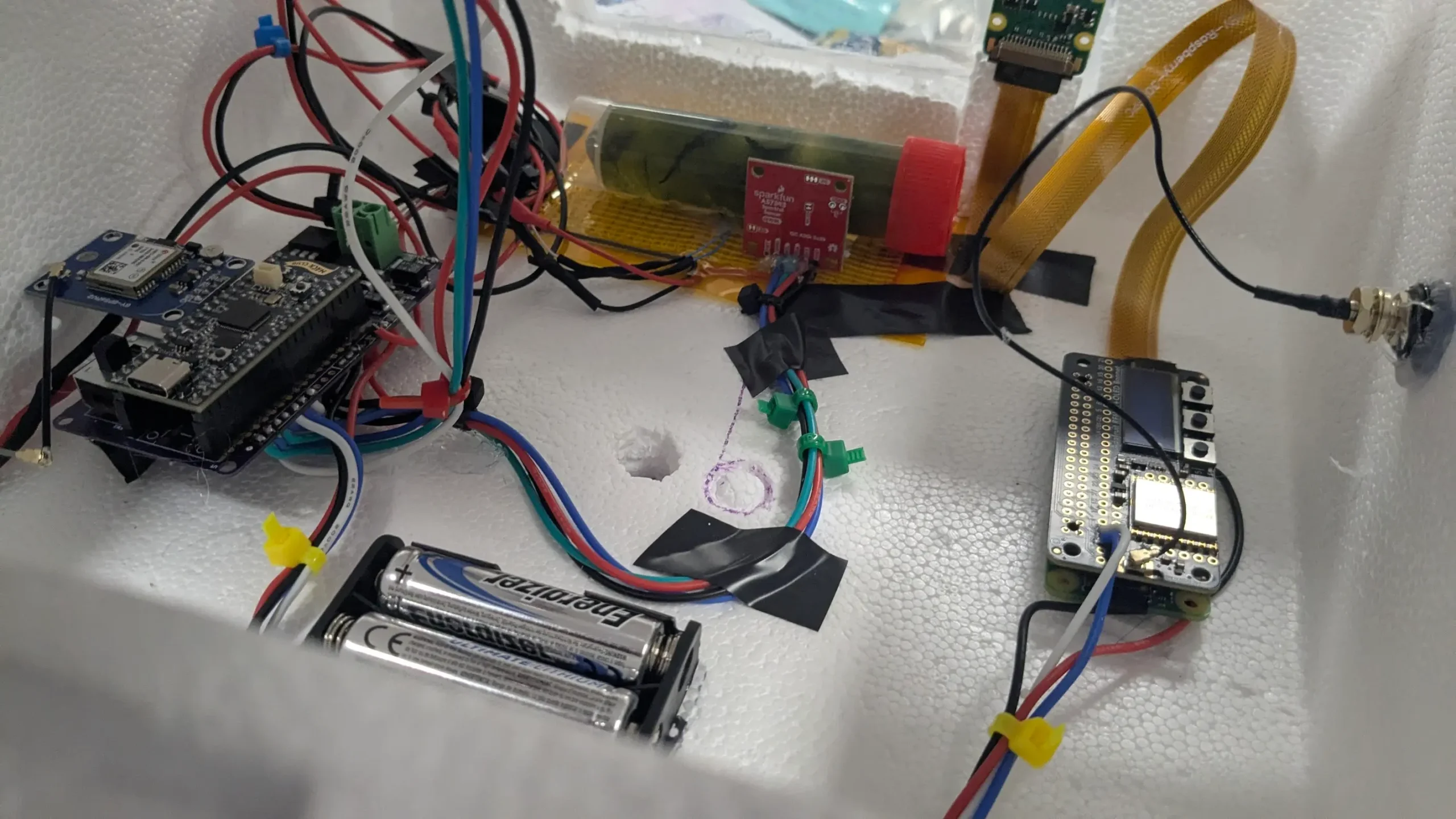
I thought it was really interesting, and it would be interesting to pursue it further though. Since grating the lettuce and removing the chlorophyll would kill it, I wanted to try another idea. Can I use algae from my city’s lake as a source of detectable fluorescence? The plan was this: Place a test tube of algae on the payload, with a AS7263 It has a spectral sensor, which detects light in the range of ~680 nm. The idea is that the intense UV light and cold at those heights will stress the algae, causing changes in fluorescence. Also there will be one on payload neo 6m gps Module to detect altitude and location. My hypothesis was that given the increase in altitude and changes in light, fluorescence would be correlated with altitude. A kind of “biological sensor.”
electronics
Collecting data from sensors is the type of thing electronics should be designed for. I had limited experience designing NFC-based business cards before, so this would be a big change from the way I’d designed them before. This project will consist of microcontrollers, sensors, power regulators, and cameras (more on this later.) This was the mainboard I designed, with some power regulators, sensor connections, and the Orpheus Pico, which was based on a Raspberry Pi Pico from one of the hack club members. This was a low-level data collector from the pico sensor, and would eventually connect to a Raspberry Pi Zero 2W, which ultimately processed the information, took pictures, and transmitted it via LoRa to the ground station I had. I decided on this tech stack because I was familiar with it, and didn’t want to re-invent the wheel in 3 months.
The beautiful PCB was generously sponsored by OSH Park. I recommend their services if you need a really good quality (and purple!) board from America. Avoid tariffs. ,

camera
As I indicated earlier, I wanted to be able to get images from the payload. I heard the view from 100,000 feet up in the air was cool – I had to get in on the action. The photos were taken with the Raspberry Pi Camera Module 2, which can withstand harsh stratospheric conditions. As I’ll talk about later, I transmitted these images along with telemetry data over LoRa. LoRa, stands for Heyng RAnge, places fairly strict limits on the amount of data you can send. To send a picture within a few hundred bytes, I had to use quite a bit of lossy compression. Here are some initial efforts.
Initial stock image (not something I actually got from the balloon, just for testing):

Here is a palletized compressed image:

This was one of the pictures I got down from the balloon. Unfortunately, the payload for the complete images could not be retrieved:

Instead of being the traditional 1080p, the picture is 10p.
I also tried to train an autoencoder for compressing images. It turned out great, but I ended up not using it.

However since I wrote the compression system it works something like this: reducing the resolution to 18×10 pixels, quantizing to a dynamic 4-color palette, bit-packing pixel indices, and applying zlib compression. If you’re interested in reading implementation details, I have the code on GitHub. Sorry in advance for the bad code.
lora
I used Adafruit’s LoRa bonnet with the Pi Zero 2W to send this data to a ground station, where I collected the data. Telemetry and camera images transmitted over LoRa. At this time, I didn’t have my amateur radio license (I do now!), so LoRa was a good option. LoRa operates on the license-free ISM band (915 MHz) in the US. It can transmit really far at low power ( Flying to Boston for this event was an amazing opportunity. I had a great time and enjoyed making new friends and seeing the project. One of my favorite projects among some of the others was Slushosphere. They were trying to see if the stratosphere could make them dirty. We drove up to southern New Hampshire the next day, where we launched. I was experiencing some glitches and the GPS could not work before the flight. Other people had GPS data, so I added that to my data. To test whether my hypothesis would work, I built a machine learning model (a random forest regressive model). There are some parts missing in my data. Unfortunately, the payload could not be recovered as it got stuck in the dense forest. Check it out! These were some other non-ML graphs I created from my data. Stratospore was one of the most challenging and rewarding projects I have worked on. It taught me good lessons on hardware design, environmental testing, data compression under severe constraints, and the logistics of HAB flight. While the payload was not recovered and the data was not complete, the experience of iterating on the design, flying to Boston, and meeting was incredible. hack club The community was a real success. Next time, if there is one, I hope to add redundancy and more detailed radio functionality for systems like GPS. Video streaming, perhaps? These projects could not have been successful without the help of these people listed:
Amazing drone footage, courtesy of Anvay Ajmera.
Some of us went exploring in downtown Boston (??) on the last day. We even saw MIT!Result
 Graph showing points with true elevation line plot based on elevation mapping”/>
The actual height change was not linear, so unfortunately it is a bit inaccurate.
some thoughts
credit

<a href