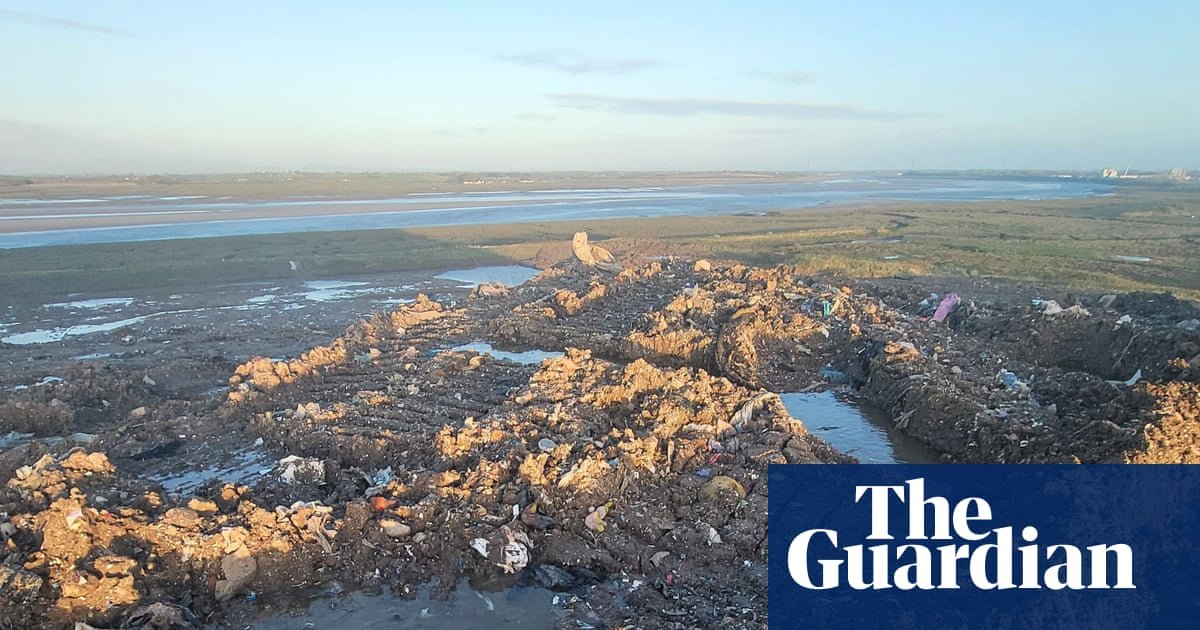
“I just kept smelling this horrible, foul smell… like animal feces, and I was wondering what it was,” says Jess Brown, from Fleetwood, Lancashire.
Brown’s mother suffers from chronic obstructive pulmonary disease and believes the smell makes the condition worse. She is also worried about her eight-year-old daughter, whose asthma is worsened by foul smells inside the house.
The stench was traced to the Jameson Road landfill, which was reopened by Transwest Recycling & Aggregates Ltd. in late 2023 after previous owners Suez stopped accepting garbage in 2017. The Environment Agency says reopening long-dormant landfills could release gases including hydrogen sulphide, which produces a “rotten egg” smell.
Determined to act, Brown launched a Facebook group, which grew to include more than 4,000 members who complained of headaches, nausea and problems breathing.
Thousands of odor complaints followed, leading to an enforcement order in April 2024 to curb hydrogen sulfide emissions, which are linked to health problems including respiratory and eye irritation as well as neurological and cardiovascular effects.
Following partial compliance, Transwest resumed tipping at the site, which is located in an erosion and flood zone on the banks of the protected River Wyre. It made a second enforcement order six weeks after the first enforcement order.
In March this year, the company’s license was suspended until new gas extraction infrastructure was installed. This happened in April, and topsoil is still being added to the site to reduce emissions. The Environment Agency says pollutant levels generally remain within health limits, although odors continue to cause discomfort.
Barbara Neal, a retired doctor who lives near the site, said: “Fleetwood is classified as a deprived area and has double the national average of chronic respiratory diseases… People with conditions such as asthma or chronic obstructive airways have increased symptoms. Children are not able to play outside.”
Nor is air quality the only concern. A Guardian and Watershed investigation found that waste legally dumped at the Jameson Road landfill by AGC Chemicals until 2014 contained the potentially carcinogenic “forever chemical” perfluorooctanoic acid (PFOA), which has since been banned. The site also borders a former ICI landfill, which is believed to have received PFOA waste for decades.
Sampling of water next to both landfills conducted by Watershed revealed that the sites were leaking long-lasting chemicals, known as per- and polyfluoroalkyl substances (PFAS).
David Megson of Manchester Metropolitan University said: “These PFAS results are cause for concern, the concentrations of PFOA are 5-10 times higher than environmental quality standards. This would indicate that those landfill sites contain PFAS, and (they) are leaking.
“The landfills are located right next to the coast, so with rising sea levels there is concern that the situation could worsen.”
A person familiar with ICI’s chlorine-producing Hillhouse site on the edge of Fleetwood in the 1970s, who preferred to remain anonymous, said: “The waste from various parts of Hillhouse was disposed of in the ICI landfill. It was massive.
“It was a system of open, shallow lagoons. There was an acid lake. Part of the waste was liquid sludge and some white solids went in there… The landfill had no lining.”
Although a multi-agency investigation of AGC Chemicals found PFOA in nearby soil and warned against eating local produce, the landfill was left out of the investigation. The Environment Agency says it will only take action if there is evidence that not only are contaminants present in dangerous quantities but also that they could spread harmfully.
However, the community wants the site closed as soon as possible, even if it risks repeating the situation at the Walleys Quarry landfill in Staffordshire. Here, the operator failed after the closure order and backed out from the costs, leaving responsibility for management of the site to the Environment Agency.
“I think it’s going to be the same situation regardless of when it closes on schedule,” Brown says, referring to Transwest’s lease expiring in 2027. “It will be left to the Environment Agency or the taxpayer (to foot the bill for long-term management).”
“This will probably remain an issue for years to come, but it’s better to stop it now than add more damage to what’s already going to happen.”
After newsletter promotion
According to Transwest, the old hazardous landfill has been closed and covered with an impermeable layer of soil, meaning that gas and leachate (liquid that has seeped through the waste) are completely contained, and the only runoff will be uncontaminated rainwater.
It said: “It is not correct to claim that odors have been present for 18 months. We acknowledge that there have been occasional odors which coincide with necessary engineering works on site.
“The ongoing Environment Agency air quality monitoring survey concluded that emissions were largely negligible and air quality is within WHO (World Health Organisation) and UK regulatory safety standards.”
In reference to the samples in which PFOA was found, Transwest said the tests were routinely conducted at a location covered by the Wire River, which is already known to have high levels of PFOA contamination as a legacy of the chemicals industry, “so the PFOA reading is not unexpected”.
It added: “To put this into context, testing results showed 560 nanograms per liter (ng/L), while in the River Wyre, when tested in 2021, PFAS/PFOA levels were measured at 12,100 ng/L, compared to 11,000 ng/L in fish in the river.”
Transwest said that before being used for landfill, the area had been used as a disposal lagoon for the chemical industry since the 1940s, and so “again, PFAS/PFOA readings in the surrounding area would not be unexpected”.
NPL Group, which manages the former ICI landfill, declined to comment.
Wyre Borough Council said: “There are no plans to renew the lease held by Transwest Recycling & Aggregates Ltd beyond its current lifetime, which is due to expire in March 2027. Transwest is legally obliged to redevelop the site as part of its planning consent.”
Elsewhere, there are concerns that old landfills from before pollution laws could contaminate groundwater, rivers and even drinking water.
Last year at the former Cominside landfill in Cheshire, levels of polychlorinated biphenyls (PCBs), which are linked to immune, reproductive, nerve and endocrine damage, were found to be 1,000 times higher than UK norms. PCBs have polluted the area’s streams since the 1970s and despite a fine being issued to the site owner in 1994, no cleanup has taken place. The council is now re-evaluating the site.
“It’s a sham,” says local farmer Paul Jackson, who lives next to the Commonside landfill, which closed in the 1970s. “There’s three-quarters of a million tons of chemicals, debris and waste and 50 different chemicals that are stashed away.” He said sludge regularly leaks from the tip, which worries him it could pollute drinking water.
United Utilities, which manages water supplies in the northwest, said water quality remained good. It added: “Since becoming aware of concerns about PCBs (in the area), we have conducted enhanced testing, these were also clear. We will continue with these additional tests.”
<a href