Noordin, who uses a wheelchair after a stroke, has resigned himself to his fate.
Recommended Stories
4 item listend of list
“I was just waiting to die. I didn’t want to leave my house,” Noordin, who lives in the city of Langsa, told Al Jazeera.
“I decided I would rather die there, but my wife insisted we leave.”
As the water rose, Noordin’s younger brother called the couple’s neighbors for help.
By the time Noordin’s neighbors arrived at around 4 am on Wednesday morning to rescue the couple, the water was chest deep.
“While I was being transported, we were hit by the strong current of water, which caused my neighbor’s foot to slip and we both fell into the flood,” said Noordin, 71, who, like many Indonesians, uses one name.
“I started sinking because I couldn’t stand up, and I thought ‘this is it’.”
Noordin and his wife reached their neighbors’ house safely, but torrential rains soon made the building uninhabitable, forcing them to seek assistance from the army, which evacuated the couple to a local mosque using a table as a makeshift stretcher.
“There were no clothes there, so I just had to wear a sarong,” Noordin said. “I was there for four days.”

At the mosque, Noordin said another resident of Langsa told him he lived next to a cemetery and had seen bodies coming out of the ground and being swept away in the deluge.
Noordin, who has been staying at his brother’s house since the flood waters receded, has not yet returned to his home, but his brother told him that almost everything was over when he reached the spot.
Noordin said, “Maybe about 1 percent of my stuff can be saved. Everything in the kitchen is gone, and my fridge is destroyed.”
“The doors of my wardrobe were burst, and all the clothes were covered in water and mud. The mud is still about half a meter high in front of my house.”
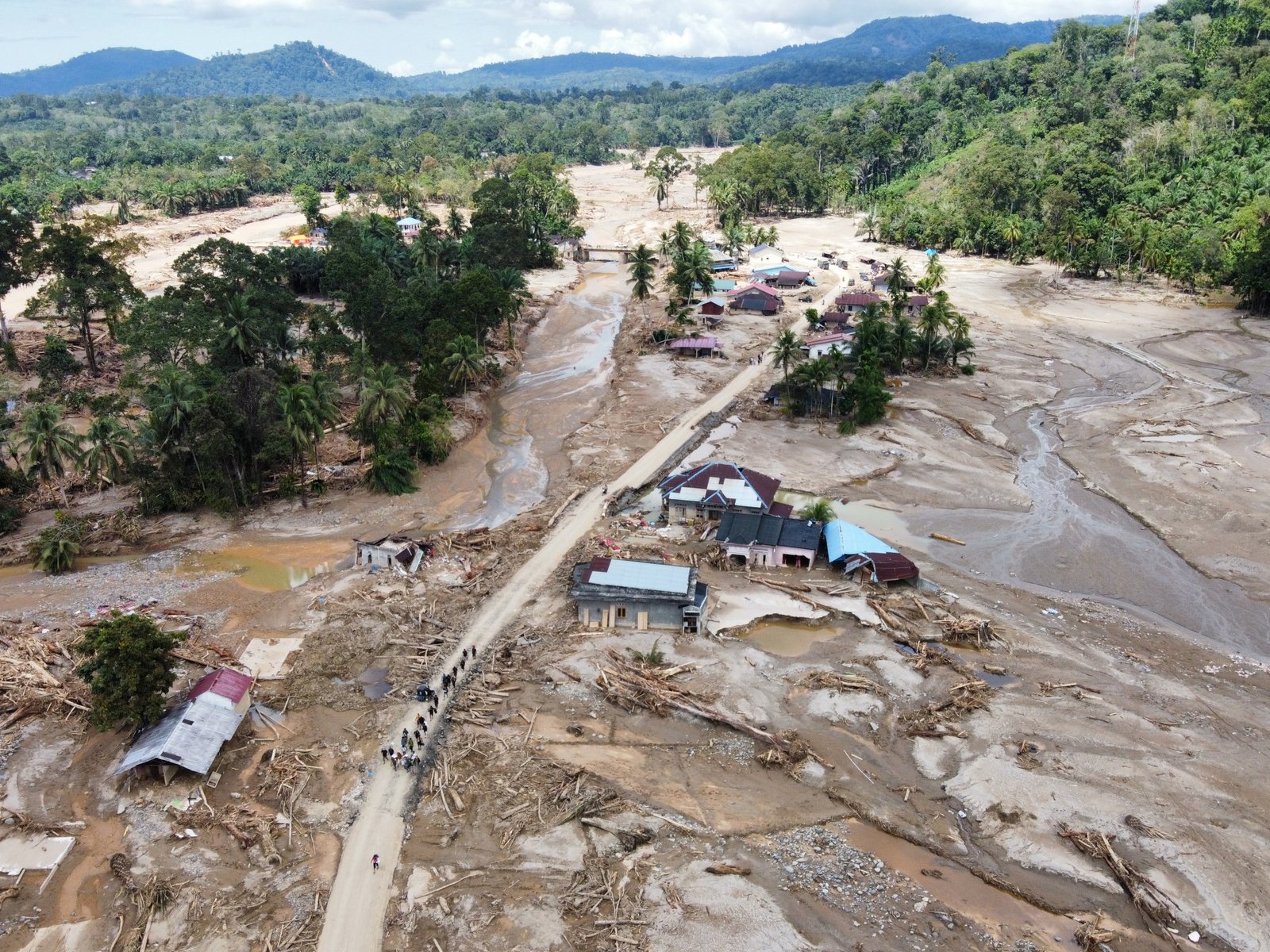
Extreme weather caused by three tropical cyclones has left more than 1,140 people dead in floods in Indonesia, Sri Lanka, Thailand and Malaysia last week.
At least 631 people have died in Indonesia alone.
Many areas of Sumatra island are still inaccessible, so the death toll is expected to rise.
Flash floods have left parts of the island buried in landslides, rendering roads impassable and hampering search and rescue efforts.

Narksyah, a 70-year-old resident of Kuta Makmur in northern Aceh province, is among those who lost almost all of their property.
“My washing machine, my fridge, rice cooker and all my rice were destroyed,” Narkasyah told Al Jazeera.
“Everything is still in my house; it didn’t float away, but it was submerged in water, so I can’t use it anymore. If I put it outside and let it dry in the sun for a few days I might be able to save my bed.”
Narkasyah said the water began to rise on Tuesday, but subsided slightly before rising again on Wednesday after torrential rain overnight, until the water was “coming in through the windows”.
Along with 300 others, Narkasyah took shelter in a local community center for the next five days, eating only the few basic necessities that panicked residents were able to grab as they ran to escape the rising waters.
“We just ate rice, instant noodles and some eggs. There wasn’t enough food to eat,” he said. “I went to see my house, but now it’s filled with mud, so I can’t stay there.”
At the same time that Narkasyah was watching floodwaters rising around her home, her son, Nasir, was taking a bus from Banda Aceh, the provincial capital of Aceh, to Medan, the provincial capital of neighboring North Sumatra.
Traveling by road usually takes about 12 hours, but Nasir was stuck in a bus for the next five days.
“After we left on Tuesday, the flood waters started rising, but we could still leave,” he told Al Jazeera.
“Unfortunately, when we reached Kuala Simpang on Wednesday afternoon, the driver said he could not go further or go back,” he said, referring to a town on the border of Aceh and North Sumatra provinces.
As the city began to submerge in the rising flood waters, Nasir and other passengers climbed onto the roof of the bus to stay safe and observe the scene.

“On Sunday morning, a group of us decided to take the initiative and try to find an alternative route to get out of there,” Nasir said.
“We agreed among ourselves that there was no way back to Aceh, and that we would have to head towards Medan. We managed to find a fisherman’s boat, which took us part of the way, and then a pick-up truck took us the rest of the way.”
With many roads impassable due to mud, fallen trees and other debris, Nasi now faces the prospect of a difficult trek home.
“Now, I am going to try to go back to Aceh by plane instead of traveling by road again,” he said.
<a href