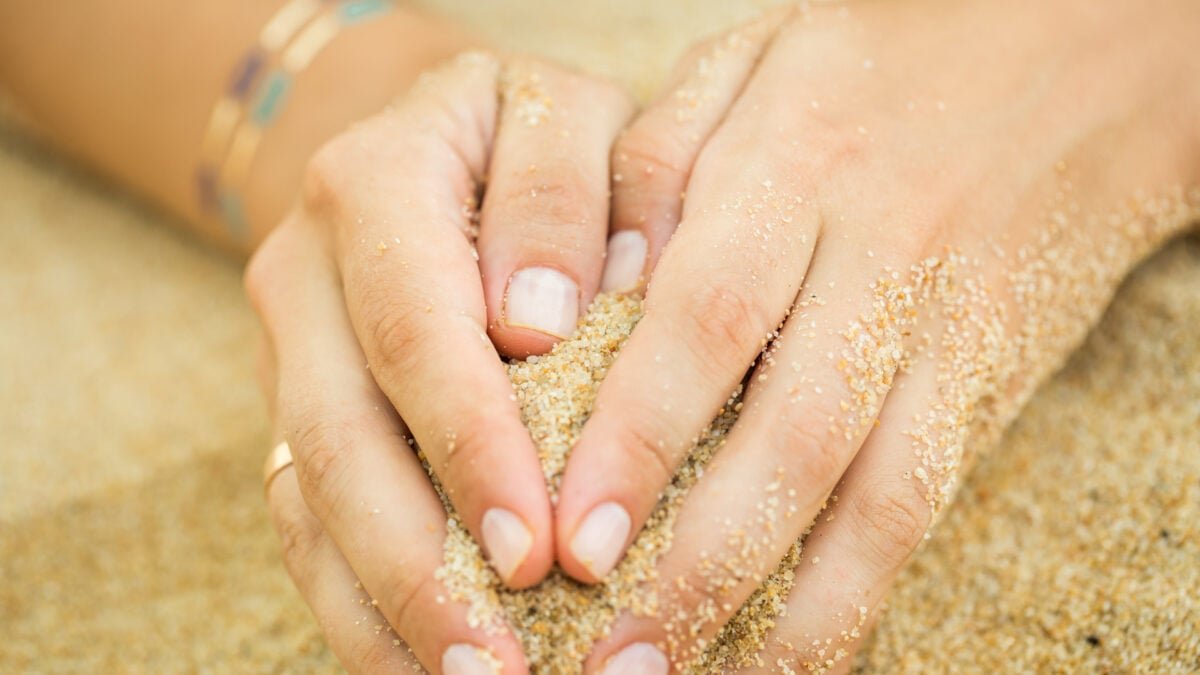
In a study published last October in the journal IEEE International Conference on Development and Learning, researchers found that, like some sea birds, we have a form of “remote touch.” Simply put, when you move your hand through a granular material like sand, you can feel the object buried in said material before you can directly touch it.
“This is the first time that remote touch has been studied in humans and it changes our concept of the perceptual world (called the ‘receptive field’) in living beings, including humans,” Elisabetta Versace, co-author of the study and head of the Ready Minds Lab at Queen Mary University of London, said in a university statement.
better than a robot
Versace and his colleagues asked 12 study participants to gently move their fingers in the sand to find a hidden cube before touching it. This approach revealed that humans have remote touch similar to that of some coastal birds, such as sandpipers and plovers – even though we do not have their specialized beak structures that allow them to sense.

This is the first time researchers have documented this tactile skill in humans. So how do we do it? The team found that human hands are so sensitive that they can identify buried objects by sensing small changes in the sand around them. In fact, participants were 70.7% accurate, within the expected detectable range.
The researchers also tested the remote tactility of a robotic touch sensor (because why not?). While on average, the robot could find objects from a short distance away, it often gave false positive results and the overall accuracy was only 40%. Both humans and robots approached the maximum sensitivity predicted by the researchers. In other words, robots may take our jobs, but we may still be able to find things buried in the sand with a little more accuracy.
practical applications
Remote touch in humans is amazing but probably not a very useful skill in itself. However, Zhengqi Chen, co-author of the study and a PhD student in the Advanced Robotics Lab at Queen Mary University of London, said, “This discovery opens up possibilities for designing devices and assistive technologies that enhance human tactile perception.”
“These insights could inform the development of advanced robots capable of performing delicate operations, for example unearthing archaeological artefacts without causing any damage, or exploring sandy or granular areas such as Martian soil or the ocean floor,” he said. “More broadly, this research paves the way for touch-based systems that make hidden or dangerous exploration safer, smarter, and more effective.”
<a href