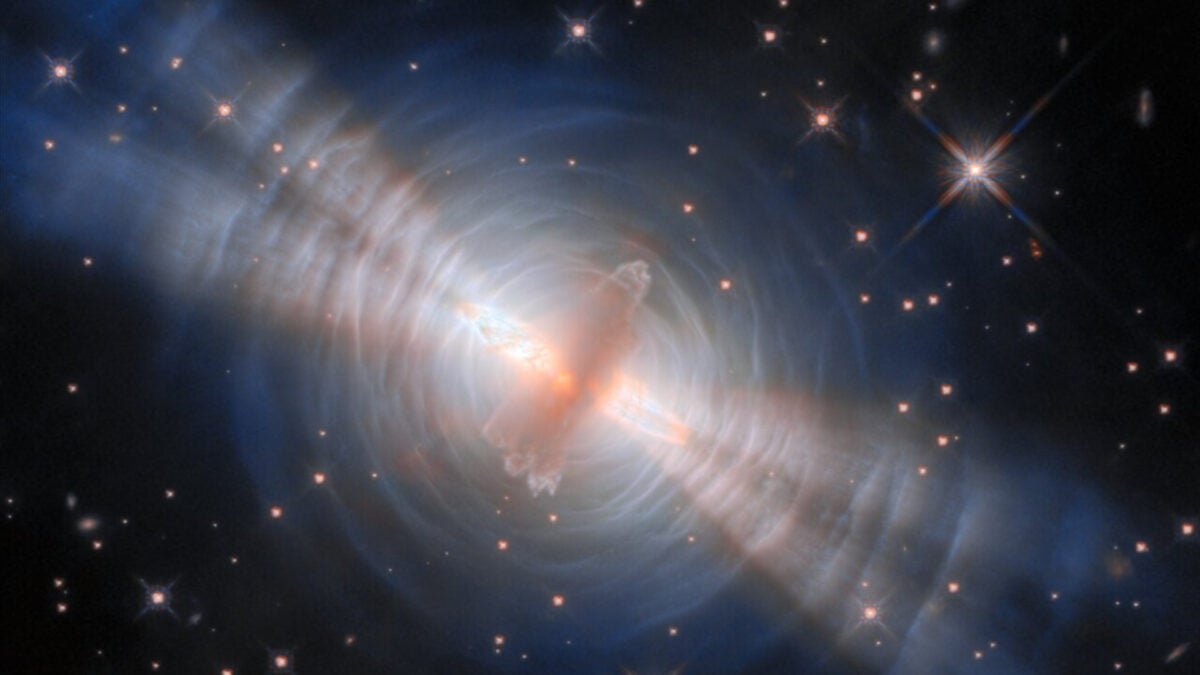

NASA and the European Space Agency published the image yesterday, showing a dynamic landscape of light and newly spewed stardust on a dark, bright background. The Egg Nebula, or CRL 2688, is the earliest, nearest, and youngest pre-planetary nebula known to science, and Hubble has been able to reveal complex features that indicate what it’s doing. Studying it sheds rare light on the end of stars’ lives, even though the Egg Nebula contains the earliest chapter of this old age.
it’s just a phase
As the name suggests, this type of nebula will eventually turn into a planetary nebula, which is a formation of dust and gas formed from material expelled by a dying star similar to our Sun (despite the name, it has nothing to do with planets).
At the center of the Egg Nebula sits a star covered in a cloud of dust. The star spit out this dust a few centuries ago, and light leaks through it through the polar “eye.” The entire nebula shines with brightness reflected from the star. “The dying star’s twin rays illuminate rapidly expanding polar lobes that pierce a slower, older series of concentric arcs,” a statement from Hubble said. “Their sizes and motions suggest gravitational interactions with one or more hidden companion stars, all buried deep within a thick disk of stardust.”
As stars like the Sun run out of helium and hydrogen fuel, they lose their outer layers, and the exposed core becomes hot enough to ionize nearby gas (when something turns into one or more ions). This creates luminous structures such as the Helix, Stingray and Butterfly planetary nebulae. However, the Egg Nebula hasn’t gotten there yet. It is going through a short and transitional pre-planetary phase that is only a few millennia long, providing researchers with the perfect opportunity to investigate the expulsion process.
mysterious vibration phenomena
“The symmetric patterns captured by Hubble are too systematic to have arisen from a violent explosion such as a supernova. Instead, the arc, lobes, and central dust cloud likely arise from a coordinated series of poorly understood sputtering events in the carbon-rich core of the dying star,” the statement said. “Aging stars like these formed and released dust that ultimately seeded future star systems, such as our own Solar System, which coalesced into Earth and other rocky planets 4.5 billion years ago.”
Hubble’s recently processed image joins several other views it has captured over the years and represents the most detailed snapshot of the nebula yet. The telescope’s extremely detailed view means astronomers can compare images from different ages to analyze the evolution of tiny features of the Egg Nebula’s dust shell. This leads to more accurate planetary nebula simulations, which also enable researchers to accurately calculate the progress of various comparable stellar explosions.
<a href