hong kong
cnn
,
HSBC’s top executives defended their strategy on Monday to disappointed shareholders in the lender’s biggest market, as Europe’s biggest bank continued to face calls for a split.
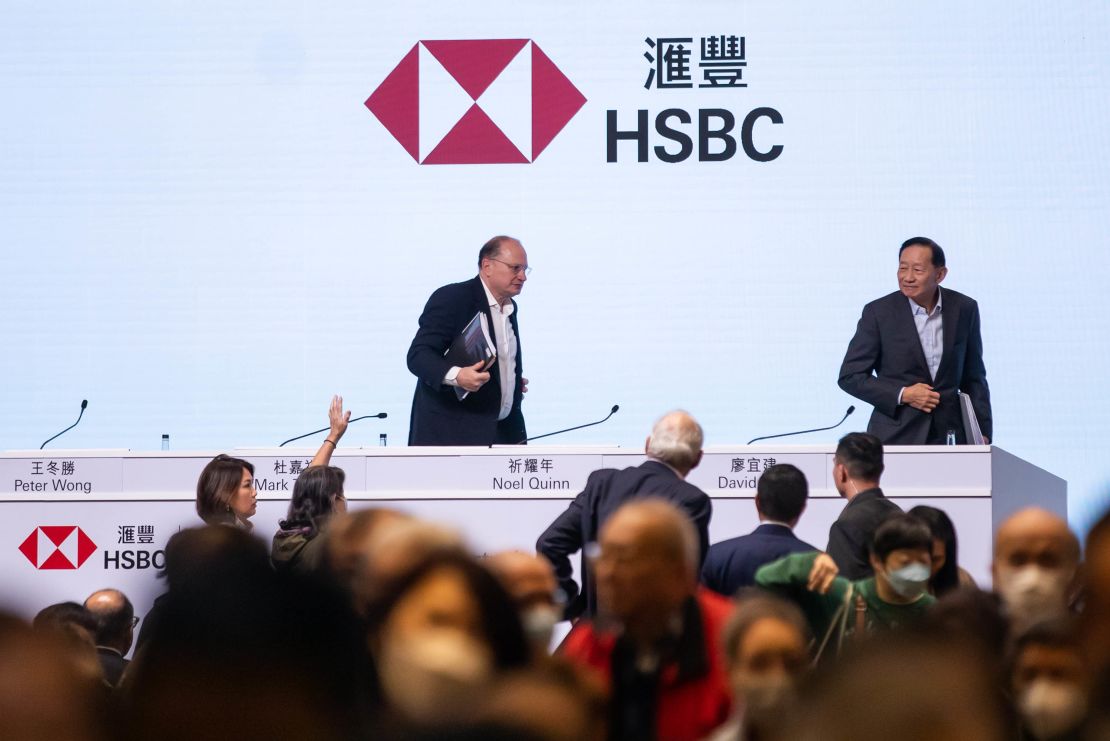
At an informal shareholder meeting in Hong Kong, Chairman Mark Tucker and CEO Noel Quinn took questions from investors on a range of issues ranging from the bank’s demands for major changes to its business to the purchase of Silicon Valley Bank’s UK branch.
In prepared remarks, Tucker and Quinn reiterated the board’s recommendation that shareholders vote against a resolution on the docket for its annual general meeting in May that would force the bank to come up with a plan to spin off or reorganize its Asian business – the lender’s main source of profits.
Tucker said the board was unanimous in its opposition to the proposal and stated clearly: “It would not be in your best interest to break up the bank.”
He said the board had previously reviewed several options for restructuring the bank, and had concluded that such options would “really destroy value for shareholders”, including dividends.
“Our strategy is working,” Tucker told the room of more than 1,000 shareholders. “Our current strategy is to keep the dividend moving up.”
HSBC has been facing demands since last year to separate its Asian business from the rest of the bank.
Shareholders in Hong Kong – where HSBC is a mainstay of many retail investors’ portfolios – argue that the London-based lender’s performance has declined. Business in other areas.
Quinn addressed those complaints on Monday, saying, “Our profits in Hong Kong and the UK are no longer being eroded by poor performance elsewhere. The group is performing well overall.”
Later pressed on the issue by a shareholder, Quinn said that breaking up the bank would result in “significant revenue loss” as much of its business depended on cross-border transactions.
Investors are also unhappy with HSBC eliminating its dividend in 2020 at the request of British regulators. They argue that if the lender locks down its activities in Asia, it will not have to expose Hong Kong shareholders to requests in other jurisdictions.
Christine Fong, a district council member in Hong Kong, said she represented about 500 small shareholders who were affected by the dividend cancellation.
“Street hawkers, taxi drivers or teachers – they all depended on dividends to pay their regular expenses like mortgages, insurance payments, school fees,” Fong told CNN.
“That’s why, three years ago, what HSBC did upset those small minority shareholders.”
Fong has now joined calls for shareholders to vote in favor of the proposal to spin off the bank’s Asian business, even though the lender will bring back its dividend in 2021, albeit at a lower level.
Ken Lui, an activist shareholder in Hong Kong who put together the proposal, doubled down on his call for support ahead of Monday’s meeting.
The motion will need 75% of votes to pass in May, but “nothing is impossible,” he told reporters outside the meeting venue.
Lui, who said he personally has a stake worth 100 million Hong Kong dollars ($12.7 million), planned for his team to focus on “targeted outreach to institutional shareholders to present our case and garner their support.”
His group will also campaign in 18 districts of Hong Kong to “let HSBC shareholders know that they finally have the chance to speak for themselves and defend their rights through voting,” he said.
HSBC is also facing pressure from its largest shareholder.
China’s biggest insurer Ping An (PNGAY) owns an 8% stake in HSBC and has backed calls for the bank to rethink its structure.
In a series of comments made public by the Chinese firm last November, Huang Yong, chairman of Ping An’s asset management arm, said, “We will support any initiative, including spinoffs, that is conducive to improving HSBC’s performance and value.”
The insurance giant’s views have not changed since then, according to a person familiar with the matter.
Ping An is calling on HSBC to explore a restructuring aimed at boosting its valuation and simplifying its regulatory obligations around the world, the source told CNN.
The insurer did not recommend any specific path forward but would support any initiative, including the spinoff of its Asian business, that could boost its stock performance or value, the person said. Ping An did not immediately respond to a request for comment about how it plans to vote at the upcoming general meeting.
HSBC leaders on Monday were also asked why the bank propped up SVB’s British unit following the surprise collapse of its parent company in the United States. The purchase was made last month for £1 ($1.20), just days after SVB closed down.
Critics have questioned HSBC’s ability to conduct adequate due diligence on SVB UK clients because the deal was completed so quickly.
“Did HSBC look into SVB’s customers in detail? Reveal financial details – can they pay back the loan?”. Fong said.
Quinn and Tucker defended the acquisition as a good business opportunity, helping the bank gain hundreds of innovative startups as customers. He rejected the notion that management did not have time to conduct due diligence.
Tucker also took aim at the recent turmoil in the banking industry, saying he did not expect an “immediate impact” on HSBC.
“Following the collapse of many small regional banks and the takeover by Credit Suisse, share prices of all banks have declined,” he said.
But he said he did not believe such developments represented a “systemic risk” for the sector. “I expect a period of uncertainty” before the panic subsides, he said.
<a href