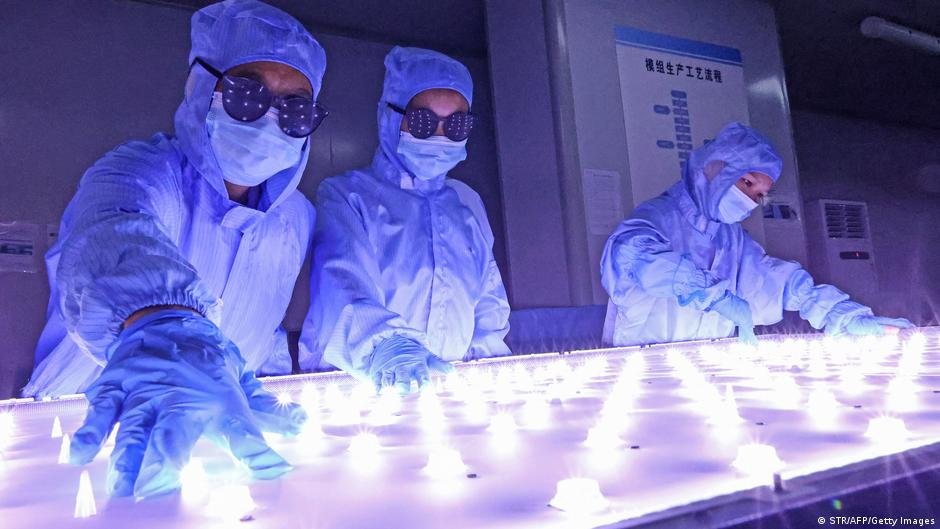
The global research landscape is currently facing a turning point: According to a new survey published in the journal “Proceedings of the National Academy of Sciences” (PNAS), Chinese scientists already took the lead role in almost half of the collaborations with American colleagues. In 2023. This is a landmark figure that underlines Beijing’s rapidly growing influence. China now sets the research agenda when it comes to major international issues.
China’s leading role: change of power at the top based on new norms
It is not just traditional indicators such as prestige, but also the archaic Nobel Prize or mere publication numbers that reflect real scientific power. China’s rise is now measured by other parameters as well. The US-Chinese joint study, analyzing nearly six million research papers, found 45% of leadership positions were in Chinese hands in 2023, compared to 30% in 2010. If this trend continues, China will catch up with the US in leading roles in strategic areas such as artificial intelligence, semiconductor research and materials science by 2027-8.
China is also a leader in terms of scientific publications. According to the latest G20 Research and Innovation report, nearly 900,000 scientific publications come from ChinaWhich is three times increase compared to 2015. In the Nature Index, which evaluates the 150 most important medical and natural science journalsChina has overtaken America long ago. Of the ten leading institutions whose publications in journals are evaluated by the Nature Index, seven are Chinese institutions.
The situation looks less rosy for the West, with about 20,000 scientific institutions: Harvard University in the US still leads the Nature ranking while places 2 to 9 are occupied by Chinese universities. especially. Massachusetts Institute of Technology (MIT) in America is at 10th place.
Strategy, investment, networking: why China is gaining the lead in research
China has invested extensively in science and made it the centerpiece of its development strategy. The country has increasingly opened up its research to international collaboration and is actively conducting this collaboration.Chinese students and scientists are encouraged to work around the world, Thus a network developed to enhance international cooperation,
Billions of dollars of investment — particularly in technology industries — and through the export of education through the Belt and Road Initiative (BRI), an infrastructure and development project — go toward attracting talent to China and creating global connections. According to the PNAS study, science diplomacy is deliberately used as a tool.
Central management versus creativity: strengths and weaknesses of the Chinese system
Speed, strategic investment and centrally controlled networks are China’s strengths. Engineering, Electronics, Materials Science, Physics and Chemistry provide excellent results and high citation rates.
However, tight central control by institutions does not only have advantages. In many areas of research, China also lacks unprecedented innovations and the necessary freedom in science. Success can be achieved in a controlled manner, but creativity cannot. In this respect, the US still has a considerable edge over China and Europe, with its decentralized, company-driven culture of innovation.
Furthermore, times are becoming tougher for international research collaboration. The US and Europe view China as a strategic rival, and recent geopolitical and economic turmoil have been mutually unaffordable.
Competition between China and America for AI supremacy
The US is still the leader in artificial intelligence (AI), but China is catching up. The DeepSeek language model shows how quickly and cheaply Chinese technologies can enter the market. Harvard also remains a driver of innovation in this area, but Chinese academies are catching up.
Today, it is mainly China that plays a key role in AI patent applications. The US is still keeping good pace, but even the best European institutions often lag far behind in global comparisons.
Crisis of Western systems: Why are America, EU lagging behind?
China’s rise coincides with a period of weakness in the US and Europe. The US-American research landscape is suffering from political turmoil, budget cuts, and an exodus of top talent. US President Donald Trump’s austerity measures and open discord between the two superpowers have resulted in a significant decline in joint projects and a shift of talent to China.
Europe may be able to benefit from top talent from the Americas and other parts of the world who are no longer really welcome in the United States. However, the European backlog in many areas of science is enormous, and great changes often fail due to national sensitivities or restrictions – both within the EU and in the rest of Europe.
Global fallout: The rise of China changed the balance of power
China’s seemingly unstoppable rise is changing the global economic and geopolitical order: China is commanding parts of the international research agenda, while Europe is falling further behind in the race for future technologies.
One option to at least survive would be to deliberately collaborate with Chinese teams. It remains an open question how the Chinese system will respond to the increasing fragmentation of the scientific landscape and geopolitical tensions.
Europe’s opportunity in research: diversity is not a weakness
A real alternative to progressive fragmentation would be a purposeful establishment of a European force beyond national interests. The diversity of Europe’s languages, cultures and traditions is not a weakness. Diversity can generate innovation, which is not offered by monolithic countries.
“Knowledge is power” – it will now be important to harness Europe’s diversity as a driving force for innovation. Similarly, the European Research Area (ERA) monitoring report points out that if Europe cooperates purposefully and pools its resources, it can become a scientific power that can compete on eye level with China and the US.
This article was originally published in German.
<a href