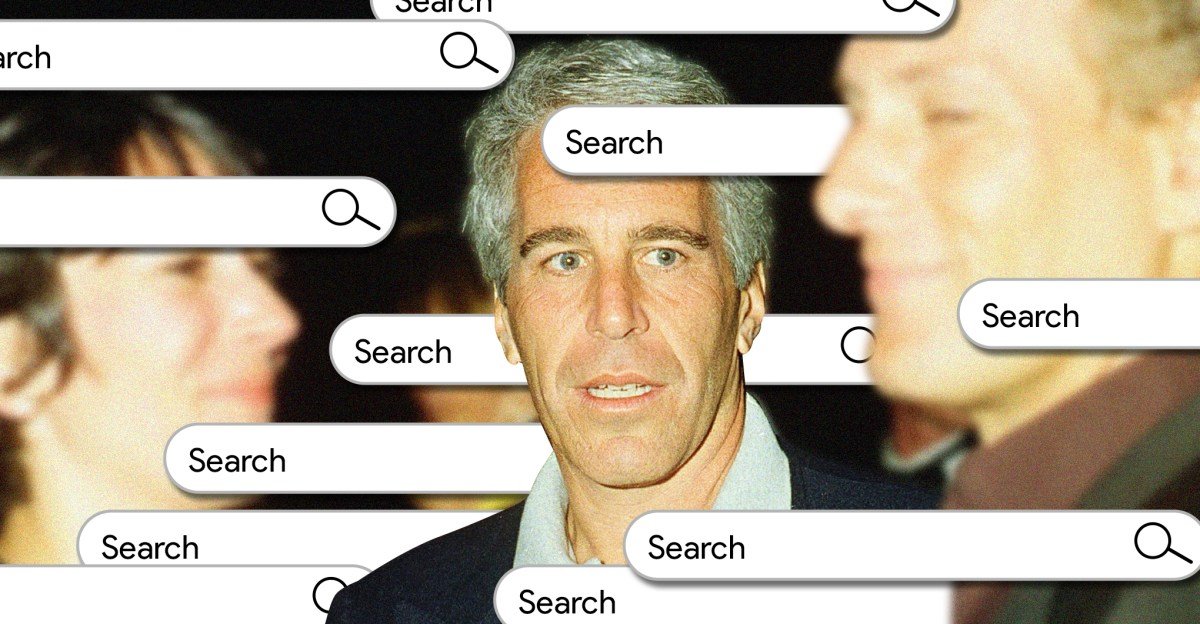
On December 11, 2010, Jeffrey Epstein was worried about what would happen if you searched him on Google. By this time Epstein had already pleaded guilty to soliciting the prostitution of a child and was a registered sex offender, and just days earlier he had been photographed walking with Prince Andrew in Central Park.
Epstein emailed an associate to complain. “The Google page is no good,” Epstein wrote, according to documents released last week by the House Oversight Committee. He also raised the issue of thousands of dollars in payments that appeared to be made to “clean up” the results. “I still haven’t received the full details of the payments. And the results are what they are.”
Someone named Al Seckel – probably the late partner of the sister of Epstein’s partner Ghislaine Maxwell – responded later that evening, sharing what he was seeing. Results include Epstein’s Wikipedia page new york Magazine articles, a “JeffreyPsteinScience.com” website, a hair transplant surgeon by the same name, and a story correctly naming him as a sex offender.
“This is before the next big sweep. I understand your point about ‘one thing kills me,’ but the Daily Beast article is gone, others including the mighty Huffington Post are about to be removed. And, the outside stuff is on top.”
Epstein and others discuss how to use technical SEO tactics to remove news articles from the first page of Google’s results
In documents released last week, we see Epstein and his group strategizing how to fend off unflattering coverage about them on Google and elevate what they want – search engine optimization for trying to whitewash the reputation of a wealthy pedophile with powerful friends. Throughout the documents, Epstein and others discuss how to use technical SEO tactics to remove news articles from the first page of Google’s results, how to socialize with journalists who find them more focused on business than Epstein’s crimes, and how to get a beleaguered PR machine to plunder their digital presence. For those familiar with SEO, these strategies will sound familiar — it’s the same playbook used by everyone from restaurants to news publishers to companies selling tennis shoes and photography services online. Everyone knows that Google Search is the gateway to the Internet; It’s just that this time, these same practices were deployed as cover for perhaps the world’s most notorious pedophile.
A few days after Epstein’s complaint, Seckel delivered good news: All but one “negative” article—from Huffington Post —Been on the first page of results.
Seckel wrote, “The Huffington Post is extremely difficult to replace, because it is so powerful, it has millions of links, and it uploads new and original content on a large scale on a daily basis, along with posting from outside readers.” “We managed to push it down the page, as it used to be at the top.” Seckel discussed SEO tactics such as regularly adding new content to Epstein’s newly created charitable website, “[promoting] The other is Jeffrey Epstein,” getting non-mugshot photos on top of Google Images, and manipulating search queries so that Google’s suggested search terms are not “toxic.”
Many of these practices – publishing new content regularly, or getting mentions in authoritative publications – are accepted as good SEO tactics these days by Google itself. “I would say they were generally mostly best practices,” explains Rand Fishkin, a longtime SEO consultant and co-founder of digital marketing firm Moz. The Verge“There was a decent level of sophistication there, although I felt like there was more that could have been done there, and it’s quite possible that there was a lot more being done that was not discussed in the email,”
One point in the documents that stood out to Fishkin were claims of manipulation of Epstein’s Wikipedia page. The importance Google gives to Wikipedia in search rankings has ebbed and flowed over the years, but Fishkin says that between 2008 and 2010 a period began where Wikipedia became “absolutely dominant” for rankings.
“It was an enormous success.”
In a December 2010 email, Seckel claimed a “significant victory” over Wikipedia: “The headlines do not mention convicted sex offenders or pedophiles. Instead, philanthropic work, Epstein Foundation, publicity of scientists,” he wrote, presumably referring to the Wikipedia section headings on Epstein’s page. “We hacked the site to change the mug shot and caption, and it now has a completely different photo and caption. It was a huge success.”
It is not clear what Seckel means by “hack”, but Fishkin believes Epstein’s associates may have connections to Wikipedia editors, perhaps paying them to edit his page. In March 2020, Wikipedia published a blog post outlining some of the edit wars on Epstein’s page over the years that raised questions about paid editing; the new York Times It was reported in 2019 that a Wikipedia editor with a username associated with Epstein had gone on an editing spree in 2013 and given exaggerated details about his charity. The Wikipedia article proved crucial: According to the Massachusetts Institute of Technology’s report on Epstein’s ties to MIT’s Media Lab, staff at the institute cited Wikipedia as they discussed whether they should accept Epstein’s money. The MIT report points out that at the time, the Wikipedia entry included details about Epstein’s crimes but “also included statements that could be read as diminishing the strength of some of the allegations.”
A Wikipedia editor wrote in a blog post, “These Epstein-related accounts were not enough to prevent the Wikipedia article on Epstein from alerting MIT to Epstein’s crimes, but they softened the story enough that MIT managed to ignore the alert long enough to accept Epstein’s money.” “Wikipedia’s editors did their jobs well, even under difficult circumstances.” Wikipedia did not immediately respond to a request for comment.
Wikipedia’s own assessment does not cover the months leading up to the December 2010 email, but the site’s public record of edits gives some indication. An account began editing in October 2010, making dozens of changes to Epstein’s page, including adding paragraphs of details about his charity, removing the “American sex offenders” category from the page, and changing the word “girls” to “escorts.” The first edit made by the account was to Al Seckel’s Wikipedia page; The editor added a link to an interview between Epstein and Seckel.
As of March 2011, Epstein’s page contained two sections: “Life” and “Solicitation of Prostitution.”
Fishkin estimates such a massive task would cost $100,000, plus monthly maintenance fees.
The Epstein documents – with their strange, indecipherable typographical style and abrupt ending – leave you unsettled when you realize what depravity they represent. They are also sometimes extremely pedestrian: In one exchange after Google’s “sweep”, Epstein complained about how much he was being charged for SEO services. He wrote in a message, “I was never told that there is a fee of 10 thousand per month?” You initially said the project would take 20.. then 10 more. Then 10 more.” Fishkin estimates that a job of this magnitude would cost $100,000 initially, plus a five-figure maintenance fee per month.
“I found the prices extremely low,” says Fishkin. “Here’s a billionaire who’s reportedly worried about his reputation as a pedophile publicly arguing over a few thousand dollars. Honestly, the chutzpah is crazy.”
Customizing search results to suit the client’s story is a standard practice for PR agencies – SEOs are hired to maintain a client’s reputation, even if they are not prone to scams. In a document dated June 14, 2011, PR firm Osborne & Partners LLP laid out a game plan: minimize mention of Epstein in US and UK tabloids, position him as “a leading proponent of science and technology”, “clean up Google”, and expose him to select editors and writers.
Regarding Google moderating content the document reads, “We have hired an excellent team of Israeli experts for other clients, and there are many companies that claim to be able to optimize results in this way but fail to deliver results.” “I can’t overstate the importance of this, as it is the initial source of information about you for many people.”
Later that year, in December 2011, Epstein’s publicist Christina Galbraith emailed him a summary of strategies for removing bad press from the top of Google results, recommending that he hire Reputation, a company that advertises services to help businesses manage their online reputations. Among the steps Galbraith names: “Eliminating bad information using popular and proprietary algorithms; redirecting the way Google indexes your information (realigning it with positive content).”
As for Reputation’s services, Galbraith told Epstein it would take about a year to be “solidified” and would cost $10,000 to $15,000 per month. Reputation did not immediately respond to a request for comment on whether the company had stopped working with Epstein.
Epstein and associates flooded Google with flattering articles, taking advantage of the often poorly vetted contributor networks that existed at various digital media outlets. Stories – Later Deleted the new York Times The inquiry into him in 2019 followed the playbook laid out in newly released documents detailing Epstein’s business and science interests.
It appears that Epstein’s efforts to clean up his reputation online have worked, at least for a while: In a 2019 story the new York TimesThe president of Bard College defends accepting donations of more than $100,000 from Epstein. Leon Botstein explained, “If you looked at Jeffrey Epstein online in 2012, you would have seen what we all saw.” Time– A “former con man who had done well on Wall Street,” he was a friend of the Clinton family and donated to educational causes.
The Epstein files are a labyrinth of a network of possible conspiracies, collusion and abuse and cover-ups spanning decades; It’s hard not to get lost in the documents, not to fall down the rabbit hole and start following the threads. But there will be the occasional reminder that the worst part of what happened isn’t in the files at all – an email chain will suddenly end and you, the reader, will be forced to fill in the blanks of what the parties are talking about, or rambling about.
In an email on December 16, 2010, Seckel and Epstein briefly argued about pricing for the Google cleanup work – Seckel told Epstein he was “trying to get it right”. [Epstein’s] Fuck,” just trying to be helpful. But at the end of the email, it takes a twist.
“I need to talk to you about the island as soon as possible,” Seckel writes. “When can we do that?”