But this is the reality across the continent, with the EU’s law enforcement agency, Europol, warning in its 2025 “Serious and Organized Crime Threat Assessment” that “waste trafficking is intensifying with a projected increase in scale and sophistication”..” Despite this, Europol declined to answer several questions from DW on the matter, citing other priorities.
According to Europol, much of this intensity comes from criminal gangs. These operate by finding ways to bypass domestic and commercial waste disposal contracts, exploiting contracts open to corruption at all stages of the waste disposal process, fudging documents and crossing borders to take advantage of lax law enforcement. It is a black market that Europol describes as a “low-risk high-profit margin” for criminals.
These groups are a mix of traditional organized crime networks and opportunistic legal businesses that exploit inefficiencies and loopholes, creating a significant headache for the various EU agencies responsible for enforcing environmental crime.
Illegal waste trade worth billions in EU
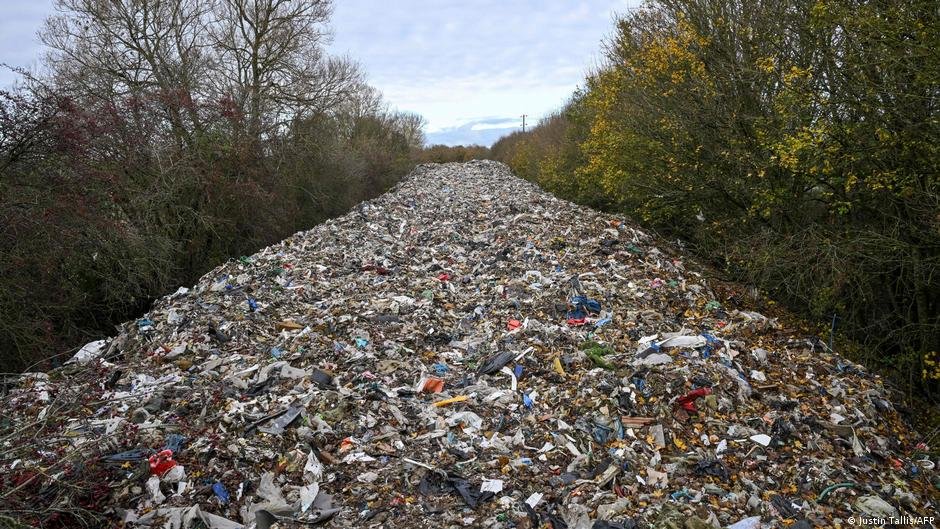
This issue was recently highlighted by the discovery of a huge mountain of garbage hidden near the River Thames in Oxfordshire, England. On Wednesday, it was reported that the 6-metre (20-foot) high pile contained evidence of waste from schools and local authorities, suggesting abuse of waste management contracts with state institutions and sub-contracted legitimate companies.
But this problem is not limited to Britain only. Reliable statistics for such a market are hard to come by, but the EU’s anti-fraud office, OLAF, estimated last year that “15% to 30% of all waste shipments may be illegal; the value of this trade could reach €9.5 billion ($11 billion) annually.” The EU ships approximately 67 million tonnes of legal waste per year within its borders and exports 35.1 million tonnes outside the EU under legal agreements.
“Hazardous or improperly managed waste can contaminate soil, water and air and its uncontrolled movement across borders undermines the EU’s transition to a greener, more sustainable economy,” the organization’s press office told DW. “It also gives criminal networks an unfair advantage over law-abiding businesses.”
Green economies have created criminal opportunities
Who governs waste management in the EU? The Waste Framework Directive, which was updated in October. It operates on the basis that the original waste producer must pay the costs of waste management. Member states must report to the European Commission at least once every two years and write up new waste management plans every six years.
Enforcement is problematic. The Commission is largely responsible for enforcement, but relies on each country’s agencies, as well as OLAF, Europol and a number of other national and EU agencies.
Further muddying the waters is the fact that not all waste is created equal. As Europe increasingly moves towards a green economy, some materials now attract high treatment costs before they can be safely and legally disposed of.
This includes electronics (WEEE), vehicles (ELV), fluorinated gases, textiles and low-grade plastics. Criminals operating in Europe, who employ industry experts as part of their organization, often recycle and sell what they can and dump the rest, often in Central and Eastern Europe, Asia or Africa.
For example, hazardous waste from the construction or medical industries is slightly different. It is sometimes mixed with other materials into something that can be sold but is still dangerous, or transferred to facilities that will dispose of it illegally without considering environmental and health impacts.
sophisticated criminal networks
In February, 13 people were arrested in Croatia for importing 35,000 tons of hazardous waste from Italy, Slovenia and Germany. Arresting authority Europol said the waste was “simply buried or dumped in at least three locations” rather than being properly disposed of.
The organized gang involved is estimated to have made €4 million and has been accused of using a network of legitimate businesses to move waste, cutting corners to turn a profit and avoiding charges linked to toxic waste.
“The networks are adept at falsifying paperwork, arranging complex transportation routes, using front companies and mixing legal and illegal waste streams to avoid detection,” Alexandra Ghenea of the Romanian nonprofit ECOTECA told DW. “Romania has observed cases involving cross-border networks, in which waste coming from countries such as Italy, Germany, the UK and Belgium is often falsely declared as recyclable material.”
However, sometimes, as is the case in Oxfordshire, it is easier for people to dispose of waste in the simplest way they think they can get away with. This was the case in July in the Romanian suburb of Sinesti, where illegal burning of recyclable materials led to a forest fire that came close to spreading across the suburbs of the capital Bucharest. Illegal waste has been a long-standing problem in the Eastern European country.
“The area is emblematic, with frequent fires releasing toxic smoke, causing severe air pollution and highlighting shortcomings in surveillance, policing and local administration,” Ghenea said. “Importantly, Romania’s problem is not the absence of legislation – the legal framework is in line with EU standards. The main weakness is enforcement, both in capacity (staff, equipment, expertise) and sustainability.”
Enforcement is proving elusive
While EU member states are united on laws and standards in this area, the Romanian case highlights how each may have different challenges – and the difficulty of implementing such directives in a continent where traveling across borders is simple.
Europol acknowledged in a 2022 report, “Law enforcement has invested substantial resources in this area only in some Member States.”“Since a large proportion of environmental crime activities are carried out by legal businesses, they are often labeled as corporate crime (or ‘white collar’ crime), The fact that criminal networks largely use businesses makes these crimes less visible,”
This is one of those weaknesses that is exploited by those who make profits by endangering people’s health and the environment. As Europe tries to move towards becoming a greener continent, it is struggling with those whose concerns are only financial.
Edited by: Martin Kuebler
<a href