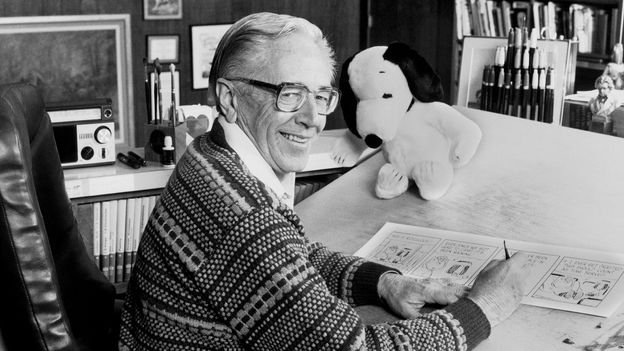
Charles M. Schulz created his beloved Peanuts strip for 50 years, until his announcement on December 14, 1999, that poor health was forcing him to retire. History has seen how a simple cartoonist created a billion-dollar empire from the lives of a group of children, a dog and a bird.
Charles M. Schulz’s classic creation Charlie Brown may have been as popular as any character in all of literature, but the cartoonist was modest about the scope of his short illustrations. In a 1977 interview with the BBC he said: “I’m only dealing with the little everyday problems of life. Leo Tolstoy dealt with the major problems of the world. I’m only dealing with why we all feel that people don’t like us.”
That didn’t mean he felt like he was dealing with small matters. He said, “I always feel very offended when someone asks me, ‘Do I ever satirize a social situation?’ Well, I do it almost every day. And they say, ‘Well, do you ever talk politics?’ I say, ‘I do things that are more important than politics.’ I am struggling with love, hate, distrust, fear and insecurity.
While Charlie Brown may be an eternal failure, the universal emotions that Schulz channeled helped make Peanuts a global success. Schultz, born in 1922, created each Peanuts strip himself from 1950 until his death in February 2000. It was so popular that NASA named two modules on its May 1969 Apollo 10 lunar mission after Charlie Brown and Snoopy. The strip was syndicated in over 2,600 newspapers around the world and inspired countless pieces of film, music and merchandise.
According to the writer Umberto Eco, part of its success was that it worked on different levels. He wrote: “Peanuts appeals to both sophisticated adults and children with equal intensity, such that every reader finds something for himself there, and it is always the same thing, to be enjoyed in two different keys. Thus Peanuts is a little human comedy for the innocent reader and the sophisticated one.”
Schultz’s initial reason for focusing on children in the strip was purely commercial. In 1990, he told the BBC: “I always hate to say it, but I drew little children because that’s what sells. I wanted to make something, I didn’t know what it was, but it seemed like whenever I drew children, these were the cartoons the editors liked best. And so, in 1950, I sent a batch of cartoons to United Features Syndicate, in New York City, and they said they liked them, and I’ve been making little ones ever since.”
<a href