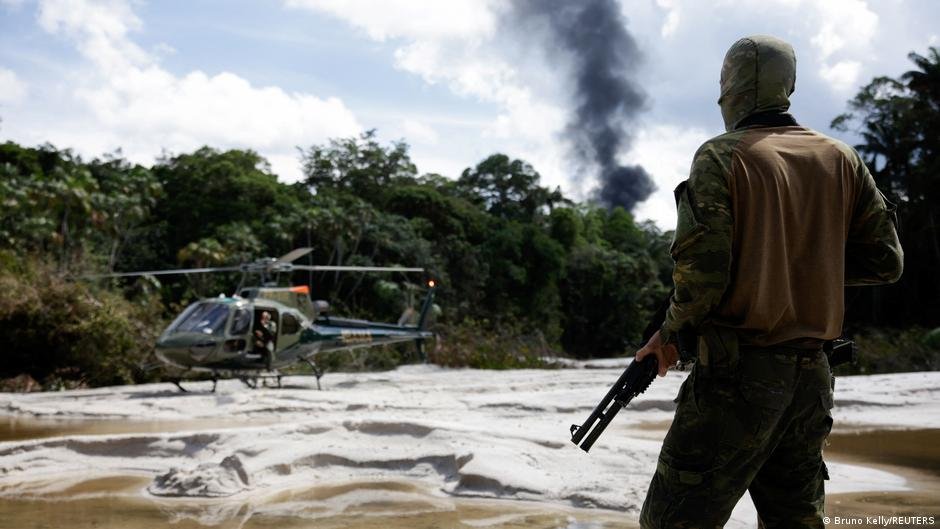
In the Amazon, criminal groups such as the Comando Vermelho (CV), or Red Command in English, control the illegal trade in gold, rainforest timber, and drugs.
“CV is the most important organization involved in illegal mining and illegal deforestation and drug trafficking,” said Rodrigo Ghiringhelli, professor at the Pontifical Catholic University of Rio Grande do Sul (PUC) and member of the Brazilian Forum for Public Security (FBSP).
The rainforest as a legal vacuum
A study published in October by Brazilian intelligence service Abin and the Forum for Public Security concludes that drug trafficking, illegal gold mining and human trafficking pose the greatest threats to the region’s population and environment.
The study highlights how cartels’ lucrative business is fueled by a number of factors. “These include the rising price of gold, low levels of government presence in the Amazon region, and the permeability of borders with neighboring countries, including Brazil, Colombia, Peru, Venezuela, Bolivia, Ecuador, Suriname, and Guyana.”
Geographic spread of organized crime
In December 2024, the Forum for Public Safety reported in its study, Violence in the Amazon, how cartel power was increasing.
“The scenario is worrying,” it said. “The struggle for control of territories has led to killings and other crimes, as well as irreparable damage.”
“Controlling legal and illegal economic activities in the Amazon region is no longer just an issue of public safety, but also an obstacle to sustainable development.”
According to the FBSP, the proliferation of criminal gangs from south-eastern Brazil and their alliance with local groups is increasing at an “astonishing rate”. In the Amazon, criminal gangs are present in at least 260 municipalities, half of which are controlled by the CV.
Energy suppliers in danger
The Amazon city of Belém is also largely controlled by the criminal group CV. A recent investigation by investigative website Intercept_Brasil revealed its implications. According to reports, shortly before the start of COP30, CV ordered the suspension of expansion work at a substation that supplies electricity to the city from 3pm every day.
Mines and Energy Minister Alexandre Silveira later called for increased security measures, according to The Intercept_Brasil.
This is not the first time something like this has happened. According to media reports, the local energy company, Belém Transmissora de Energia, has been the target of threats and intimidation since May 2025.
security money and privacy
In some neighborhoods of Belém, residents have to follow the rules of the “bosses”, a local told a Brazilian daily newspaper. Folha de S PauloMany business owners pay security money while people have to follow orders broadcast via WhatsApp and adhere to a strict “code of silence”,
After a massacre in a favela in Rio de Janeiro on October 29, many people in Belém feared reprisals. During police raids against Comando Vermelho, more than 120 people were killed, many of whom were linked to criminal gangs.
A few days after the massacre, President Luiz Inácio Lula da Silva Deployed armed forces during the climate conference in Belém. The military “Operation to Guarantee Law and Order” (Garantia da Lei e da Ordem, GLO) was also used at other major events such as the G20 summit in November 2024 and the BRICS summit in July this year, both of which took place in Rio.
How CVs were pushed north in Brazil
The rapid spread of Comando Vermelho from Rio to northern Brazil is indirectly linked to major sporting events. To curb crime during the World Cup and the Olympic and Paralympic Games in 2014 and 2016, a new security concept was introduced in Rio: the so-called Peace Police (UPP, Unidad de Polícia Pacificadora).
The UPP is widely seen as a success. Due to the permanent presence of police in settlements, criminal gangs left the neighborhoods, state institutions such as schools and kindergartens began to function again, and the population was no longer terrorized by rival gangs.
However, according to the Brazilian intelligence service Abin, this successful displacement led to drug gangs moving to other areas of the country.
“When leaders were forced to leave Rio, they looked for other places where they could work,” Abin coordinator Pedro de Souza Mesquita told the Brazilian press on November 7. “This process began in 2013 and will reach its peak in 2024.”
Prisoners set up CVs while behind bars
CV was founded 40 years ago during the Brazilian military dictatorship, which lasted from 1964 to 1989.
It began when political prisoners and common criminals united in the notorious Cândido Mendes prison on an island near Rio de Janeiro. Its purpose was to prevent crime among prisoners and improve prison conditions.
Meanwhile, the group has become one of the most powerful criminal syndicates in Brazil and throughout Latin America.
Following the massacre in Rio in October, political pressure has increased: on 4 November, Brazil’s Congress formed a parliamentary commission of inquiry to expose the networks of organized crime and its infiltration into political and social institutions.
According to Aila Cotovón, a lawyer at the State University of Pará, CV already has all the characteristics of an international drug cartel: “They control the transportation routes of the international cocaine trade and they have diversified their illegal activities.”
This article was originally published in German.
<a href