The more gain an amplifier offers up the more likely it is to
oscillate and hum. That’s why many high gain amps have “extra” high
frequency filtering plate load bypass caps, DC preamp heater voltage, shielded signal cable and
“stability” caps across the phase inverter plates. Component placement, lead
dress (wire length and placement) and power filtering all become more critical.
Higher gain amps can take what would be an acceptable level of noise and amplify
it to the point the amp is unusable. If you build a high gain kit amp you can
expect to spend some time troubleshooting hum and noise issues until you get the
kinks out–you’ve really got to pay attention to lead dress, especially around
the first couple of gain stages.
The 5F1’s V1 and V2 use “common cathode biasing”, also
referred to as “self biasing” or just “cathode biased.” V1A’s bias voltage is
set by cathode resistor R4 which is connected to V1A’s cathode (pin 3). V1B’s
bias is set by R6. V2’s bias is set by R8. Capacitor C6 is a cathode bypass cap
that helps decrease local feedback and increase V2’s gain. Although not shown on
the original 5F1 Champ Fender schematic and layout, most
Champs came from the factory with the C7 cathode bypass capacitor shown at
extreme right. The bypass cap boosted the amp’s gain. For Champs without the C7
bypass cap adding one is a common and recommended
modification.
For the tube’s control grid to control the flow of electrons
between the cathode and plate there must be a voltage difference between the cathode and
control grid. The voltage difference is what repels the electrons to control
their flow. The cathode is ‘boiling off’
negatively charged electrons and a more negatively charged control grid can keep
them in place because like charges repel. This voltage difference between the cathode and control grid
is called tube ‘bias.’ Common cathode tubes use the voltage drop across a
cathode resistor placed
between the cathode and ground to generate the bias voltage.
The much more powerful 5E3P amplifier shown below uses an “adjustable fixed bias” system to
supply the bias voltage. It is called “fixed bias” because a steady bias voltage
is applied to the tube control grid. A cathode biased amp’s bias voltage will
fluctuate with the input signal (it’s not fixed). A fixed bias amp applies a
negative voltage (usually between -35 to -50 volts DC) to the power tubes’
control grids and the cathodes
are connected directly to ground at zero volts (there is no cathode resistor).
Power tubes have a maximum heat dissipation rating given in watts. Exceed this
limit and you can melt the tube. Setting a tube’s bias for a higher % of maximum
dissipation is considered a hotter bias. The power tube grid voltage is always
negative on fixed bias amps and a hotter bias will have the grid voltage closer
to zero. A hot bias for the 5F6A Bassman would be around -44V DC. Setting
a lower % of max dissipation is considered a cooler bias and the grid voltage
will be a larger negative number like -50V. See this for info on How to
Measure and Adjust Bias.
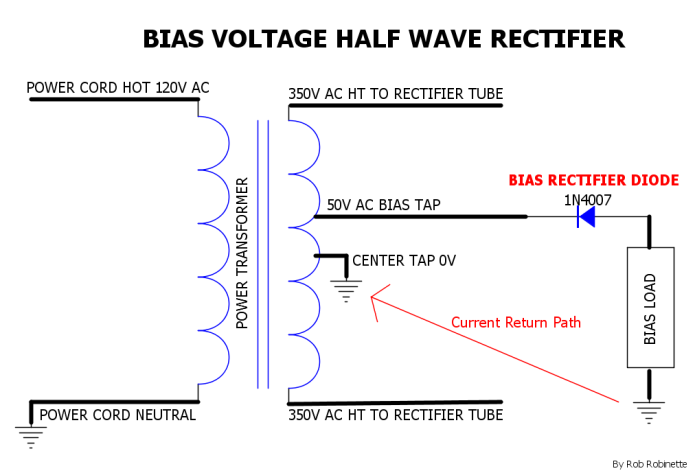
Power Transformer on left supplies 50 volts AC to the
Rectifier Diode. The AC power flows into the diode’s negative terminal (cathode)
so 50 volts of pulsing negative DC flows out. The 1K resistor and large
50uF Filter Capacitor
form an RC (resistance capacitance) low pass filter to smooth out the DC pulses.
The Bias Adjustment Pot adjusts the amount of
negative DC voltage that flows to the Power Tubes’ Control Grids. The 27K resistor sets
the maximum hot bias, reduce it for hotter max bias, increase it for cooler.
A 1kHz 37 millivolt sine wave (AC) audio signal is injected at a 65 Deluxe
Reverb Normal and Vibrato channels’ Hi
input jack (upper left) with all the volume and tone pots set to a half turn. The 1kHz audio
signal path through the amp is highlighted and each stage’s gain factor is shown
in red with an “x”. Yellow ovals list the audio signal voltage.
The 1kHz AC sine wave test signal measures 37 millivolts AC RMS (root-mean-square average) at the V1A
(Normal channel) and V2A (Vibrato channel) grids.
V1A and V2A amplify the 37mv AC signal
on their grids to 1.6 VAC (volts AC) at their plates. This is a voltage increase
(voltage gain or gain factor) of 43 times (.037v x 43 = 1.6v).
The tone stack and volume control load the AC signal down from 1.6 VAC at the
V1A and V2A plates to 47mv AC at the V1B and V2B grids. V1B and V2B amplify the
47mv signal 57 times to 2.7 VAC (gain factor of 57).
The Vibrato channel’s signal off the V2B plate is attenuated by the reverb
circuit from 2.7 VAC down to 115 millivolts AC at the V4B grid. V4B amplifies
the Vibrato channel signal 33 times. One explanation for the lower gain factor
of this stage is the load
applied to the plate from the tremolo circuit. Disconnecting this load with a
“tremolo off” mod will significantly boost the Vibrato channel’s gain.
We can see the extra gain provided by the Vibrato channel when we compare the 3.8 VAC at its
220k mixing resistor with the 2.7 VAC at the Normal channel mixing resistor.
The Vibrato channel puts out 47% more gain than the Normal channel at this
volume setting due to the extra V4B gain stage.
The schematic shows 5.3 peak-to-peak volts on the V6A upper phase inverter grid.
5.3vpp equals 1.9 VAC RMS (assumes an
undistorted sine wave).
With 1.9 VAC on the phase inverter upper grid and an output at the plate
of 22 VAC we get an 11.6x gain. The phase inverter lower triode (V6B) plate is at
23 VAC for a 12.1x gain. Note the 82k plate load resistor on the upper phase
inverter triode and 100k on the lower. 82k was used to lower the gain to balance
the phase inverter output but 82k is actually a little too low for an exact
balance. We can add the two triodes’ gain together to get the
total phase inverter gain of 23.7x. Note that each phase inverter triode’s gain factor is only about 25%
of a normal triode
gain stage. Also note the audio signal travels from the phase inverter upper triode
to the lower triode through their interconnected cathodes. The 1.9 peak-to-peak
volt signal shown on the lower phase inverter grid is the negative
feedback signal.
While the previous gain stages are voltage amplifiers the power tubes amplify
power, meaning voltage and current.
The schematic doesn’t show power tube grid voltage so we’ll ignore the signal
loss caused by the 220k grid leak resistors and assume 22 and 23 VAC on the power tube grids for a
7.9 and 7.6x gains to 174 VAC. Each power tube puts out 174 VAC between one half of the transformer primary
to the center tap so there is 348 VAC total across the transformer
primary so the power tubes’ total gain factor is 15.5. Remember the power tubes
are amplifying both voltage and current so their contribution to overall gain is
higher than the voltage gain number suggests.
The output transformer steps down the 348 VAC primary
voltage to 11 VAC at the secondary (and speaker jack) for a -31.6x signal voltage
reduction but the signal’s current is stepped up by the output transformer 31.6
times (current gain factor of 31.6). The output transformer matches the high impedance audio signal (high
voltage but low current) from the power tubes with the low impedance signal (low
voltage but high current) needed by the speaker coil.
37mv audio signal in -> V2A 43x ->
V2B 57x -> V4B 33x -> Phase Inverter 23.7x -> Power Tubes 15.5x -> Output Transformer -31.6x -> 11 VAC out
With the volume pots set at 1/2 we get 11 VAC into an 8 ohm speaker which yields
15 watts. The amp is rated at 22 watts with 5% total harmonic distortion with
the Normal channel volume pot at max.
Note the gain factors of each stage are not additive because there are signal
voltage losses between gain stages. If there were no losses between stages
in the Vibrato channel
and no loss to overdrive a 37mv signal into
the amp would yield 65.5 VAC and 536 watts at the speaker jack!
Amplifier rectifiers can use tubes or solid state diodes to
rectify alternating current (AC) into direct current (DC). They do this by
acting as one-way valves that only allow electrons to flow in one direction.
Solid state rectifiers (silicone diodes) are known as sounding
stiff and punchy because they don’t create as much voltage drop and sag as tube
rectifiers which can have over 60 volts of voltage drop across them.
Voltage drop is caused by the internal resistance of the
power transformer and rectifier. It lowers the amp’s B+ voltage and can soften
the dynamics of an amplifier where the higher voltage provided by solid state
rectifiers can make an amp sound punchier, louder and offer up a tighter lower
end and overdrive tone. Solid state rectifiers typically drop only 2 volts and a GZ34 tube
rectifier drops around 15. The 5Y3 offers up 60 volts of drop.
Voltage sag is the dynamic voltage drop across the
rectifier that increases with current demand and creates output volume
compression. Output volume compression occurs because high current demand during
loud notes lowers the amps B+ voltage and maximum volume is decreased.
Conversely, low demand, quiet passages create less voltage sag and generate
greater amplification. This makes loud notes quieter and quiet notes louder
which equals compression. Class A and AB amps differ in how much voltage sag is
generated. Since Class A amplifiers idle near max current there are less current
demand fluctuations and therefore less voltage sag. Voltage drop and sag help
contribute to the warm, round, tubey sound of vintage amplifiers. The
combination of the 5E3 Deluxe’s small power transformer, 5Y3 rectifier tube and
Class AB operation lead to metric shit tons of voltage sag.
Photo by Rob Robinette.
A single diode or single plate rectifier tube is a half wave
rectifier because only half of the AC wave is converted into DC voltage. Many fixed bias power supplies use a single diode half wave rectifier
to generate the power tube bias voltage. Silicone diodes are similar to single plate rectifier tubes in
that both have one cathode and one anode (plate is another name for a tube’s anode). The
term “diode” means two electrodes (cathode and anode). Tubes with two electrodes
are also called diodes.
Half Wave Rectification In Amp’s Bias Circuit
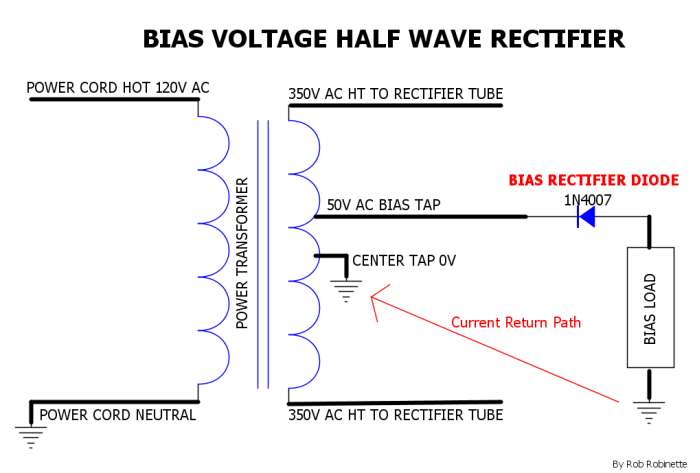
50V AC is tapped off the power transformer and sent to
a single diode. It acts as a one-way valve to convert the 60Hz AC into
60Hz pulsing negative DC voltage. The DC out voltage is negative because of the
polarity of the diode (turning the diode around would provide positive DC
voltage). With the diode’s cathode connected to the AC power
source, negative DC is created. The bias circuit uses the power transformer’s
grounded center tap as the current return path.
Half Wave Rectification
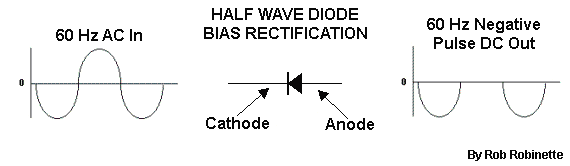
60Hz AC in and 60Hz pulsing negative DC out. Half wave rectification is inefficient
because it only converts half of the AC wave. It generates very lumpy DC power
which is smoothed using resistors and large capacitors that form a
resistance-capacitance (RC) low pass filter.
Two diodes, or a standard dual plate rectifier tube such as the
5Y3 or GZ34, are conventional full wave rectifiers. They are “full wave”
rectifiers because both the positive and negative AC wave are converted into DC
voltage. Conventional rectifiers
require a power transformer center tap to provide a DC current return path from the
amp circuit back to the transformer.
Conventional Diode Rectification
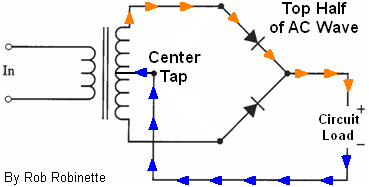
Conventional two diode rectifier showing current flow during the positive half of
the AC wave. The power transformer’s center tap provides the current return path
from the amp circuit back to the transformer. The center tap is grounded at zero volts.
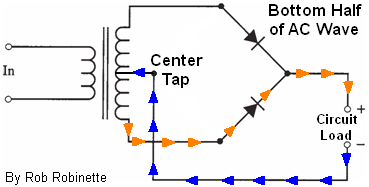
Conventional rectifier during the negative half of the AC wave.
Conventional Tube Rectification
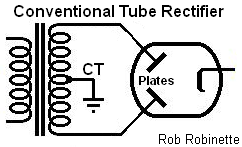
A standard dual plate rectifier tube like the 5Y3 works in exactly the same manner as the
above
two diode rectifier. That’s why
tube rectifiers are always paired with power transformers with center taps–the
center taps are required to provide a current return path from the amp circuit
back to the transformer.
Full Wave Rectification
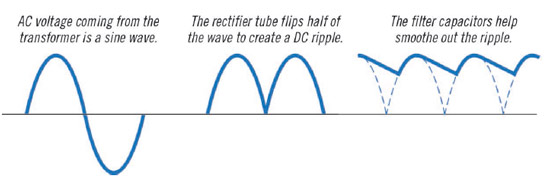
Full Wave Conventional and Bridge rectifiers convert both the positive and negative AC
wave (full wave) into DC voltage so they create 120Hz pulsing DC. Compare this
graph with the “Half Wave Rectification” graphic above showing 60Hz
pulsing DC. Knowing that power line and bias voltage are at 60Hz and high
voltage rectified DC is at 120Hz helps with tracking down the source of
amplifier hum.
Four diodes can be used to create a full wave bridge rectifier
which does not need a power transformer center tap. A bridge rectifier
is very efficient and extracts almost twice the voltage from an AC supply as a
conventional rectifier.
4 Diode
Bridge Rectifier Current Flow During Positive Half of AC Wave
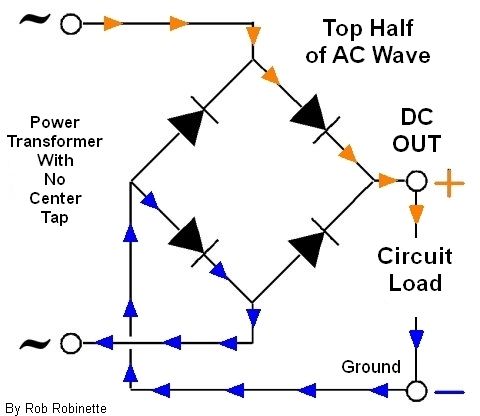
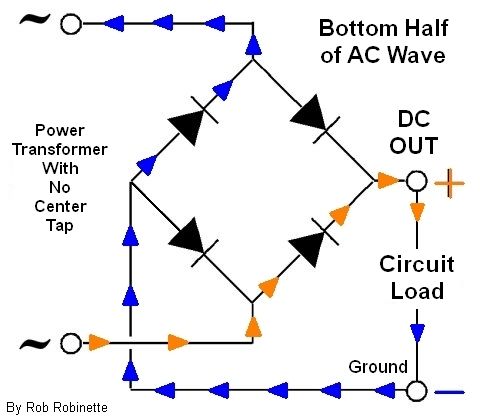
All four diodes in a bridge rectifier act as one-way valves that allow current to flow in only one
direction. The two diodes on the left side form the ‘bridge’ from the amp circuit
back to the power transformer so a center tap is not required. As the outflow of
current (shown with orange arrows) is ‘pushed’ by the transformer, the return
path (shown with blue arrows) is simultaneously ‘pulled’ by the transformer’s
negative voltage so a bridge rectifier can extract twice the voltage of a
conventional two diode rectifier which only ‘pushes’ because the transformer
center tap is grounded at zero volts and does not pull.
Bridge Rectifier Current Flow During Negative Half of AC Wave
Note: All diagrams in this All About Rectifiers
section show conventional current flow when in reality to create a
positive voltage electrons must be removed from a conductor (+ voltage =
scarcity of electrons, – voltage = excess of electrons).
All rectifiers must have a DC current return path back to the power
transformer because the rectified DC flows in only one direction–away from the
transformer. The transformer center tap or rectifier bridge provides the
current return path back to the transformer.
Although a bridge rectifier will extract twice the voltage
from a transformer compared to a conventional rectifier, a bridge rectifier will only
supply 62% the rated current at that higher voltage. If you tape off the center tap of a power transformer
and replace a conventional rectifier with a bridge rectifier it will generate
twice the voltage but the winding wires would have to be of a heavier gauge to
generate the same current.
Predict Amp Idle DC Voltage
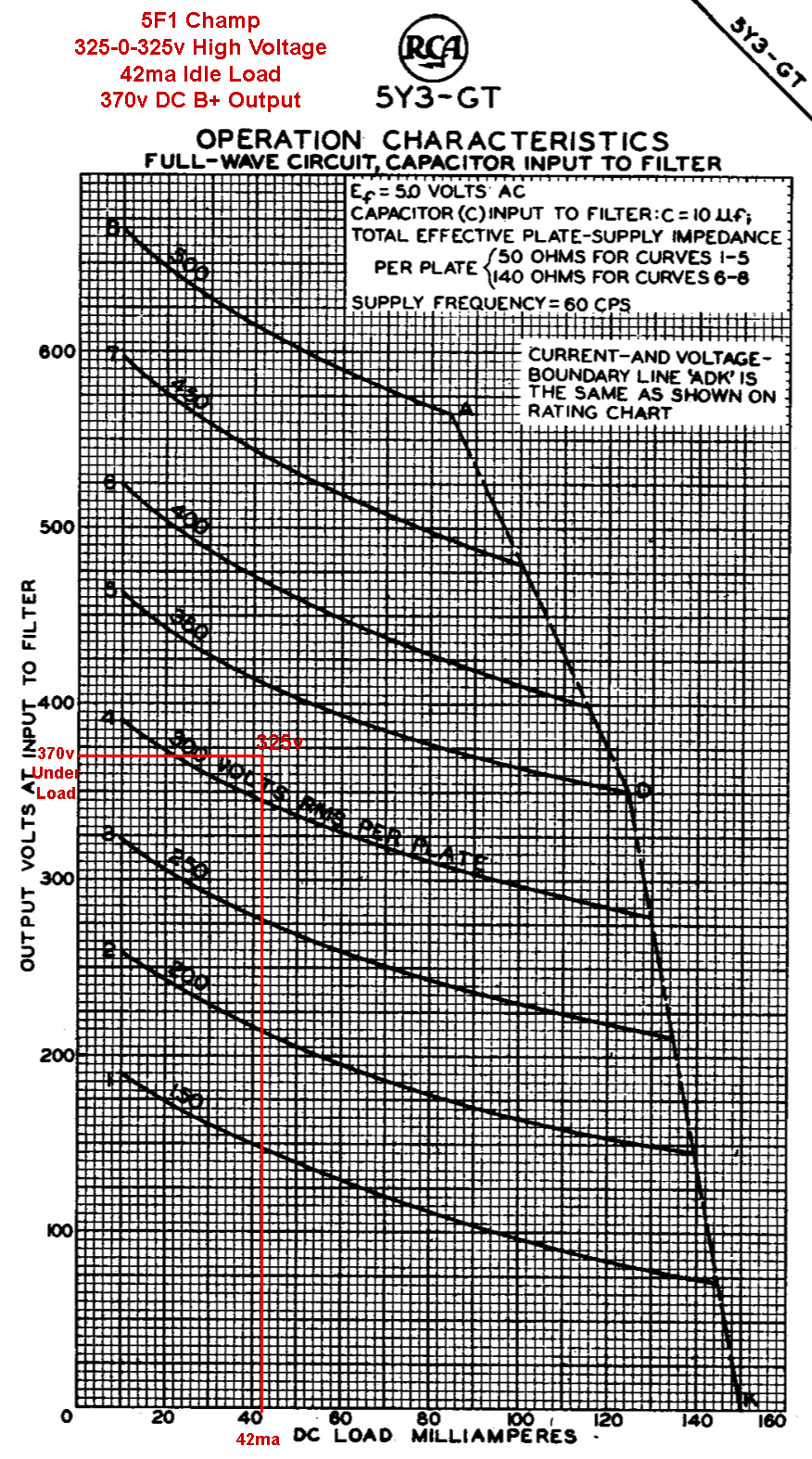
This chart is from the 5Y3 tube rectifier datasheet and
shows predicted DC voltage when using a B+ filter cap (there is another chart
for chokes). If we know the power transformer high voltage output and the amp’s
DC current draw the chart will show the rectifier B+ output voltage. The 5F1
Champ uses 42 milliamps of DC current and a 325-0-325v high voltage secondary so
we enter the chart at the bottom at 42ma and go up to find the 325v chart curve
and move left to find the rectifier output DC volts under load of 370 volts.
The no-load B+ voltage is equal to the high voltage secondary peak
voltage: 325v * 1.41 = 458 peak volts (1.41 is equal to the square root of
2) so with the power and preamp tubes pulled (no load on the rectifier) you
would expect to measure 458 volts DC at the first filter cap.
Concise Rectifier Design Guide by Hammond
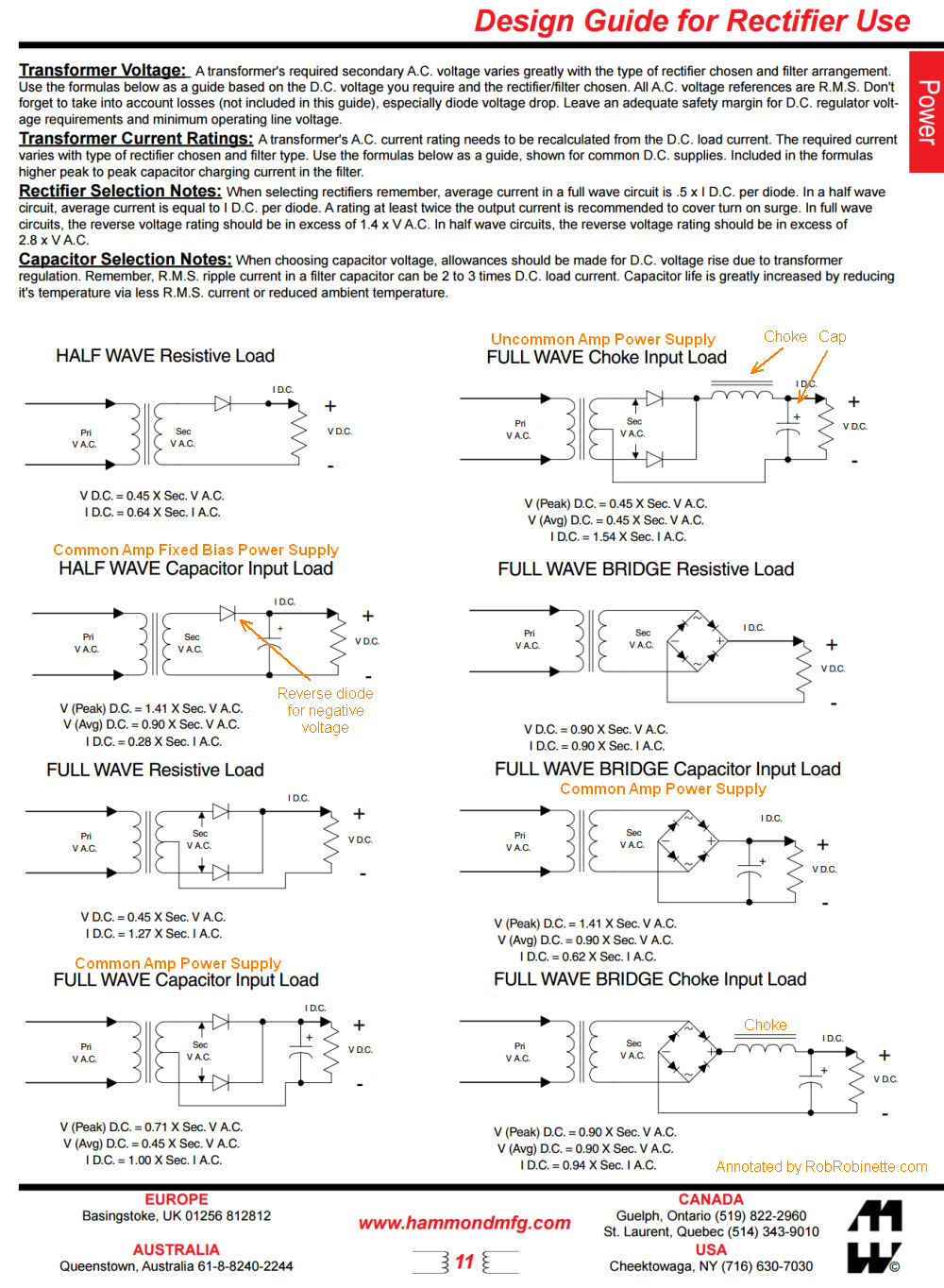
Note the FULL WAVE Capacitor Input Load at
bottom left and FULL WAVE BRIDGE Capacitor Input Load at mid
right. These are the two most common designs for tube amplifiers. Pri VAC
& Sec VAC = Primary & Secondary volts AC RMS.
Why Center Tapped Transformers Don’t Need a Bridge
Rectifier
This bothered me for a long time until I did enough research to
understand the current flow through 2 diode (conventional) and 4 diode (bridge)
rectifiers.
Why does a power transformer with a center tap allow
rectification with just two diodes versus four needed with no center tap?
Because the transformer center tap provides the path for returning current to
the transformer. If you use a
transformer without a center tap then a 4 diode bridge rectifier is needed to
provide the DC current return path from the amp circuit back to the transformer.
Conventional Rectifier and No Center Tap
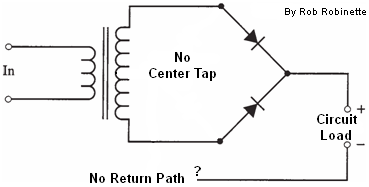
With no center tap there’s no return path to the transformer so this will not
work.
Hybrid Rectifier With No Center Tap
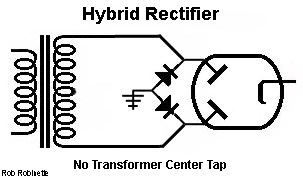
To use a transformer with no center tap with a tube rectifier you can install
the ‘bridge half’ of a bridge rectifier to provide a current return path. Two
1N4007 diodes running from the tube plate pins to ground will do the trick.
Diode polarity is important, install the diodes with their stripes (cathodes) to the tube
plates.
Hybrid Rectifier With No Center Tap + Backup Diodes
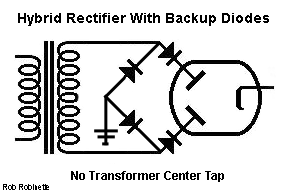
The two diodes connected to the tube plates are soft fail protection ‘backup’ diodes
that will prevent AC from entering the amp if the tube fails as a short circuit.
This is the equivalent of a bridge rectifier feeding a tube rectifier.
The 6.3v filament heater circuit is different from the high voltage circuit
in that the 6.3v circuit can function fine without a center tap. The 6.3v center
tap is not used as a current return path, its only used as a zero volt reference to
balance the voltage of the two heater wires and set a stable voltage difference
between the heaters and tube cathodes. Keeping the two heater wire voltages the
same helps with twisted wire hum cancellation. Since the heater circuit is AC
and is not converted to DC both 6.3v wires act as “send” and “return” wires. In these
purely AC wires the electrons flow back and forth in both lines so a separate
return line isn’t needed.
The key to understanding grounding schemes is to realize the ground is the
source for all the DC electrons
flowing through the amp. That’s right, the power supply pumps electrons out
of the amp circuit creating a scarcity of electrons we measure as a positive
voltage. Electrons are pulled out of the ground to replace the ones removed by
the power supply. Conventionally we think of DC current flowing
from the power supply through the circuit to ground but in actuality the
DC electrons are flowing the opposite direction. For amp’s using a
conventional rectifier the DC current must
return to the power transformer center tap. For amps using a bridge rectifier the current must
return to the rectifier bridge (see the Rectifier section
for more detail on this).
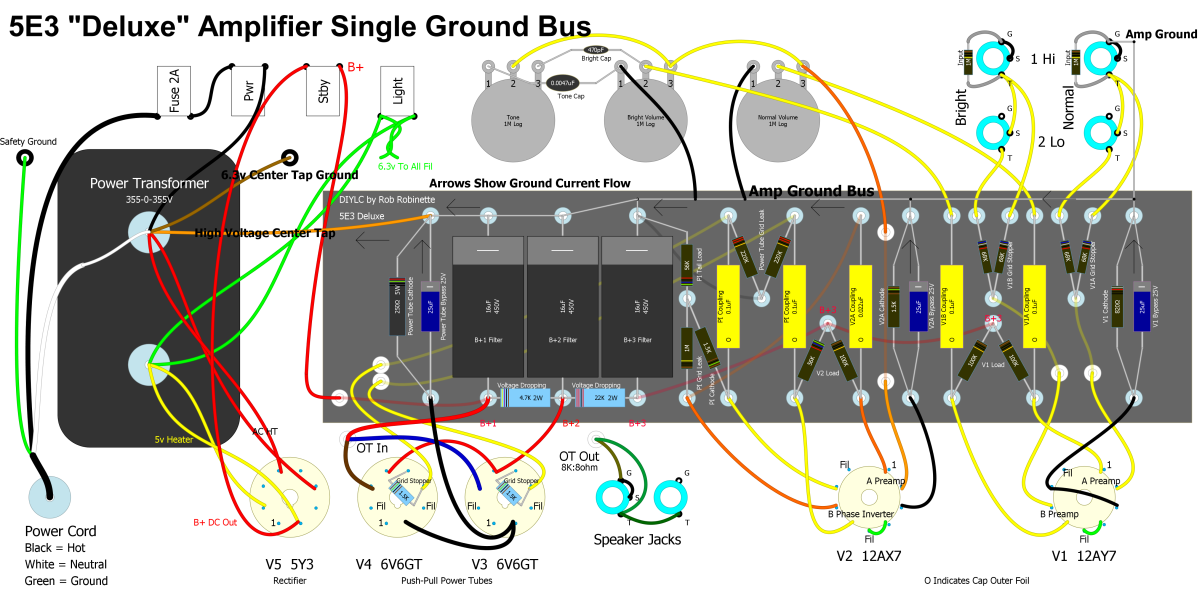
Arrows show flow of ground current back to the power transformer center tap.
The Split Grounding Bus Bar
Splitting the power amp and preamp grounds is currently (no pun intended) the
most popular grounding scheme used by amateur amp builders. By far most of the
amp’s B+ current is used up by the power tube plates so we want a nice “loop”
from power transformer, to rectifier, to B+1 filter cap,
through the output transformer to power tube plates, to power tube cathode &
resistor and back to the power transformer through its center tap. That loop needs a ground reference
connection to reduce hum so we bolt the center tap to the chassis but no current
should flow into the chassis–it flows through the loop from the transformer,
through the amp circuit and
back to the transformer.
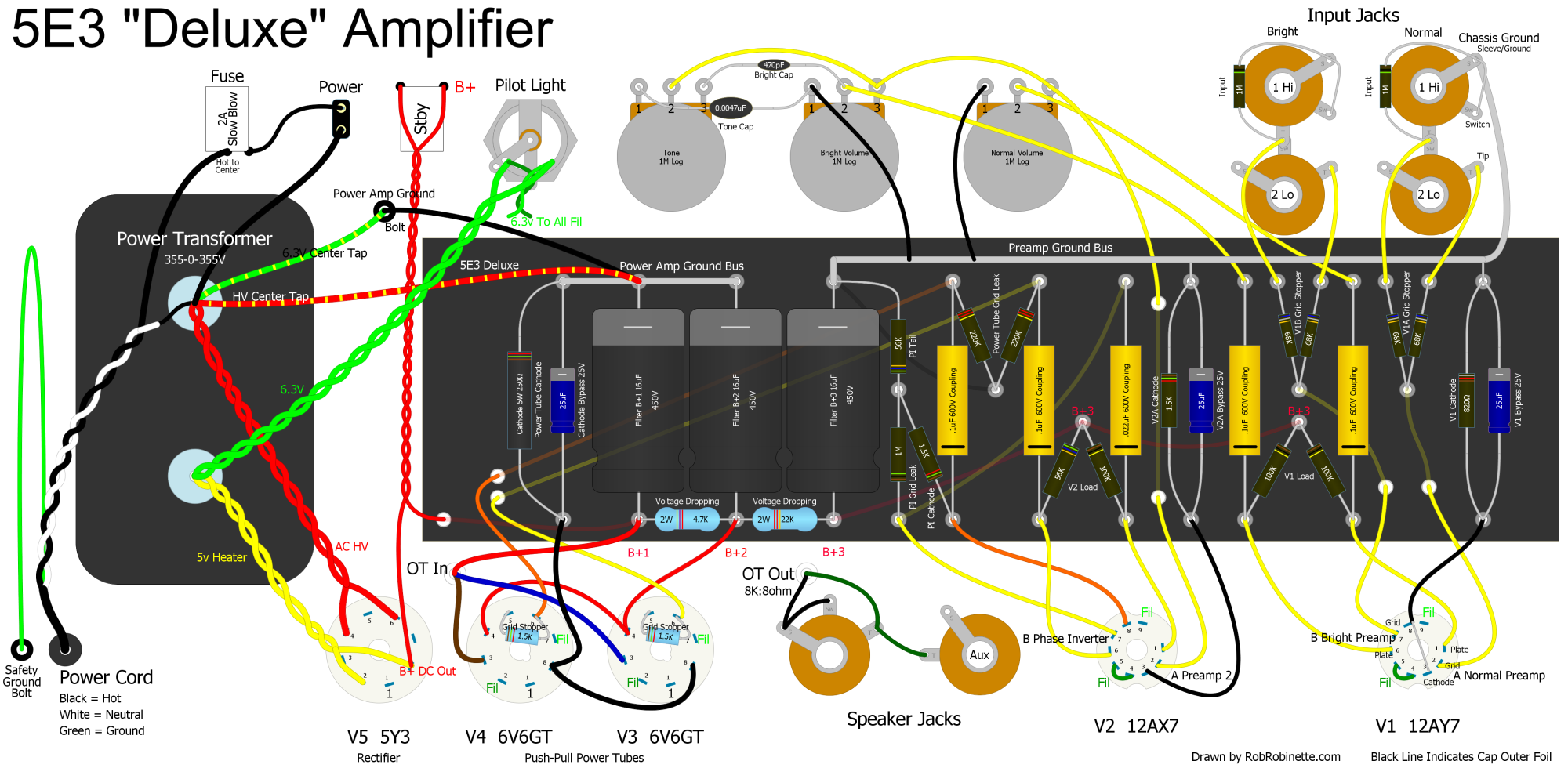
Note the split “Power Amp Ground Bus” and “Preamp Ground Bus”
running along the top of the circuit board in this 5E3
Deluxe layout. The power amp is connected to the chassis to the right and above
the power transformer. The preamp is connected to the chassis at the upper
right input jack.
Since the power tube screens are part of the power amp we usually connect the
B+2 (power tube screens) filter cap to the same power amp chassis ground
point–but again the current is flowing in a loop through the screen resistors
back to the power transformer.
The B+3 (preamp) filter cap provides power to the rest of the amp and its
current must also make its way back to the power transformer center tap by way
of the ground connection at the input jack. So the preamp’s DC current must
flow through the chassis from the input jack to the power transformer’s center
tap. We do it this way to try to prevent interaction between the high
current power amp and low current preamp but eddy
currents in the steel or aluminum chassis can add noise and hum. Electrical
engineers will tell you that flowing ground current through the chassis is a bad
idea. I agree but this split bus works fine in low gain amplifiers like the
Fender Tweed, blackface and silverface amps.
Actual DC Electron Flow Through the 5E3
The actual flow of electrons is opposite the direction of conventional current
because Benjamin Franklin guessed wrong on the direction of electrical flow.
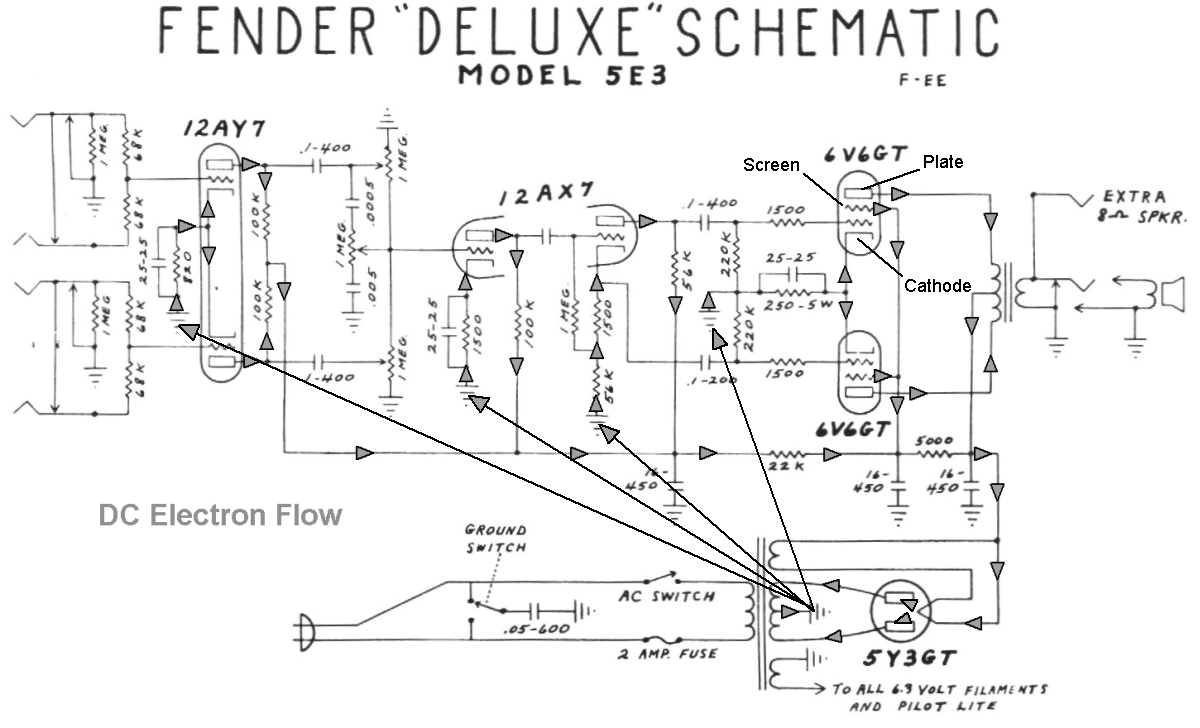
Gray arrows show the actual DC electron flow through the amp (flows negative
to positive) which is opposite of “conventional” current direction. Electrons
flow from the power transformer center tap to chassis
ground to all the tube cathodes. DC electron flow is very slow and takes about 170 hours to make a 600 inch loop around an amp circuit which includes half the
length of the power transformer secondary winding and half of the output
transformer primary due to their center taps. Don’t believe this? See
electron drift velocity
for more info.
Actual DC Electron Flow With Single Point Bus Ground
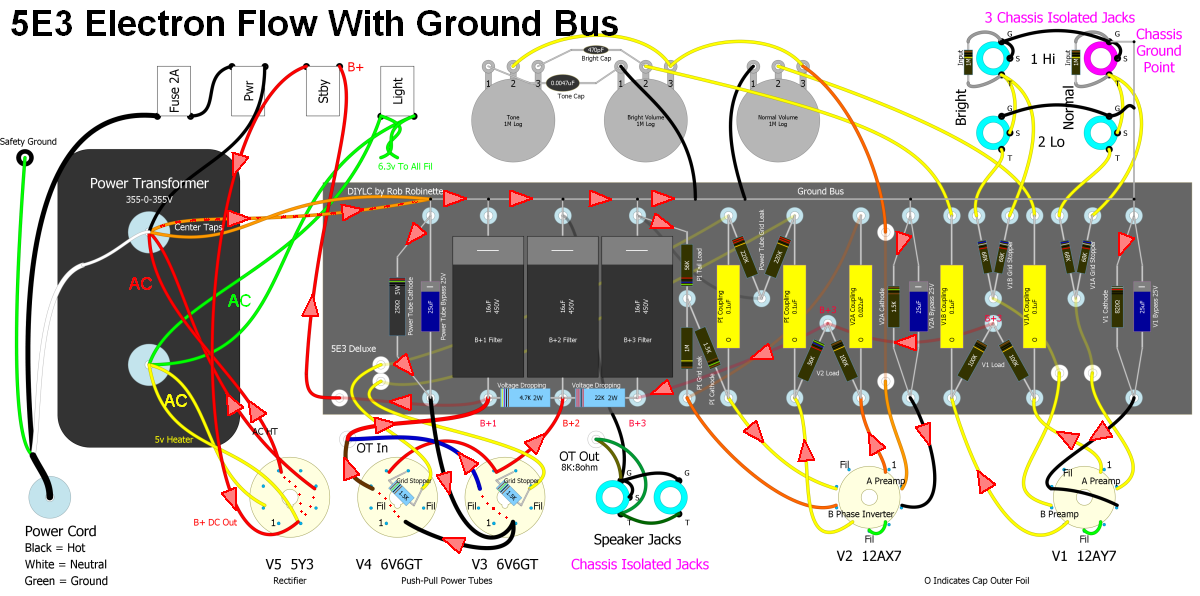
This single point ground bus is only grounded at the upper right input jack.
The other three input jacks and speaker jacks must be isolated from the
chassis and connected to the ground bus. DC electrons flow in a circular motion
starting at the power transformer center tap around the amp.
Electron flow starts with the black Hot and white Neutral power cord wires at
far left. Electrons alternate moving back and forth under AC voltage. They
really don’t move so much as vibrate or wiggle because they only move about .00001 inch
each AC cycle. These wiggling electrons in the power
transformer primary winding induce AC electron wiggle in the transformer
secondary. The high AC voltage from the power transformer secondary tries to push and
pull electrons to the rectifier tube but the rectifier acts as a one-way valve
that only allows the wiggling electrons to move in one direction so electrons
are pulled out of the rectifier’s cathode into the transformer.
So the transformer and rectifier act as an electron pump that pulls electrons
out of the B+ wire connected to the rectifier’s cathode at pin 8. Pulling
electrons out of the B+ wire creates a positive DC voltage (scarcity of
electrons = positive voltage). Although the power transformer puts out an AC
voltage, the only current flowing through the high voltage secondary is DC–the
electrons flowing from the rectifier to the transformer center tap. For amps
with bridge rectifiers, which do not need a transformer center tap, there will
be AC current flowing in the high voltage secondary. See the
Rectifier section for more info on how conventional
and bridge rectifiers work.
The electrons pulled out of the B+ wire flow through the power transformer’s
high voltage secondary leads and out its grounded center tap to the ground bus
bar. The center tap is the source of all DC electrons that flow through the
amp (the guitar signal is AC). Most of the amp’s electrons will flow from
the ground bus through the power tube cathode resistor and on to the power tube
cathodes. Then they flow out the plates and through the output transformer
primary then to the B+1 power node, standby switch and back to the rectifier
tube for a complete “lap” around the amp. During the amp’s operation
electrons are constantly making this circular trek around the amp. Electrons
captured by the power tube screen flow to the B+2 node and on to the rectifier.
Electrons also flow through the preamp tubes’ cathodes and out their plates to
the B+3 wire and back to the rectifier.
Big Picture Amp Power
The electric company’s generators (spinning at 60Hz = 60
revolutions per second = 3600 revolutions per minute) push and pull electrons
(alternating current or AC) through wires to your wall socket. You connect your
amp’s power transformer primary winding to the wall socket and electrons are
pushed and pulled through the winding. The transformer’s iron core captures the
magnetic field (flux) generated by the primary winding and induces a stepped up higher
voltage AC in the secondary winding. The secondary winding is connected to the
5Y3 rectifier’s two plates. Every AC half cycle one
plate is charged positive (scarcity of electrons) while the other plate is
charged negatively (excess electrons). The negatively charged plate does nothing
while the positively charged plate pulls electrons from the cathode and the B+
supply
wire attached to it (removing electrons from the B+ wire creates a positive
voltage).
During the next AC half cycle voltage on the two plates is
reversed. One plate is charged
positive and pulls electrons from the cathode while the other plate does
nothing. Because the 5Y3 has two plates and pulls electrons during both halves of the AC cycle it
is a ‘full wave’ rectifier and because it only ‘pulls’ electrons they flow in
only one direction which makes the current DC (direct current). A rectifier with
just one plate and cathode would only pull electrons during half the AC cycle so
it would be a half wave rectifier. The single diode in bias power supplies is a half
wave rectifier.
Back to the Output Stage.
Fender Tweed 1959 5F6-A Bassman Schematic With Signal Path and Component Function
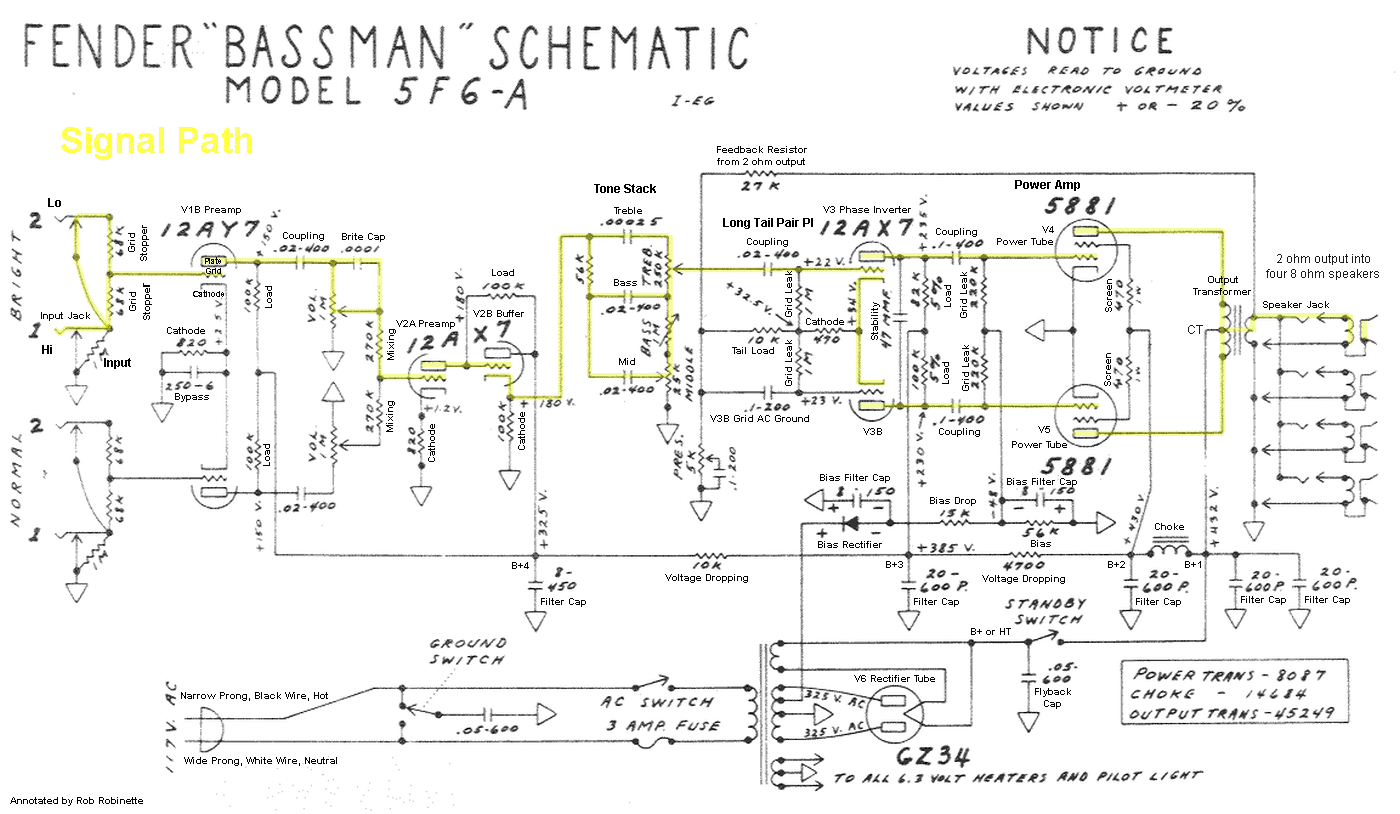
The 5F6A Bassman is a truly classic amp. Major differences from the 5E3
Deluxe include a tone stack with bass, treble and mid controls and a tone stack
buffer (V2B) just before the tone stack. The long tail pair phase inverter adds
gain and helps drive the big 5881 fixed bias power tubes into full distortion. The amp also came
with much larger value filter/reservoir caps to drive the lows from a bass guitar. Click on
image to see the full size (readable) graphic.
Cathode Bypass Cap C5
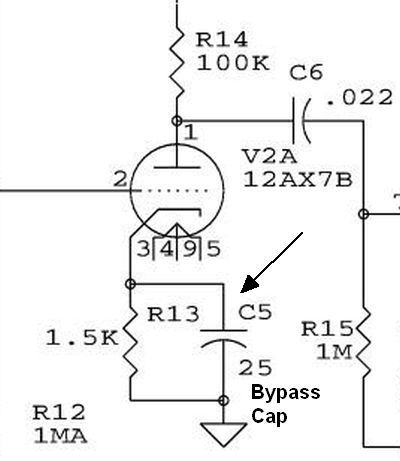
Cap C5 at the bottom center bypasses the R13 cathode resistor.
Adding a bypass capacitor to a tube’s cathode resistor is a common way to boost
gain. Without a bypass capacitor electrons flow from ground through the R13
cathode resistor to the tube’s cathode (3), through the grid (2) and out the
plate (1). As electrons are pulled through the cathode resistor a positive
voltage is formed on the cathode which is used as the tube’s bias voltage. In
the circuit above (5E3 Deluxe second gain stage) about 1.7 volts DC will be
found on the cathode.
The larger the positive signal voltage is on the grid the larger the flow of
electrons through the cathode resistor and therefore the larger the voltage on the
cathode. These increases in cathode voltage and therefore bias voltage acts as a
negative feedback mechanism because a higher bias voltage leads to a reduction
in bias current. This bias voltage fluctuation helps keep the flow of electrons
through the tube in check. This is why cathode biased tubes are called “self
biasing.”
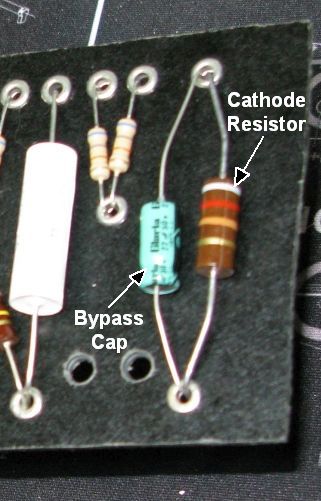
5E3 Deluxe V1A bypass cap.
Adding a bypass capacitor around the cathode resistor reduces this negative
feedback because the bypass capacitor acts as an electron reservoir. When
the tube’s grid goes positive and flows more electrons through the tube it’s
much easier to pull electrons from the bypass cap reservoir than pull them
through the cathode resistor. The freer flow leads to more electrons flowing
through the tube so more gain is generated.
When the grid goes negative and slows the flow of electrons through the tube the
capacitor is recharged and is ready for the next positive grid electron demand.
How the Bassman’s Long Tail Pair Phase Inverter Works
The Long Tail Pair (LTP) Phase Inverter (also called the cathode-coupled phase
inverter) is the most popular phase inverter in
guitar amplifiers due to its large output voltage swing and sweet overdrive tone. Unlike the non-amplifying cathodyne phase inverter in the 5E3
Deluxe the LTP phase inverter not only creates a dual mirror image signal
stream but it also acts as a gain stage boosting the signal by about 1/4 of what
two normal triode gain stages would. This added gain gives its output more
voltage swing to drive big bottle power tubes to a fully distorted state. The
LTP is a true differential amplifier that amplifies the difference between its
two grids. It uses both halves of a dual triode tube (usually a 12AX7 or
12AT7).
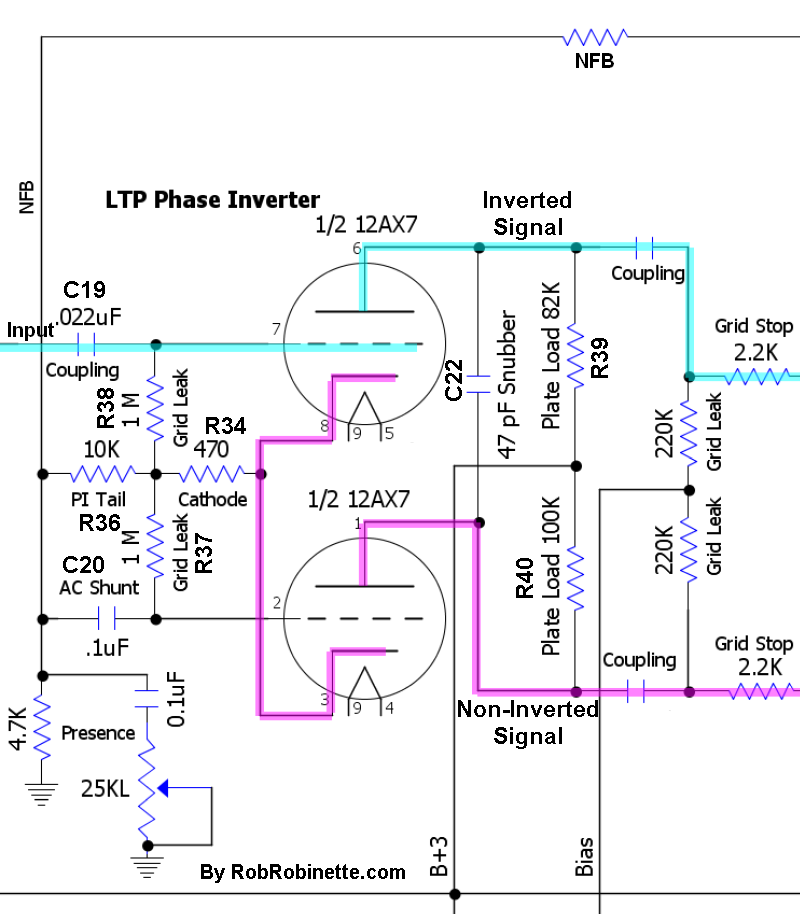
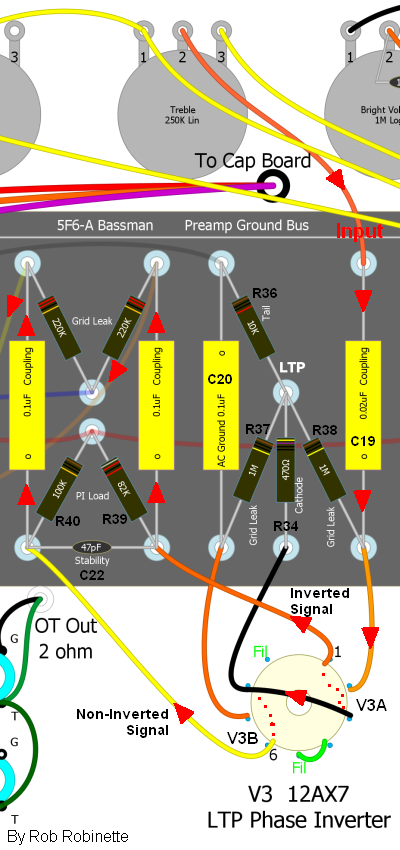
Signal flow shown with red arrows. Component numbers on the schematic and
layout match. The signal enters the phase inverter at V3A’s grid and flows out both its plate
(inverted signal) and cathode (non-inverted signal). The cathode signal flows to
V3B’s cathode where it is amplified.
For simplicity I will refer to the upper V3A triode as the “upper triode” and
V3B as the “lower.”
The upper triode in the schematic above has a dual function. It acts as a normal gain stage
by outputting an inverted signal at its plate
but also
acts like a
cathode follower by outputting a non-inverted signal at its cathode.
In the schematic above the AC input signal flows through coupling capacitor C19.
Cap C19 blocks the upper triode’s 32.5v of DC grid voltage out of the tone stack. The signal
then flows onto the upper grid while the lower grid is held at a constant
DC voltage
and all AC signal is sent to ground through shunt capacitor C20. C20 also passes
the negative feedback signal to the lower triode grid. C20’s third function is
to act as a coupling cap to handle the DC voltage across the R36 tail resistor.
The upper and lower cathodes are tied together. All of the lower triode’s input signal flows from
the upper cathode. With the lower grid held constant, signal voltage
fluctuations on the lower cathode alter the electron flow from it to the plate
which creates an amplified signal on the lower triode plate.
R36 is the tail resistor that creates the relatively high voltage (34v DC in the
Bassman) needed for the
cathode follower function of the upper cathode. It also supplies a near constant current flow
shared between the two cathodes–as current increases through the upper cathode the
current decreases through the lower and vice versa.
R34 is a standard bias resistor and creates a 1.5 volt difference between both tubes’
grid and cathode.
R37 and R38 are simply grid leak resistors which leak off DC grid current to
maintain a steady DC bias voltage between the grid and cathode.
The plate load resistors R39 and R40 are different values to balance the
difference in gain between the upper and lower triodes.
The negative feedback signal from the output transformer’s 2 ohm speaker tap is injected
into the LTP phase inverter in two places: the lower grid through C20 and at the R36 tail resistor which leads to the cathode. The negative feedback signal on the
lower grid is in phase with the primary signal on the upper grid and counteracts the signal
resulting in negative feedback attenuation. Injecting the NFB signal at the tail
resistor helps balance the feedback effect on the upper and lower plates.
The Presence control (R35 and C21) removes a variable amount of high frequency
from the negative feedback signal. Reducing negative feedback has the effect of boosting
output so reducing the high frequencies in the negative feedback signal boosts high frequency output. C21 shunts high frequency
AC NFB
signal voltage to ground. Increasing C21’s capacitance value will lower the
cutoff frequency and bypass a larger range of frequencies to ground therefore
boosting a larger frequency range at the speaker output.
Capacitor C22 suppresses oscillations above audio frequencies between the two
triodes’ plates to help stabilize the circuit.
LTP and cathodyne phase inverters present a very high impedance to upstream
circuits because their grid leak resistors are “bootstrapped” to the phase
inverter tail resistor. The input signal on the grid is also present at the
top of the tail resistor. This in-phase tail resistor signal reduces signal loss
through the grid leak resistor which greatly reduces the load shown to the
previous gain stage. Since impedance affects an audio filter’s corner frequency
we must use a much smaller coupling cap at the phase inverter grid to get the
same low frequency roll off. This is why phase inverter input coupling caps are
so small. AB763 blackface head cab amps use a 500pF coupling cap and the .022uF
cap used by Marshall in their Plexi and JCM800 could easily be reduced to .002uF
with no effect on tone but decrease the likelihood of blocking distortion.
Function Detail: When a positive voltage signal arrives at the upper grid
the reduction of blocking negative electrons on the grid allows electrons to
flow from its cathode, through the grid, to its plate. The electrons flowing
onto the plate lowers the plate voltage–this is the inverted and
amplified output signal. As electrons leave the upper cathode a positive voltage is
created on the cathode (scarcity of electrons = positive voltage) caused by the
voltage drop across the cathode resistor R34. This positive
signal voltage is also present in the lower cathode because the two cathodes are
directly connected. Since the lower grid is held constant at 0 volts AC, any
change in its cathode voltage will create a voltage difference between the grid
and cathode. This voltage difference changes the flow of electrons from the
cathode, through the grid to the plate. As the lower cathode goes positive (scarcity of
electrons) fewer electrons will flow from it through the grid to the plate. The
reduction of electrons flowing onto the plate raises the plate voltage–this is the non-inverted and
amplified output signal.
Bassman 5F6-A LTP PI Voltages
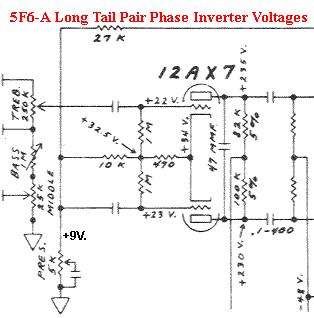
Note the voltage difference between the tail resistor junction of 32.5v and
the cathodes at 34v equaling a normal bias for a 12AX7 of 1.5v. The voltage
difference between the grids (22 and 23v) and the resistor intersection (32.5v)
is measurement error caused by voltage probe circuit loading. If the voltage
difference were real the tube would be in cutoff.
If you power the power tube screen grids (g2)
from the output transformer center tap (B+) the tubes function as normal
pentodes since the screen voltage will be fixed at or near B+.
But if you power the screens with the ends of the output transformer winding
(same voltage as the power tube plates) the tube functions as a triode because the
plates’ and screens’ voltage will fluctuate together.
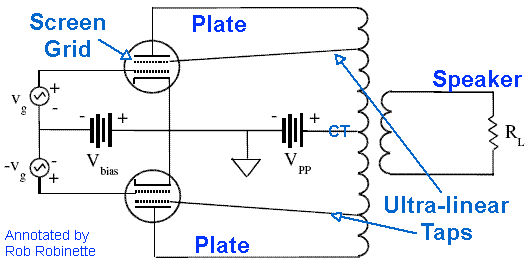
An ultra-linear output transformer has two extra tap wires that power the
power tube screen grids. The ultra-linear transformer taps are part way between the center tap
and winding ends so the power tubes function as a triode-pentode hybrid. The
screen voltage will fluctuate with the plates but with much less amplitude. This results in more linear amplification (less clean
signal distortion) and is used extensively in stereo audio tube amplifiers.
Ultra-linear is such a fundamental change to how a power tube operates that
it does affect both the amp’s clean and overdrive tone. Some Fender silver face
amps use ultra-linear and they tend to be loud, clean and excellent pedal
platforms.
This diagram from Richard Kuehnel’s
Vacuum Tube Circuit
Design: Guitar Amplifier Power Amps shows the ultra-linear taps
connected to the power tube screens:
The problem is ultra-linear operation reduces power tube distortion
which usually sounds better than preamp distortion. This shifts the balance
of preamp and poweramp distortion toward the preamp which is just not a good
thing.
You can simply ignore the ultra-linear taps on an output transformer by
disconnecting and insulating them and then powering the screen grids like normal
guitar amps with an RC filter or choke between the center tap power node and
screen grid node.
You can also put the screen grid connection on a switch and power them from
either the ultra-linear taps or from their own power node. Use ultra-linear mode
for clean headroom and to handle high output effects pedals and use the normal
mode for sweet power tube distortion.
Understanding impedance was one of the last things I figured out about guitar
and amp electronics.
Impedance, whose symbol is Z, is only a factor in alternating current (AC) circuits
so in a guitar amplifier impedance applies to the guitar audio signal voltage
and not so much to the DC power supply.
Impedance is made up of three things that impede or restrict AC current flow: resistance, inductance and capacitance
but its easier if you just think of impedance as “AC resistance.”
We’ll leave inductance and capacitance to the end of this discussion to simplify
things. The term “impedance” can apply to both signals and circuits.
A high
impedance signal has relatively high voltage but low
current so the signal is “thin.”
A low impedance
signal has relatively low voltage but lots of current so the signal is
“thick.” There’s more current backing up the signal voltage.
A high impedance
circuit is a low
load circuit that restricts AC current flow.
A low impedance circuit is a heavy
load circuit that allows AC current to flow easily.
I like to think of a low impedance signal as a slow moving, deep
river and a high impedance signal as a shallow, fast moving stream. I also
visualize a high impedance signal as “thin” and a low impedance signal as being
“thick.”
A thin signal is more likely to lose it’s high end when it
encounters resistors, capacitors and inductors.
Let’s take a
look at a guitar circuit:
Simple Guitar Circuit
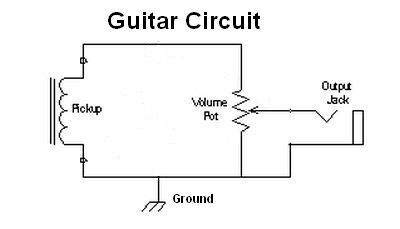
The Pickup on the left generates the guitar signal. The
Volume Pot bleeds guitar signal to ground to
lower the guitar’s output volume. A typical guitar has an impedance of 10k to
20k ohms.
In the circuit below we short the guitar output jack and turn the volume pot all the
way up so there’s very little to restrict electron flow from one pickup coil wire,
around the circuit and back to the pickup. This is a very low impedance circuit
with lots of current flow and little restriction to generate electron pressure
or voltage:
Low Impedance Circuit
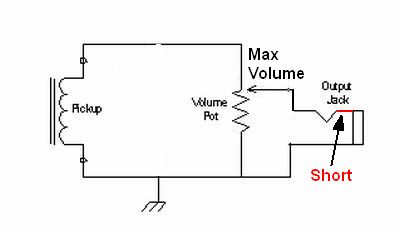
Electrons easily flow from the pickup coil, around the
circuit, back to the pickup so we have high current and low voltage. The
guitar’s AC output audio signal will have very little voltage but lots of
current will flow which makes this a low impedance circuit and a low impedance signal.
In the circuit below we turn the volume pot all the way down so the electron flow
from the pickup has to flow through the volume pot’s 500 kilohms of resistance. The
circuit is now a high impedance circuit. A small amount of current flows because
of the volume pot’s restriction. This restriction causes the electrons to stack
up at the pot which generates electron pressure or voltage across the pot:
High Impedance Circuit
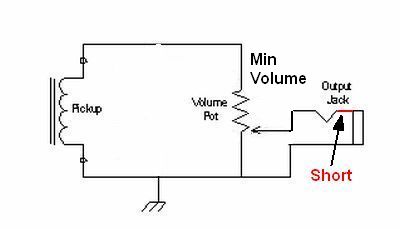
Electrons stack up trying to flow through the volume pot’s 500k of resistance
which reduces current but increases the voltage across the volume pot. The
guitar’s AC audio signal at the pot’s input will have high voltage but little
current flow which makes it a high impedance circuit and high impedance signal.
You’ve probably heard how a tone stack can “load down” an upstream preamp
circuit. The preamp tube’s AC
output audio signal is a high impedance signal with lots of voltage swing but
very little current driving those voltage swings–I think of it as a “thin”
signal. If the following circuit has a
low impedance it will “eat up” or load down the audio signal’s current. The
low impedance circuit allows too much current to sink to ground so the amplitude
of the audio signal voltage swings are reduced and attenuated. That’s what
happens in the tone stack when you turn the tone controls down. The tone
stack becomes a low impedance circuit and too much AC signal current can be bled
to ground lowering the amp’s output volume. Guitar players don’t want their volume to
change when they change a tone control setting.
As I said in the beginning, impedance is made up of three things that impede or
restrict AC current flow: resistance, inductance and capacitance.
Inductance is generated by AC signals flowing through coils so guitar
pickups add impedance to the guitar and amp input circuits.
Capacitance in a circuit acts as a drag on AC signals because the signal
looses energy moving electrons on and off the opposing capacitor
“plate.” The “plate” can be the actual plate of a capacitor, the ground shield
in a guitar cable or a nearby wire in an amp. There’s even capacitance between
the electrodes in a tube.
Tube amp gain stages typically put out high impedance signals (high voltage,
low current, “thin”) but a cathode follower can put out much more
current to create a low impedance signal.
It took me a long time to understand why input and
output impedance matters in amplifier circuits. Here’s my layman’s explanation:
For simplicity sake you can think of impedance as AC
resistance. The maximum power-transfer theorem says to transfer the
maximum amount of power from a source (guitar) to a load (amplifier), the load impedance should
match the source impedance (a.k.a. Impedance Matching).
Impedance Matching is used for maximum power in the power amp circuit where the
power tube output impedance is matched to the speaker impedance through the
output transformer. But at the amp’s guitar signal input we’re not
concerned with maximum power transfer, we want maximum voltage
transfer because a guitar amplifier amplifies a signal voltage–the voltage changes
are the audio signal. We really don’t care about the current generated by a guitar’s
pickup coil, it’s the
pickup’s voltage changes that will be amplified by the preamp tubes.
Since we favor voltage over current we can use an impedance
mismatch to trade current for voltage. This intentional impedance mismatch reduces the
current
from the guitar but boosts the
signal voltage the amplifier receives.
Guitar Output Impedance & Amplifier Input Impedance
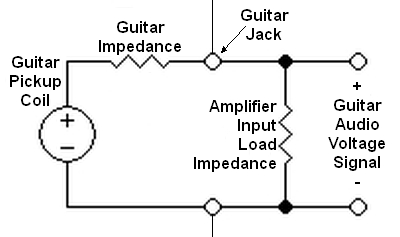
Guitar circuit on left, amplifier input on the right. The
current generated by the guitar pickup coil must be allowed to loop back to the
guitar pickup. Typical guitar impedance is around 10k to 20k ohms. The “Amplifier Input Load Impedance” is typically a 1 megaohm input
resistor mounted on the amp’s input jack.
In the diagram above the guitar’s pickup coil generates a signal
voltage.
The guitar’s output impedance is made up of the resistance of the pickup coil, volume and
tone controls + the guitar circuit’s capacitance and inductance. Since we can’t control the output impedance of
the guitar we can maximize the signal voltage by making the amplifier input
impedance as large as possible, preferably 10 or more times greater than the
guitar’s output impedance (Rule of 10).
A high input impedance reduces the
current flowing through the amplifier but increases the signal voltage level.
It also reduces distortion
because the guitar’s coil can output less current. This is called high
impedance bridging and is used extensively in electronic audio circuits.
The Input Resistor R1 on the 5F1 amplifier’s guitar Jack 1 adds input impedance to boost the signal voltage from the guitar.
The same principal applies between amplifier stages.
The output stage driver tube V1B sends the guitar signal
voltage to the power tube V2. Low output impedance from the driver tube and high
input impedance from the power tube boosts the signal voltage. This is what
resistor R9 (power tube grid leak) does, it sets a high input impedance to the driver tube V2.
Back to Signal Input.
As mentioned earlier to get the most power out of the amplifier the power
tube and speaker should match their impedance. But what happens when they don’t
match?
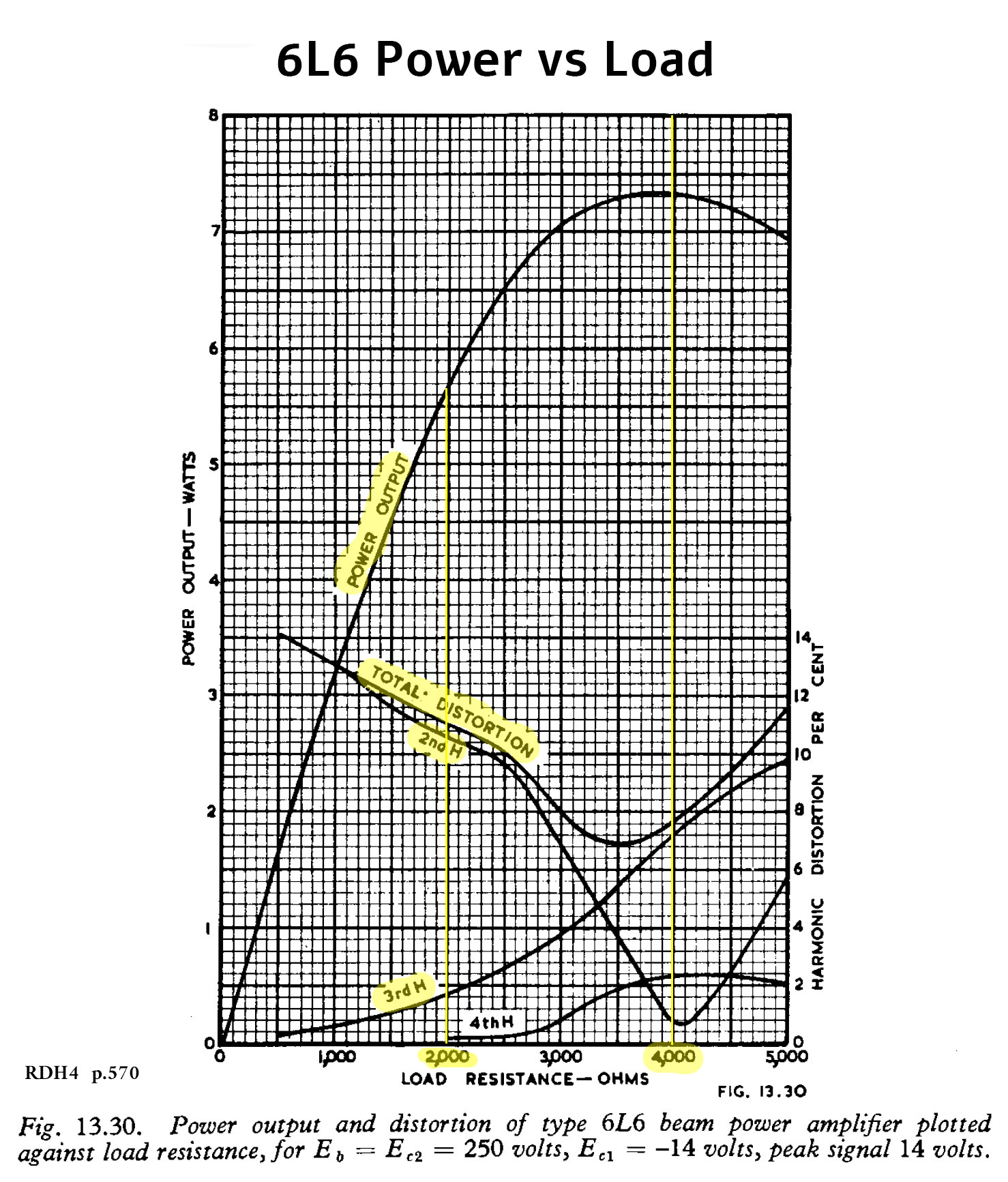
Notice how when plate load resistance (bottom of graph) is
increased beyond 4k ohms power output begins to drop off (left side of graph),
total distortion increases, 2nd order harmonic distortion increases (2nd H) but
nasty sounding 3rd order harmonic distortion (3rd H) increases much more. Also notice how when plate load is decreased
power output again decreases, total distortion again increases but sweet sounding 2nd order
harmonic distortion increases and and nasty sounding 3rd order decreases. This
is why a low impedance mismatch can sound better than a perfect amp-to-speaker
impedance match. Also note that when running a 6L6 amp with an 8 ohm output
transformer hooked up to a 4 ohm speaker the load resistance is cut in half from
4k to 2k and output power drops from 7.3 watts to 5.6 for a 23% power loss.
High Mismatch
If you connect a 16 ohm speaker to your 8 ohm output transformer (16 ohm load
and 100% increase) the
impedance as seen by the power tube plate increases and plate current
decreases which can lengthen the lifespan of your power tubes, especially in
Class A amps. This decrease in plate current will decrease demands on the power
transformer and it will run cooler. Power filtering effectiveness is increased
as current demand decreases so hum and line noise should decrease, especially
in Class A amps. Decreased hum can help prevent ghost notes which are
caused by hum interacting with musical notes to create false harmonic tones.
Since the power tube and transformer are not coupled at maximum efficiency
some power is turned into transformer heat and
the amp’s power output is reduced.
We get the opposite of the sonic improvements of a low impedance mismatch:
Sweet sounding 2nd order harmonic distortion in the power tube and nasty
sounding 3rd harmonic distortion increase but the 3rd harmonic
dominates.
The main problems with a high impedance mismatch are increased screen
current and flyback voltage
generated in the output transformer. A higher plate load impedance can
rotate the plate load line to below
the knee and cause excessive screen current which can melt the screens and
kill the tubes. Flyback voltage can damage the power tubes and the output
transformer itself. Flyback voltage spikes can cause the power tube to arc
between pins or burn through the thin lacquer wire insulation used in the
transformer windings. This is normally not a concern when going “one step” away
from a match such as running a 4 ohm output transformer with an 8 ohm speaker
unless the output transformer is cheaply made or really old. But running a 4
ohm transformer with a 16 ohm speaker can generate very high flyback voltages
when running the amp hard near max volume.
For you Hi-Fi guys, increasing a speaker’s impedance will change a
passive crossover’s crossover frequency. Changing out a two-way speaker’s 4 ohm
bass driver with an 8 ohm will shift the low pass filter’s crossover point
higher a full octave which will feed the bass driver more mid freqs and create
an overlap where both the tweeter and bass driver are active. The bass driver
impedance mismatch won’t directly affect the tweeter crossover frequency.
Low Mismatch
If your output transformer is designed to match your power tubes to an 8 ohm
speaker and you connect a 4 ohm speaker then the impedance as seen
by the power tube plate decreases by 50% too. Less impedance will cause plate current
to increase. The power tubes are stressed by this increased plate current so the power tube
lifespan can be shortened. This is especially true of Class A amps because
they idle near max current flow. Since the plate current idles near maximum, the
entire power supply also runs at maximum output so the rectifier tube and
power transformer will run hotter. Power filtering effectiveness is reduced
as current demand increases so hum and noise may increase, especially in
Class A amps. Increased hum can cause ghost notes.
The increase in primary current will cause the output transformer to run
hotter. This generation of excess heat reduces power output at the speaker.
Many vintage Fender tube combo amps have an aux speaker jack that’s
wired in parallel with the built-in speaker. Plugging in a speaker rated at the
same ohms as the built-in speaker will cut the speaker load in half for a “one step” low
mismatch. Fender designed their output transformers to handle this and is
considered safe.
But there are two possible sonic improvements with a power tube and speaker
low mismatch. Sweet sounding 2nd order harmonic distortion in the power tube
increases and nasty sounding 3rd harmonic distortion decreases dramatically.
This is why it’s worth experimenting with different speaker loads, you may like
the tone you get. This is also why I prefer a 6.6k:8 ohm output transformer for
6V6 power tubes like the Deluxe Reverb uses instead of the typical 6V6
8k:8 ohm transformer.
If your power and/or output transformers run hot with a matched speaker load then mismatching them is more of a risk. The
bottom line is the greater the low impedance mismatch, the harder your amp works,
and the greater the high impedance mismatch, the more likely you are to burn out
your output transformer and/or power tubes. For tube amps a low mismatch is safer
than a high mismatch, that’s why most speaker jacks have a shorting switch–a
short is better than an open circuit. The opposite is generally true for solid state amps–a
short will burn out their output transistors. An output transformer open
circuit must be avoided, that’s why I recommend soldering speaker wire to the
speaker and why I recommend you shut down your amp before changing the speaker
impedance switch (and avoid cheap impedance switches in your builds).
For two-way Hi-Fi speakers, decreasing a speaker’s impedance will
change a passive crossover’s crossover frequency. Changing out a two-way
speaker’s 8 ohm bass driver with a 4 ohm will shift the low pass filter’s
crossover point lower a full octave which will feed the bass driver less mid
freqs and create a “hole” in the speaker system’s frequency response. The bass
driver impedance mismatch won’t directly affect the tweeter crossover frequency.
Running 2 Power Tubes in a 4 Power Tube Amp
Many push-pull amps designed to run 4 power tubes can be run with 2 power
tubes to cut the output power in half. But since the output transformer was
designed to load the current put out by 4 power tubes we need to make an
adjustment on the speaker end to load 2 tubes properly. Since 2 power tubes
put out half the current of 4 tubes we need to double the speaker
impedance so 2 tubes feel the same load as when 4 tubes are used. If your
amp is designed to run an 8 ohm speaker with 4 tubes like the AB763 Blackface
Single Showman, it will need a 16 ohm speaker when run with 2 power tubes.
Amplifier and speaker phase has to do with which way a speaker moves, in or
out, with a positive voltage at the amp input (such as a 1.5v battery + terminal
to input jack tip). For multiple speakers playing the same source material
such as a stereo audio amp or a multi speaker guitar cab, phase does matter.
You want all the speakers moving in concert–all of them moving out together,
then in together. If not there will be interactions between the speakers that
change the apparent volume of certain frequencies. A loss of low end is usually
what is noticed but the volume loss and frequencies depend upon the position of
the listener.
For single speaker amps however, phase does not matter. I have had
guitar players argue with me that it does matter, especially when they are
working with guitar/amp feedback. Why would it matter if the speaker moves
outward when the guitar string moves upward versus downward? If the listener (or
guitar player if he is working with amp feedback) moves a foot or two toward or
away from the amp speaker the phase flips at his location so phase does not
matter.
Many multi-channel guitar amplifiers have different phase for different
channels. If a channel has 1 or 3 extra gain stages compared to another
channel then the amp/speaker phase will be 100% different between those two
channels at the speakers. Again, this does not matter due to the material in the
previous paragraph. But, if you jumper two out of phase channels they will sound
weak and funky due to the phase cancellation when the two channels meet inside
the amp.
What about two guitar players playing the exact same song? Does it matter
if their two amps and speakers are in phase? No, because their picking would
have to be incredibly synchronized to make a difference. At 1000Hz there is
three hundredths of a second difference between the signal and 100% out of
phase. The placement of the players’ amp speakers is also important. A 1000Hz
signal has a wavelength of 13.5 inches so if one of the speakers is 6.75 inches
closer to the listener the phase will change by 100%. Don’t worry about your
band mates being out of phase with you or your amp.
Changing an amp’s phase can help when recording live performances.
Standing acoustic waves can cause tonal anomalies that can sometimes be
improved by changing the phase of the guitar or bass amp. The bass amp
open E is 41Hz which has a wavelength of 25 feet so flipping the
polarity of a bass amp can change a standing pressure wave at the
microphone to a standing wave trough which may solve the guitar and bass
interaction at the microphone. Live concert sound board operators
sometimes run into the same situation. At their location there is a
funky interaction and by flipping the phase of the guitar or bass signal
using the sound board can improve the tone at his location. The problem
is if he moved to a new location he could find another spot with similar
funky interaction.
Let’s say we take a new 325-0-325v rated power transformer out
of the box and connect the primary to 125 volts AC from the wall. The power
transformer center tap and high voltage secondary wires aren’t connected to
anything (they’re floating) and we measure 650 volts AC from one high voltage
secondary wire to the other. We would also measure around 325 volts AC from
either hot wire to the center tap.
We can touch either hot wire or center tap and not get
shocked because the voltage isn’t referenced to ground–the voltage is only
between the three secondary wires. If we measure the voltage between a metal
ground rod sunk into the earth and any secondary wire we’ll see only random low
voltage caused by transformer leakage.
But if we touch any two secondary wires we will get shocked.
If we connect the power transformer center tap to an un-grounded
metal chassis we would measure around 325 VAC between either high voltage wire
and the chassis but we can still touch a single hot wire or the chassis (not
both) and we won’t get shocked.
If we ground the chassis we now have a modern, standard,
powered amplifier. We and the grounded chassis have a common path literally
through the ground. If we touch an amp hot wire electrons can flow between the
ground and the hot wire through our body and shock us.
If we rest one hand on the chassis and touch a hot wire with the
other then 325 volts AC will push current from one hand to the other across our
chest–that’s why we have the one-hand rule for working on hot
amplifiers.
If we stand on an insulated plastic box so our body has no path
to earth we can touch either hot wire and not get shocked.
We can hold the grounded chassis in our hands and connect a hot
wire (or failed short capacitor) to the chassis and not get shocked because the
lowest impedance path to earth is through the chassis ground wire. Now if we
were standing in a pool of water in our basement and did that we would probably
feel a tingle.
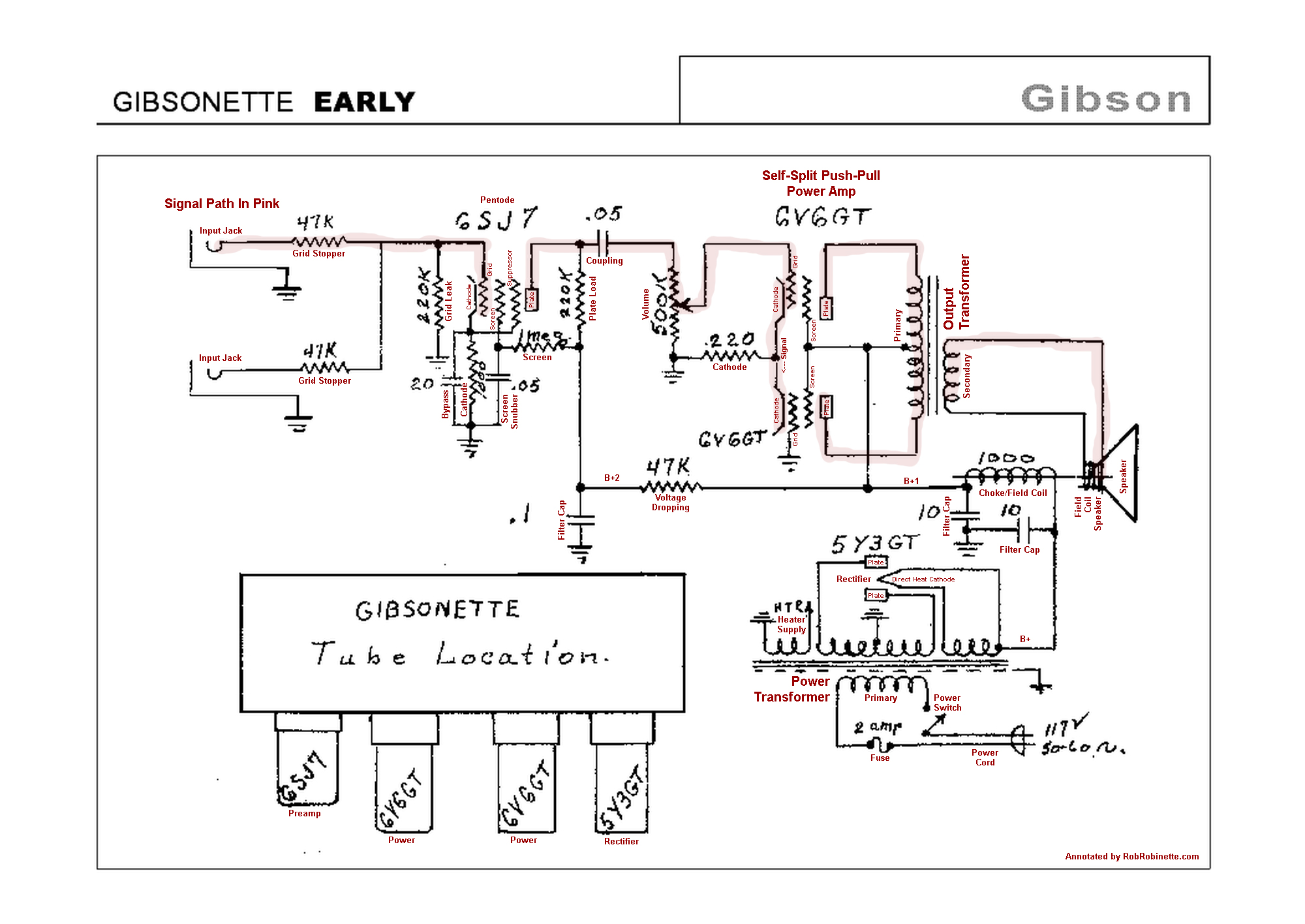
The early Gibsonette (mid-late 1940’s) has an unusual design. It uses a
single pentode (6SJ7 tube) stage for the preamp, a self-split push-pull power amp
(2x6V6) which requires no phase inverter. The self-split power amp works like this: The guitar signal
on the upper power tube grid changes the current flowing through the tube which
causes a voltage drop across the cathode resistor. This voltage drop is also
present on the lower power tube cathode and since the lower grid is grounded
(common grid) the voltage changes on the cathode affect the current flowing
through the lower power tube. The speaker field coil is an electromagnet that
takes the place of the speaker permanent magnet. The field coil also acts as the
choke.
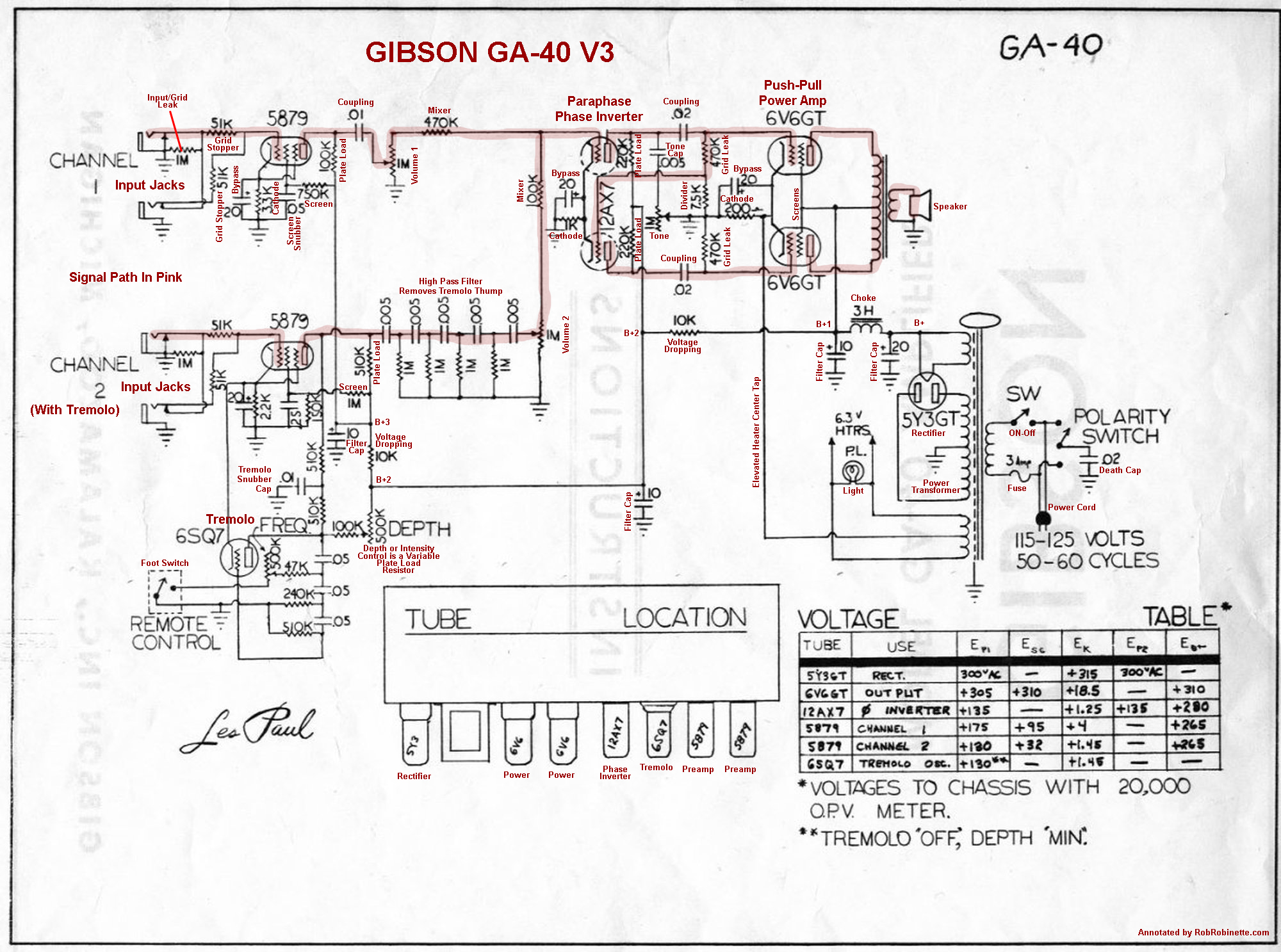
The GA-40 V3 uses one 5879 pentode per channel as a single
preamp stage. The paraphase phase inverter lower triode gets its signal to its
grid through the upper 470k grid leak resistor. The tremolo oscillation is fed
to the channel 2 preamp plate. The “Tremolo High Pass Filter” is a fifth order
high pass filter which removes tremolo thumping that can be created in the
tremolo oscillation. Each RC network stage rolls off at a slope of 6dB per
octave at 32Hz. Five successive filters create a very steep filter cut which allows the
corner frequency to be set low enough to allow normal bass response in the
tremolo channel (Channel 2) while still killing tremolo thump.
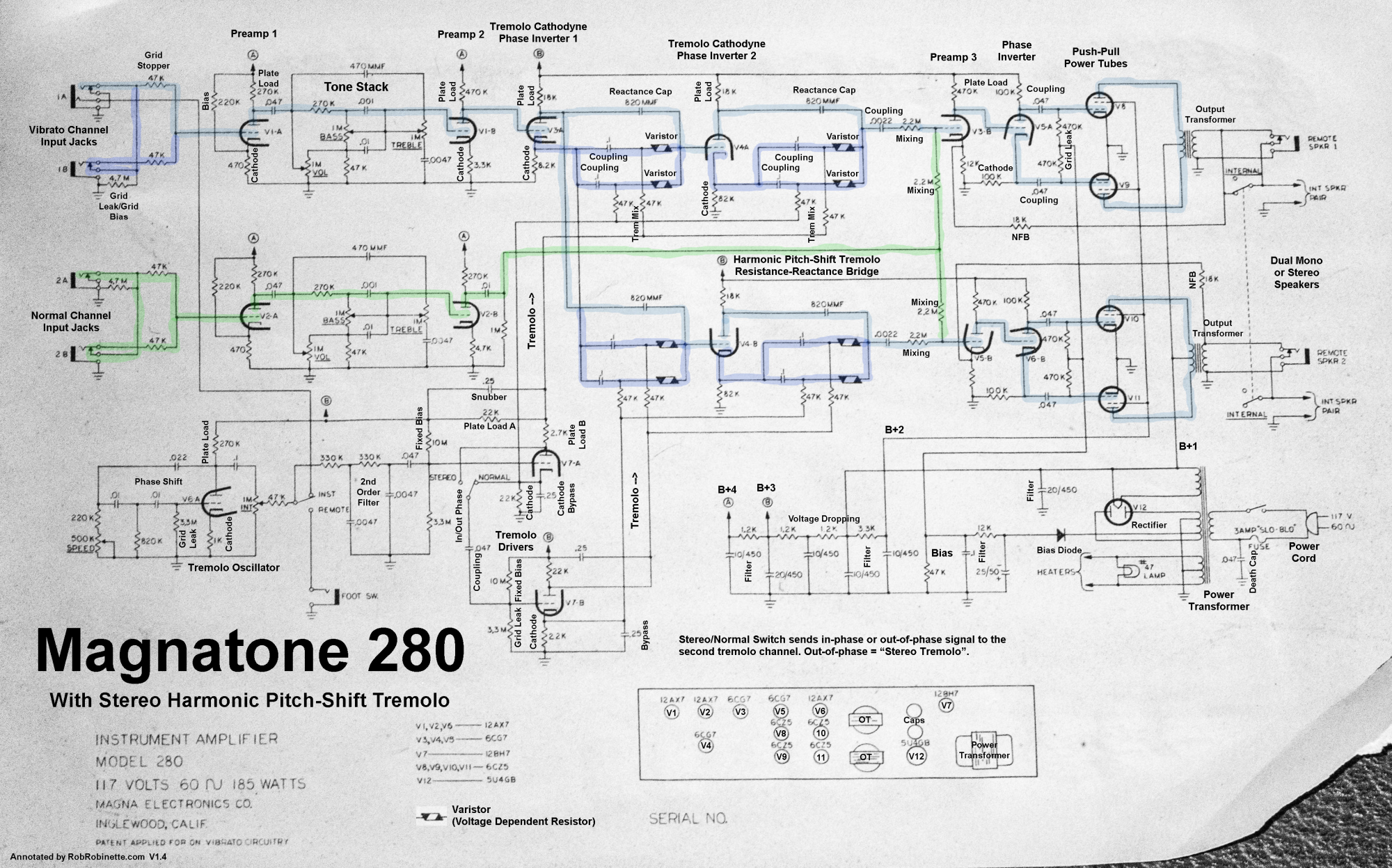
This amplifier won the Tremolo War with by far the most
complex and intricate tremolo design. Each stereo channel has its own tremolo
driver, harmonic
pitch-shift circuit, power amp
and speaker. Vibrato Channel signal path shown in blue. Normal Channel signal
path shown in green. Tremolo Oscillator and Tremolo Drivers at lower left. Dual
channel Harmonic Pitch-Shift circuits at upper center. Click image to see full
size schematic.
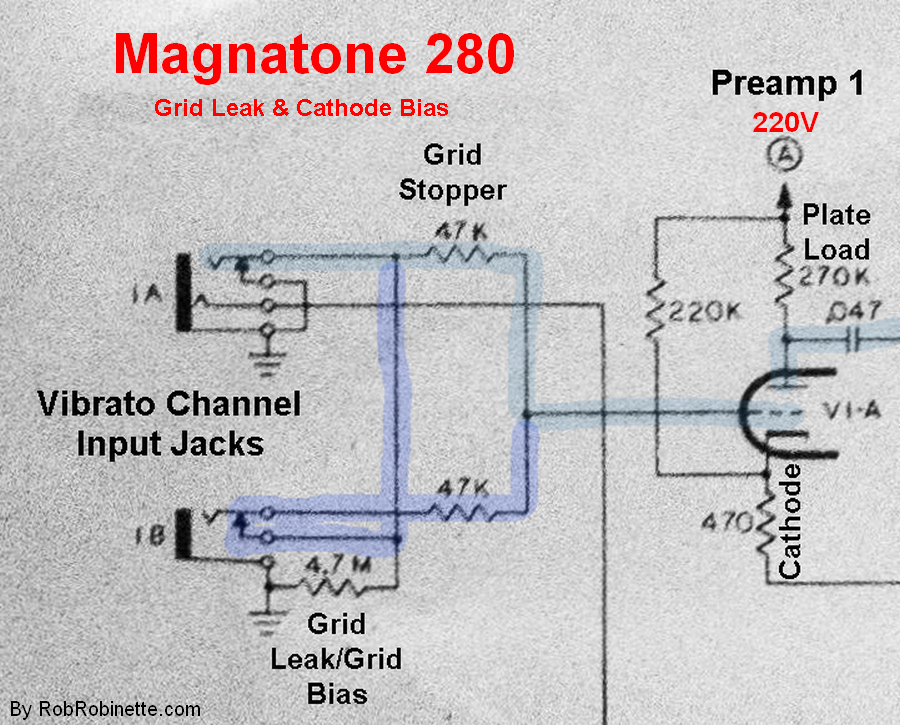
Magnatone used an unusual first stage bias circuit in some
of their amps including the 280. Using the upper 1A “High” input jack bias voltage is generated
by the
4.7M Grid Leak/ Grid Bias resistor because it creates a voltage drop as grid current flows
through it. The 470 ohm Cathode resistor generates a voltage drop when
electrons flow from the cathode to plate. Since this circuit has no blocking
capacitor the grid bias voltage will be passed to the guitar. When the lower 1B
“Low” input jack is used the 4.7M grid leak resistor is bypassed so no grid leak
bias is generated.
Rock and Roll Globe Article About Scott Totten’s Magnatone
280 Rebuild

See the article here.
Humbucking pickups are really two single coil pickups connected together in a
way that cancels noise and doubles the pickup output voltage. Humbuckers use common mode noise rejection to reduce hum
and other electromagnetic noise picked up from surrounding sources like fluorescent lights. Any noise that gets
into both pickup coils is nullified when the two signals from the two coils are
combined because the noise signals from the two coils are of opposite phase.
In
other words the positive noise signal is added to the negative noise signal and
they wipe each other out. We get a “positive” coil and “negative” coil by simply
winding the wire in the opposite direction.
Why doesn’t the guitar string signal get nullified like the noise? Because of the opposite magnetic polarity of the
pickups’ pole pieces. One pickup has North up magnets and the other has South
up magnets. This flips the
signal polarity of one coil so the string signals are in phase, not out of phase
like the noise. The string signals from the two coils are added together
instead of being subtracted and nullified.
Just like two humbucker pickup coils, two separate pickups can be paired
together to work as humbuckers and reduce noise if the two pickup coils are
connected the right way.
You need two things to get hum cancelation in a humbucker pickup or between two
single coil pickups: Opposite electrical current flow in the two coils–one coil’s
string generated current flows clockwise, the other coil flows
counter-clockwise. The two pickups must also have opposite magnetic
polarity (North+South).
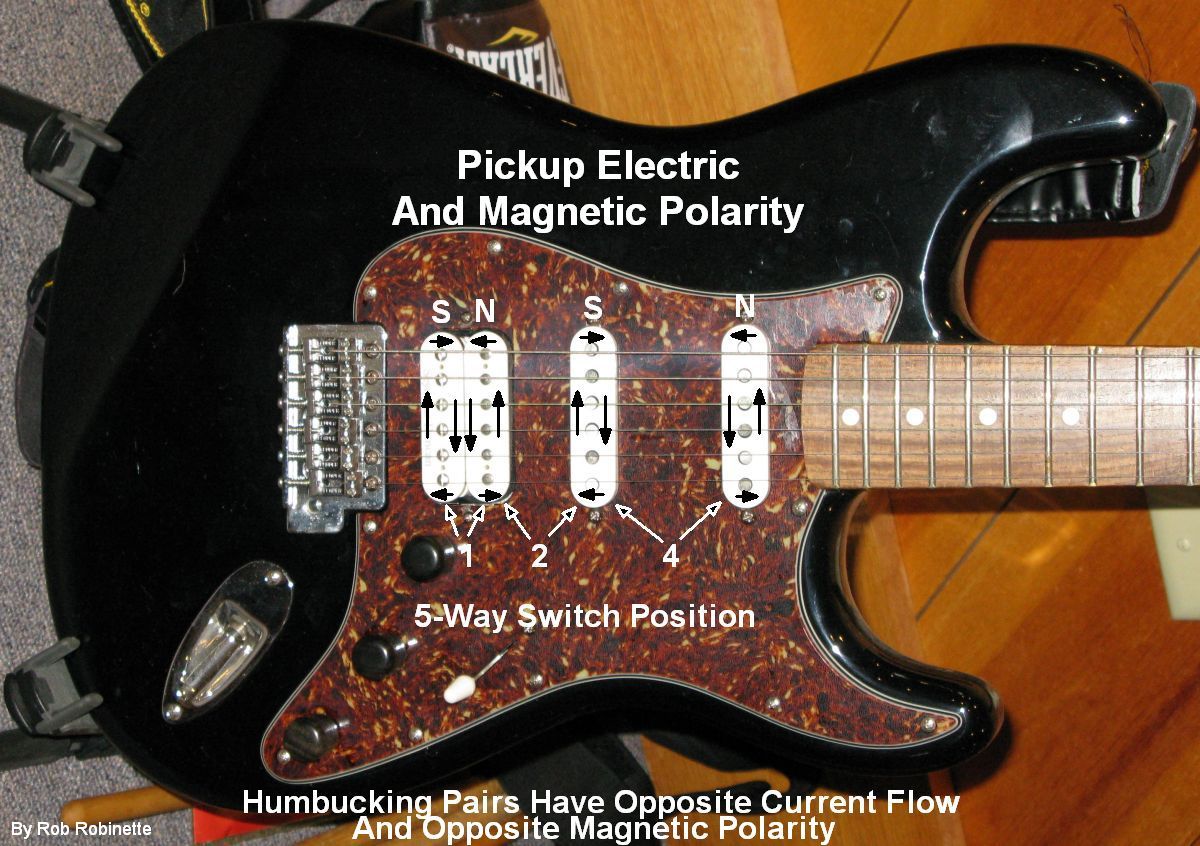
The two coils of the bridge humbucker circulate electric
current generated by the strings in opposite directions. The black arrows show
the direction of current flow around the pickup coils. The same is true when you select switch position
2 which pairs the right bridge humbucker coil with the mid pickup and switch position 4
which pairs the mid and neck pickups. The magnetic poles of the left humbucker
coil are South up and the right coil is North up. In switch position 2 the North
bridge coil is paired with the South mid pickup. In switch position 4 the
South mid pickup is paired with the North neck pickup. 5-Way switch positions
are: 1 Bridge Humbucker, 2 North Humbucker coil + South Mid Pickup, 3 Mid
Pickup, 4 South Mid Pickup + North Neck Pickup, 5 Neck Pickup.
It is pretty obvious when you pair two coils out of electrical phase
(both coils’ electrical flow running in the same direction)–the guitar tone is weak
and tinny because the two string signals are subtracting and nullifying each
other. The solution is easy, just swap one of the coil’s two hookup wires to
reverse its electrical flow.
It’s much harder to detect by ear when a pair of coils are in phase
electrically but out of phase magnetically–they will sound normal when paired but there will be no hum cancelation
so you may notice some 60Hz electrical hum. The easiest way to check the
magnetic polarity of two pickups is to carefully move the two pickups close
together–top pole to top pole. If they magnetically repel each other they are
the same polarity and will not hum cancel. If they attract each other they are
opposite polarity and will hum cancel when paired. You can also purchase a $9
Schatten Design Magnetic Polarity Tester from Stewmac which makes checking installed pickups a breeze.
Many pickup manufacturers will change the magnetic polarity of their pickups
for no charge. I had to do this on
my Telecaster to get
the mid and neck pickups to hum cancel. Note that if you change the magnetic polarity of a pickup the current flow direction
will also reverse so you will have to swap its hookup wires to keep the same
electrical polarity. Be aware that some aftermarket pickups have the opposite
magnetic polarity as modern Fender pickups so when purchasing pickups that will
be paired for humbucking make sure you know what magnetic polarity you’re
ordering.
Normal Humbucker Magnetic Polarity
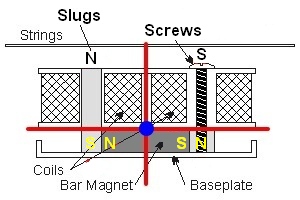
Note the magnet on the bottom in contact with the Screw and Slug poles. Note
how the bar magnet, slugs and screws all have a North and South pole.
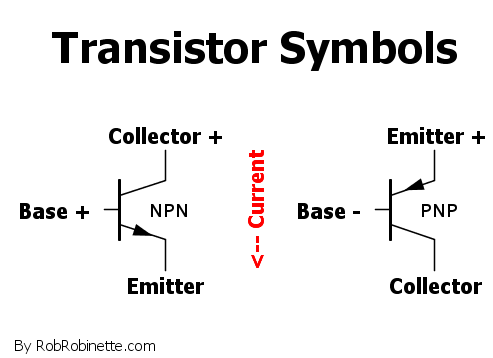
NPN transistor on the left, PNP on the right. A positive Base voltage on an NPN transistor will allow
current to flow through the resistor. A negative Base voltage on a PNP
transistor will allow current to flow.
Here’s two transistor circuits that look and function very much
like tube amp circuits. The first is the transistor common emitter
amplifier:
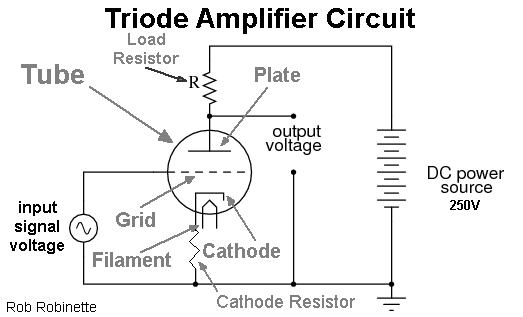

Tube triode amp circuit on the left, transistor common
emitter amp on the right. Remove transistor resistor R2 and this circuit looks
just like a tube amplifier stage. The two circuits serve the exact same purpose.
The big difference between the tube and transistor amp circuit
is the addition of resistor R2. Resistors R1 and R2
form a voltage divider which sets the bias voltage on the transistor’s base
(similar to a tube’s control grid). Resistors RC and
RE determine the amplifier gain and set the max current. Capacitor CE
is a standard bypass cap to boost gain. Capacitors C1 and C2 are
standard coupling caps.
Here’s the transistor emitter follower. It bears
an uncanny resemblance to a tube cathode follower:
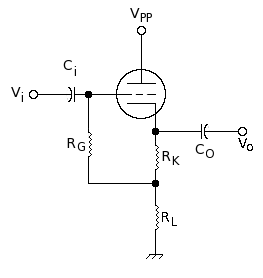
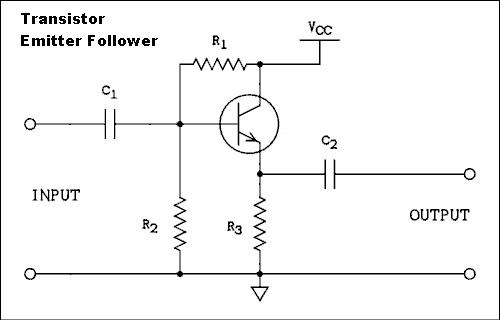
Triode tube cathode follower on the left, transistor
emitter follower on the right. Remove transistor resistor R1 and this
circuit looks just like a tube cathode follower. The two circuits serve the
exact same purpose.
Again, the big difference between the tube and transistor amp
circuit is the addition of resistor R1. Resistors R1
and R2 form a voltage divider which sets the transistor’s bias
voltage on the base (input). A
transistor emitter follower can be used as an easy to implement tone stack
buffer or effects loop buffer because they do not need a cathode heater.
How Voltage Dividers and Pots (potentiometers) Work
When I first got into electronics I had a hard time understanding voltage
dividers but they are really pretty simple. Understanding them is important
because a tube amp is full of them. Even tone controls and tone stacks can be
thought of as voltage dividers. The Soldano SLO-100 high gain amp uses five
voltage dividers to bleed off excess guitar signal to prevent harsh over-overdrive.
Classic Voltage Divider
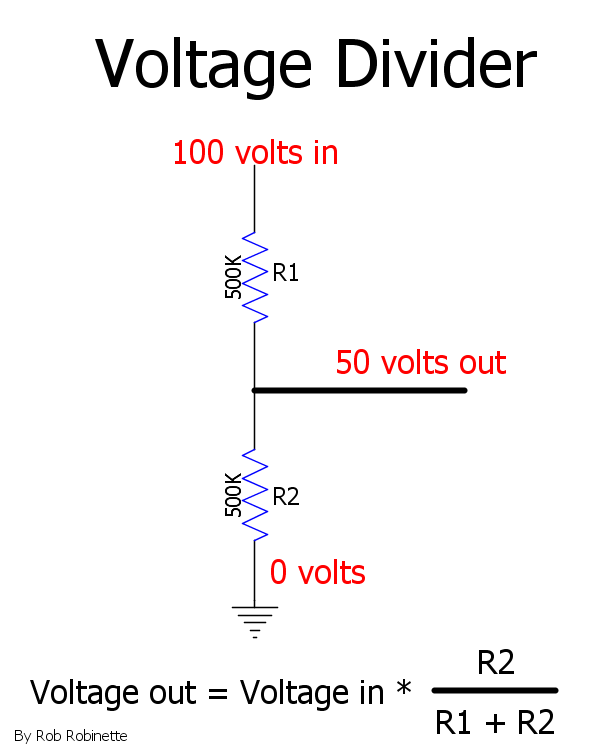
Note how there is 100 volts at the top of the resistors and 0 volts at the
bottom (ground). The resistance above the output is R1 and the lower is R2.
A voltage divider literally divides voltage. Take a look at the diagram above.
We have two 500k resistors with 100 volts at the top and 0 volts
(ground) at the bottom. If we tap the resistors at the top we get 100
volts, tap the resistors at the bottom and we get 0 volts. Now if we tap the resistors
at the middle, half way down at 500k, we will get half the voltage, 50 volts. Tap
higher and the voltage moves toward 100v, tap lower and the voltage goes down
toward 0 volts.
Note the equation at the bottom of the diagram above: The formula to
calculate the voltage out of a voltage divider is:
Voltage Out = Voltage In * resistance below the output / total resistance
We can calculate the
voltage out of the voltage divider by multiplying the Voltage in * R2 / (R1 +
R2).
For our voltage above we get: 100v * 500,000 / (500,000 + 500,000) = 100v *
.5 = 50 volts out.
The R2 / (R1 + R2) determines the ratio of the upper to lower
resistance. If you make the lower resistor smaller, more voltage will be bled to
ground so you will have less voltage out.
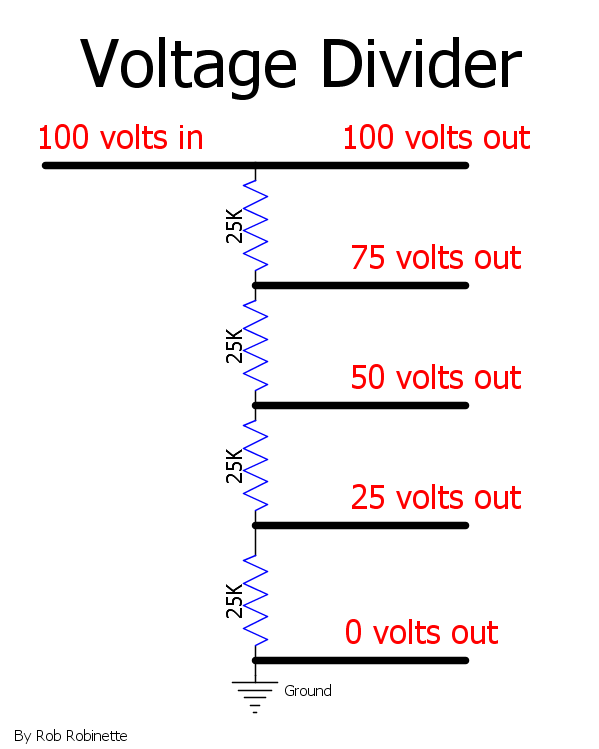
We have 100 volts at the top of this multi-resistor divider and 0 volts (ground) at
the bottom. We get lower voltages as we move down the
resistance.
If we make the top resistor in a two resistor divider 250k and the lower
resistor 750k we know less
voltage would be bled to ground so the output voltage would be higher: 100v *
750,000 / (250,000 + 750,000) = 100v * .75 = 75 volts out.
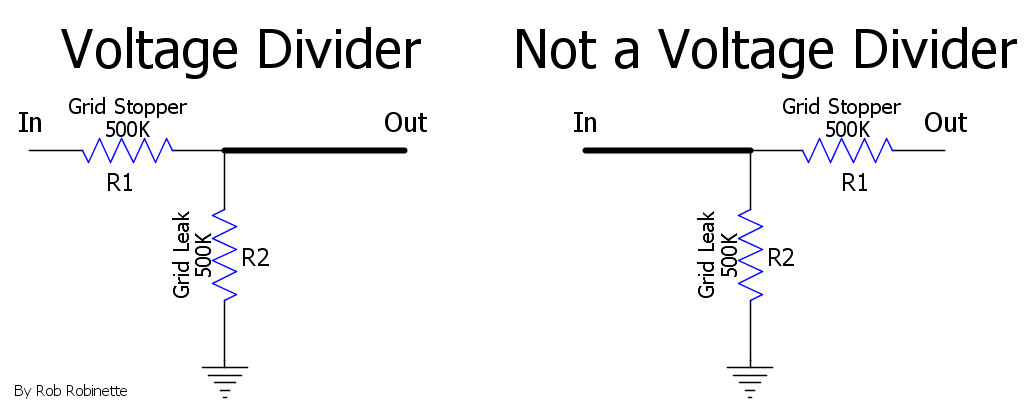
Note how the placement of the upper resistor is important. The circuit on the
right is not a voltage divider.
Treble Peakers are a special type of bright cap that bypass the upper
(attenuating) resistor in a voltage divider. By bypassing the upper resistor
high frequencies bypass the voltage divider and are not cut. A Treble Peaker cap acts
as a semi-active high frequency boost. In the voltage divider below the guitar
signal is cut in half except for high frequencies–they go around the divider
and are not cut so in effect high frequencies above the bright cap corner
frequency are doubled in volume compared to the rest of the guitar signal.
Treble Peakers are used in all high gain tube guitar amplifiers to give the amp
high gain sizzle. The Marshall JCM800 uses two 470pF Treble Peakers and the
Soldano SLO-100 uses a single .002uF Treble Peaker in the Overdrive Channel and
a tiny 120pF in the Clean Channel. A common mod in these amps is to remove a
Treble Peaker to cut ice pick highs.
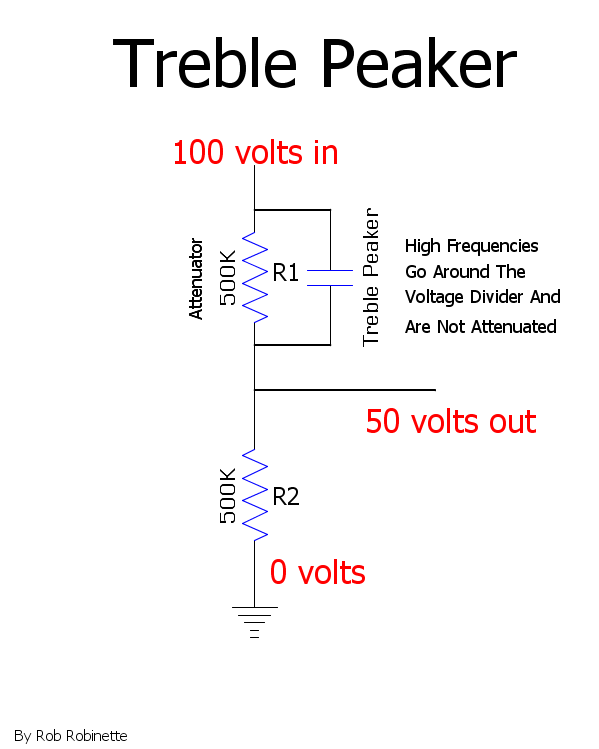
The Treble Peaker cap allows high frequencies to go around the upper resistor
so they are not cut by the voltage divider.
Here’s an online
Grid Stopper Calculator to calculate the frequency cutoff of a Treble
Peaker.
Potentiometers (pots)
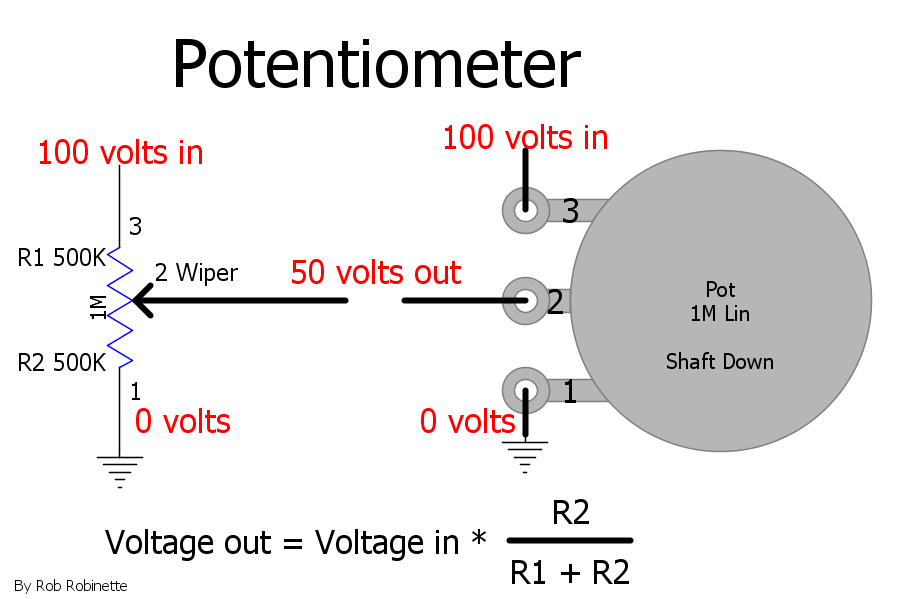
A potentiometer (pot) is simply a variable voltage divider. Schematic symbol
on the left, layout symbol on the right. Pot terminal numbers “1, 2, 3” are
shown on both symbols. The potentiometer got it’s name from voltage potential. “Shaft Down” means the pot’s knob shaft is pointing away
from you.
Now take a look at the pot diagram above. Look familiar? A pot is simply a
variable voltage divider. If we turn the voltage tap, or wiper, to the
top of the pot we get 100 volts, turn the wiper to the bottom and we get 0
volts (because it’s directly connected to ground). In the diagram the wiper is at 50% so there’s 500k above the wiper and
500k below the wiper so the input voltage is cut in half. Now we can tap
the voltage by placing the wiper anywhere between the 100 volts at the input, to
the 0 volts at the ground connection.
The formula to calculate the voltage out is the same as a voltage divider:
resistance below the wiper / total resistance. “R1” is the pot resistance
above the wiper
and “R2” is the resistance below the wiper on the ground side. For
example we turn the 1M linear pot 1/4 turn up from “off” we know that 1/4 of 1M
= 250k. That 250k is movement up from off or 0 volts so R2 = 250k and R1 would
be the rest of 1M or 750k. Voltage
out = 100v * 250,000 / (250,000 + 750,000) = 100v * .25 = 25 volts out.
Pot With Arrow

The downward arrow pointing to “CW” means the direction the wiper moves when
you turn the pot knob clockwise or “up.” If “CW” is not shown then assume the arrow
points in the clockwise direction. If there is no arrow you can assume that the
wiper moves upward when you turn the pot clockwise.
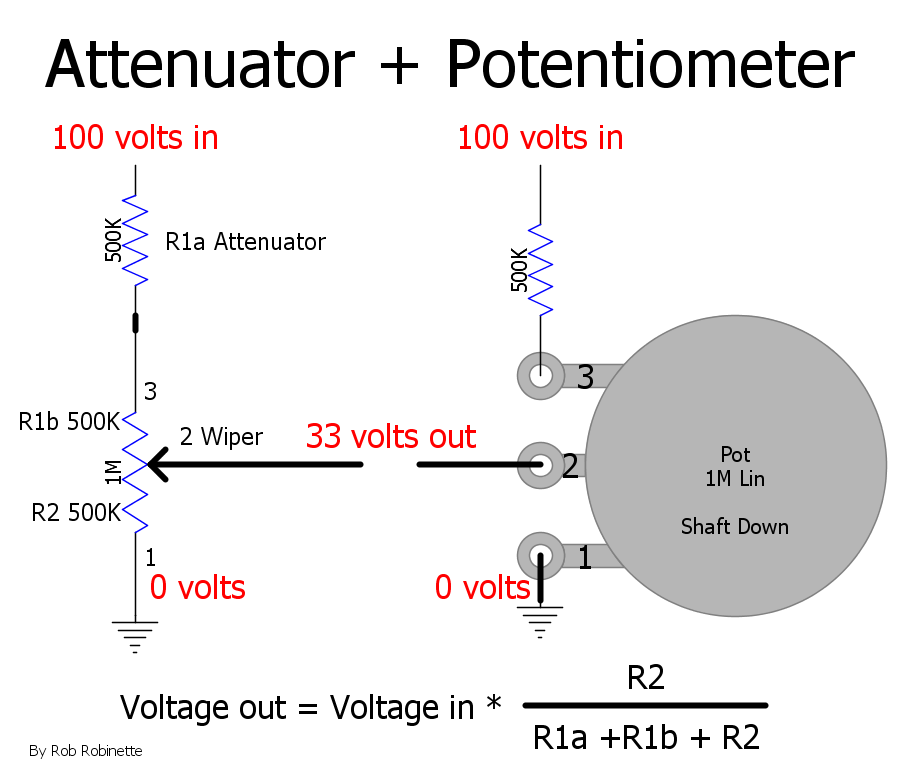
Attenuator resistor (R1a 500k) added to a volume pot to reduce max volume. The
R1a resistance is added to the pot’s “above the wiper” resistance so it adds
attenuation (cuts the max guitar signal out). With
the pot set to the mid point with 500k + 500k above the wiper and 500k below the wiper
gives us a 66% cut in the guitar signal compared to a
50% cut without the attenuation resistor. With the pot set to max the attenuator
resistor will still cause a 33% cut in guitar signal. This simple circuit
can be used in high gain preamp circuits to control excess gain. If needed, a bright cap
can be placed in parallel with the attenuator resistor to allow high frequencies
to go around the resistor and keep the attenuator resistor from
darkening the amp’s tone. The formula to calculate the voltage out is the
same as a voltage divider: resistance below the wiper / total resistance.
Capacitive Voltage Dividers
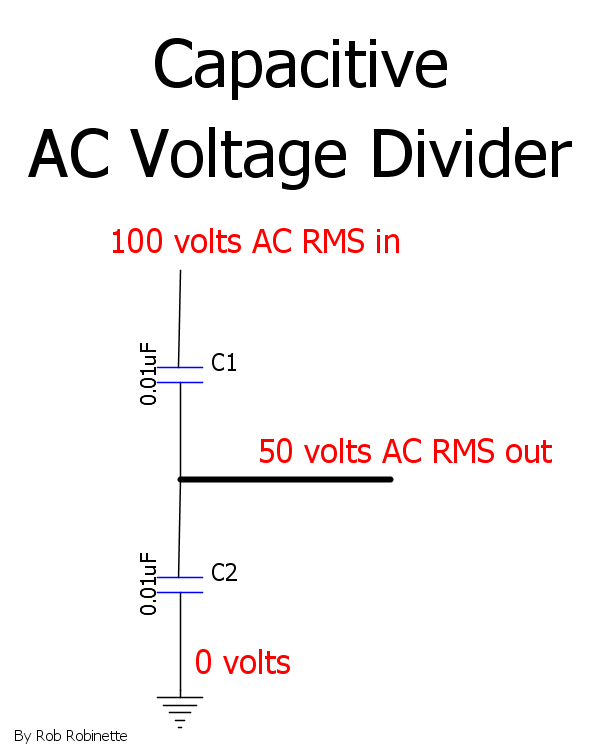
Resistance based voltage dividers work the same with AC or DC voltage but we can put two capacitors in the same configuration as the R1 and R2 resistors
above and form a capacitive voltage divider that divides AC voltage. The
capacitors block DC voltage and current so only AC voltage is divided.
Rob Hull’s Easy to Use Resistor Color Code Reader
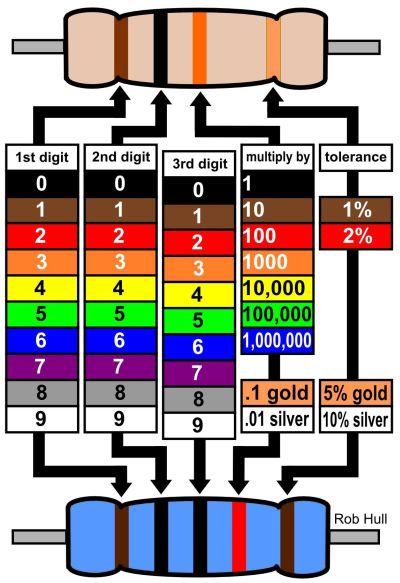
Note the 3-band resistor on top and 4-band on the bottom.
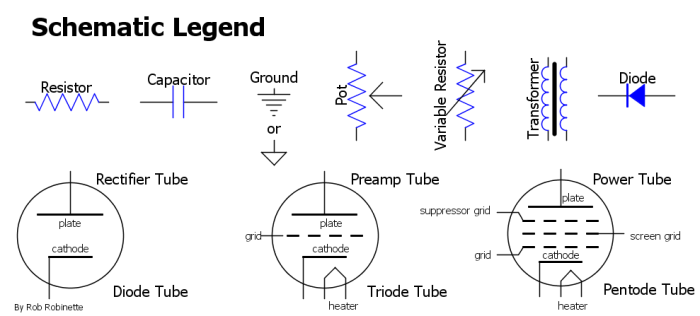
Common amp electronic component symbols. This is pretty much all you need to
know to read tube amp schematics.
The first time I saw the equation for calculating the resistance of resistors
in parallel I had a mental meltdown. It actually stopped me in my tracks as
I attempted to self-learn electronics back in high school. Then I discovered the
calculator’s 1/x
or inverse key that made this equation super simple.
Let’s say you have three resistors in parallel: R1 is 100 ohms, R2 is 200 ohms
and R3 is 300 ohms.
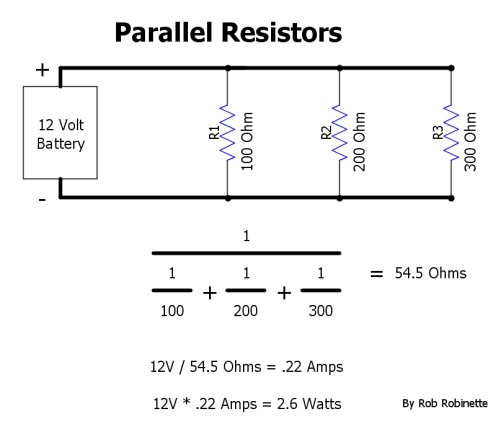
Circuit total resistance = 54.5 ohms. Using Ohm’s Law current = .22 amps,
power = 2.6 watts.
This would be the key sequence on the calculator
100 1/x
+ 200 1/x
+ 300 1/x
= 1/x
Don’t forget that last 1/x
key, it’s for the 1/ on top of the equation. 54.5 ohms should be showing on
the calculator screen when you hit that last
1/x
key. Give it a try right now, open your computer’s on screen calculator and
follow the key sequence.
The Windows built-in
calculator has a 1/x
key. If the 1/x
key is not showing when you open the Windows calculator select “Scientific” then click on the
↑ (Up Arrow) key and you will see the 1/x
key.
I have seen many amps “repaired” with new resistors because the owner/builder
measured resistors’ resistance and replaced them due to what they thought was
component value drift.
Your multi-meter applies a very low level DC voltage and
current to a resistor in order to measure its resistance. The problem is when
you try to measure resistance with the resistor in an amp or “in circuit” there
is often a “back door” path for your meter’s current flow that will cause an
inaccurate resistance measurement.
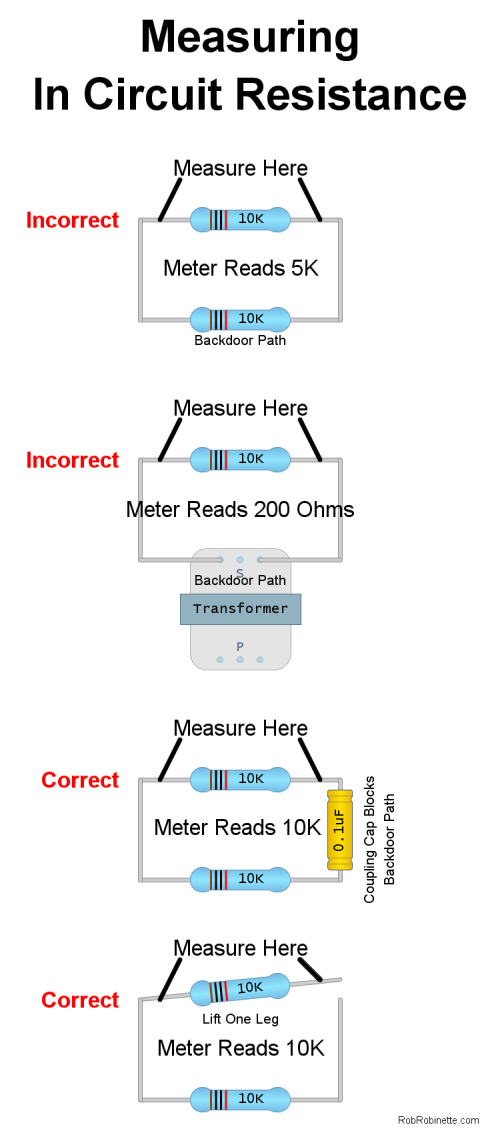
The first two circuits have two paths for the meter’s test current so
measured resistance is much less than expected. In the third circuit a cap
blocks current flow so an accurate reading is taken. “Lifting a leg” in the last circuit
also
ensures an accurate measurement.
The key to knowing when an in circuit measurement will be true is being able
to read the schematic so you can follow the “back door” path(s) to see if it
will cause inaccuracy. An unpowered tube grid, plate and cathode are “dead
ends” that will not pass current. Capacitors are also dead ends that will not
allow DC current to flow. Typical transformer windings have from 0.5 to 300 ohms
of resistance so they do provide a back door. To be sure you can always unsolder
one end of a resistor to get an accurate measurement.
Ohm’s Law Pie Chart
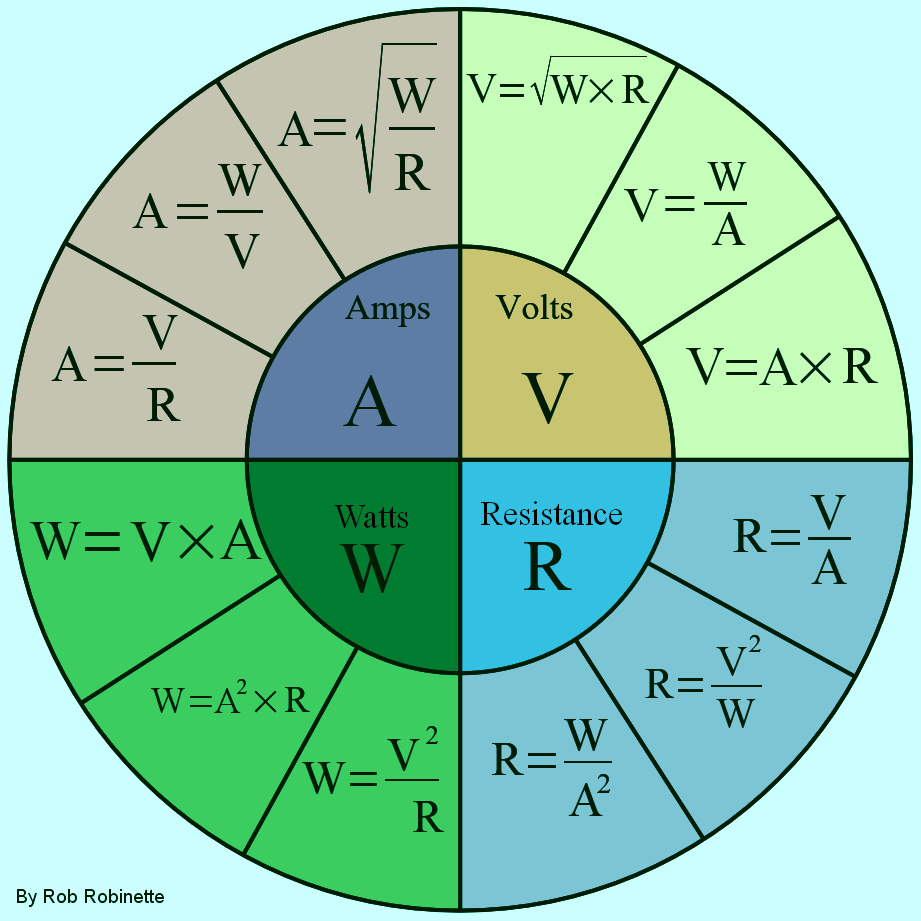
It may be easier for you to remember this stuff using A, V, R and W for
Amps, Volts, Resistance and Watts in
these equations. For example the lower left Watts section shows three
ways to calculate power: Volts * Amps or Amps squared * Resistance or Volts
squared / Resistance.
Ohm’s Law “Rules of Thumb”

Memorize “VAR” for Volts Amps Resistance and you can remember Ohm’s
equations. Place your thumb over what you want to know and the equation is
shown. Example 1: You want to know volts, place your thumb over V and “A R” is
left so Amps*Resistance=Volts. Example 2: You want to know amps, place your
thumb over “A” and and “V over R” is showing so Volts/Resistance=Amps

Here’s WVA for Watts, Volts, Amps. Example: You want to know watts, place
your thumb over “W” which leaves “V A”, so Volts*Amps=Watts.
Ohm’s Law Spreadsheet
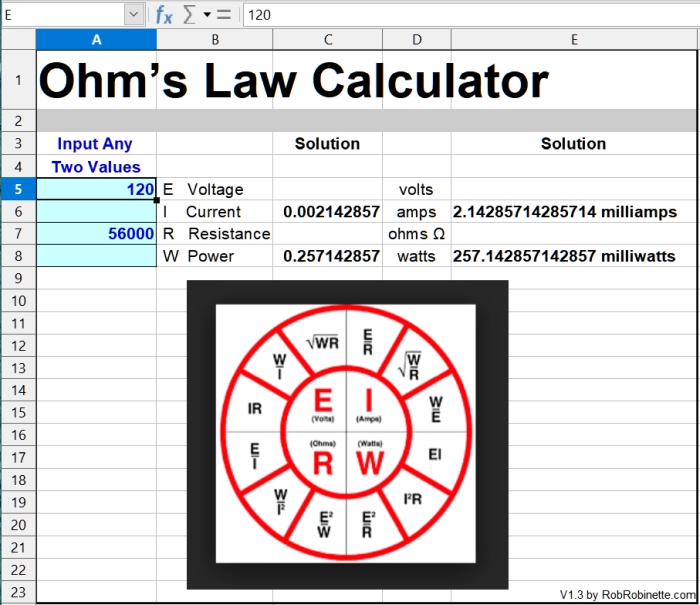
Simply enter two values of volts, amps, ohms and watts. If three or
four values are entered some of the calculations will be incorrect. Download the
Ohm’s Law Excel Spreadsheet
or the Libreoffice version.
To format spreadsheet cells for engineering notation use this format code:
##0.000E+##
The “Engineering Mode” available in Excel spreadsheets, scientific calculators (including
the Windows built-in scientific calculator) and mathematic
software is made to make keeping track of micro, nano, pico, kilo and mega much
easier during calculations. Engineering Mode is like scientific mode, which uses
exponents for very large and very small numbers, but the exponent is always a
multiple of three which fits this chart nicely:
|
Prefix |
Name |
Value |
Calculator |
|
M |
mega |
10^6 |
E6 |
|
k |
kilo |
10^3 |
E3 |
|
m |
milli |
10^-3 |
E-3 |
|
u |
micro |
10^-6 |
E-6 |
|
n |
nano |
10^-9 |
E-9 |
|
p |
pico |
10^-12 |
E-12 |
Notice how all the exponents are multiples of 3? The exponent
tells you how many places to shift the decimal point. A negative exponent means
we shift the decimal point to to the left to make the number smaller. A positive
exponent means we shift to the right for a larger number. With 47E-6 we would shift
the decimal point 6 places left to give you .000047
250pF would be shown in the calculator as “250E-12”
(see chart, read E-12 as pico)
32 milliamps
would be shown as “32E-3”
56K would be “56E3” and 1M would be “1E6”
Suppose you want to determine the cutoff frequency of a high
pass filter and need to multiply 1M resistance by 250pF.
Instead of entering “1,000,000 * .000,000,000,250 for 1M and 250 pico Farads you would simply enter
1
EEX
6
x
2
5
0
EEX
1
2
+/-
=
The EEX
key is the “enter exponent” key and the
+/- key is the “change sign” key to make the exponent negative. The
calculator will show “250E-6” so read the “E-6” as micro.
When you multiply 1E6 * 250E-12 the calculator will show the
answer as 250E-6. We know E-6 means micro so the answer is 250uF.
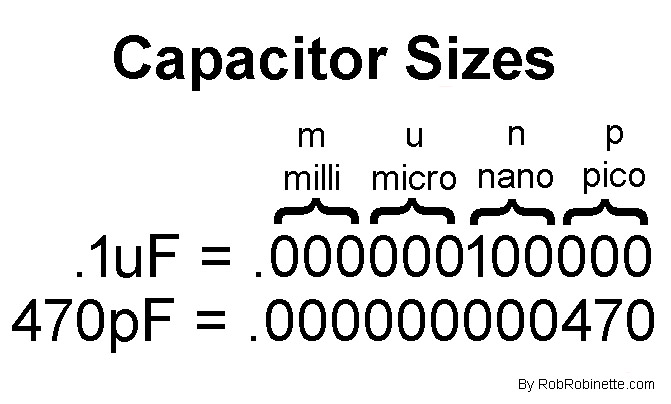
.1uF = 100nF so it would be shown in the calculator as “100E-9” and 470pF as
“470E-12”
On HP calculators press the Mode
button to select the Engineering Mode.
To format Excel spreadsheet cells to use engineering notation use this format
code: ##0.000E+00
Have comments or corrections? Email rob at:

By Rob Robinette
Suggested follow on reading:
How Tubes Work How electrons flow
through a vacuum tube.
How to Read Tube Amp Schematics
It’s easier than you think.
How the Fender 5E3 Deluxe tube
amplifier works
5E3 Deluxe Modifications
How to Draw Tube Load Lines
Deluxe Models from the Woodie
to the 68 Custom Deluxe Reverb.
Fender 5F6A Bassman Information and
Modifications
How the Fender blackface AB763
Deluxe Reverb Works
AB763 blackface Modifications
AB763 Model Differences What’s the
difference between a blackface Vibroverb, Vibrolux and Super
Reverb?
How the Marshall JCM800 works
How the TMB Tone Stack Works
It looks like a simple tone circuit but it’s not.
How Fender Input Jacks Work
Bright, Normal, High, Low: it’s an elegant circuit.
By Rob Robinette
References
RCA Corporation,
RCA Receiving Tube Manual,
RC30.
Merlin Blencowe,
Designing Tube Preamps for Guitar and Bass, 2nd Edition. This is my personal
favorite tube amp book.
Merlin Blencowe, Designing
High-Fidelity Tube Preamps
Morgan Jones,
Valve Amplifiers, 4th Edition.
Richard Kuehnel,
Circuit Analysis of a Legendary Tube Amplifier: The Fender Bassman 5F6-A,
3rd Edition.
Richard Kuehnel,
Vacuum Tube Circuit Design: Guitar Amplifier Preamps, 2nd Edition.
Richard Kuehnel,
Vacuum Tube Circuit Design: Guitar Amplifier Power Amps
Robert C. Megantz,
Design and Construction of Tube Guitar Amplifiers
Neumann &
Irving,
Guitar Amplifier Overdrive, A Visual Tour It’s
fairly technical but it’s the only book written specifically about guitar
amplifier overdrive. It includes many graphs to help make the material
easier to understand.
T.E. Rutt,
Vacuum Tube Triode
Nonlinearity as Part of The Electric Guitar Sound
[ Reading Amp Schematics ] [
Draw Tube Load Lines ] [
TMB Tone Stack ] [
Death Cap ]
[ Widowmakers ] [
How the 5E3 Deluxe
Works ] [
Deluxe Models ] [
DRRI & 68 CDR Mods ] [
My 5E3 Build ] [
The Trainwreck Pages ] [ Fender Input Jacks
] [
B9A Prototype Boards ]