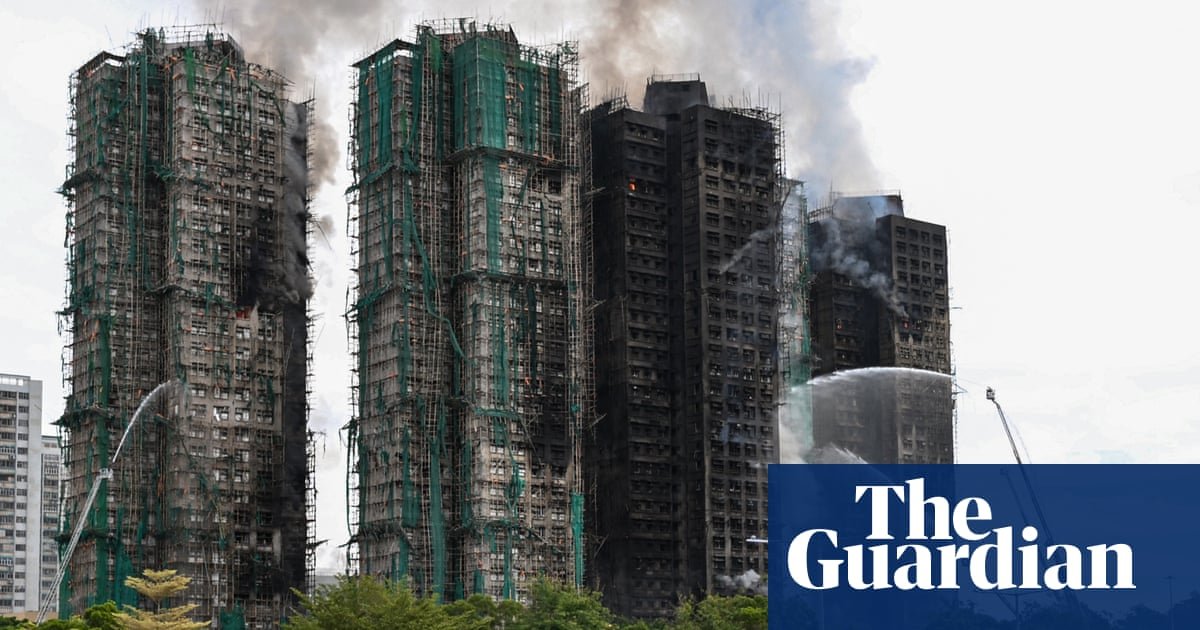
Hong Kong police have alleged that unsafe scaffolding and foam materials used during maintenance work may have been behind the rapid spread of a devastating fire at a group of residential tower blocks that has killed at least 44 people and left nearly 300 missing.
Firefighters are still struggling to reach residents who may be trapped on the upper floors of the Wang Phuc Court housing complex due to the intense heat and thick smoke generated by the fire on Thursday.
The death toll from Wednesday’s fire has reached 44, with 45 people in hospital in serious condition, officials said Thursday, making it Hong Kong’s deadliest fire in decades. In 1962, a fire swept through several buildings in the Sham Shui Po neighborhood, killing 44 people.
It appears that the fire was largely extinguished by Thursday afternoon. Earlier, officials had said that they have brought the fire under control in four blocks, while operations are underway in three blocks.
A taskforce has now been formed to investigate the cause of the fire at the site in Tai Po district, which is made up of eight 31-storey towers containing about 2,000 flats, housing about 4,800 people. Renovation work was going on at the site at that time.
Hong Kong Police Superintendent Eileen Chung alleged on Thursday, “We have reason to believe that the responsible parties of the company acted with gross negligence, which led to this accident and the uncontrolled spread of the fire, resulting in a large number of casualties.”
Three people from the construction company, two directors and an engineering consultant, were arrested, Chung said, without giving further details.
Chung did not reveal the name of the company but police later on Thursday searched the office of Prestige Construction and Engineering Company. According to local media, police have seized boxes of documents as evidence.
Separately, the government identified the registered contractor for the building complex as Prestige Construction and Engineering Company. Noting the need for use of fire retardant nets and screens on scaffolding, a statement said: “If any violation of the requirements of the Building Ordinance is found, the case will be referred to the BD (Building Department) for dealing with it as per the Ordinance including prosecution or disciplinary proceedings.”
According to the Associated Press, Prestige’s phone was not ringing.
Police alleged that the buildings were covered with protective mesh sheets and plastic that could not meet fire standards, and discovered that some windows on an unaffected building were sealed with foam material, which had been installed by a construction company performing maintenance work.
However, the fire had spread to the bamboo scaffolding around the building, and was likely caused by windy conditions. Bamboo scaffolding is a ubiquitous sight on Hong Kong construction sites, although the government has said it is being phased out for safety reasons.
The latest fire has prompted comparisons to Grenfell Tower which killed 72 people in London in 2017. That fire was blamed on failures by the firms that fitted the exterior with flammable cladding, as well as the government and construction industry. The three companies that were heavily criticized in the findings of the Grenfell inquiry last year have all denied wrongdoing.
Hong Kong’s chief executive, John Lee, told reporters: “The priority is to extinguish the fire and rescue trapped residents. The second is to support the injured. The third is to support and recover. Then, we will launch a thorough investigation.” He said that about 279 people could not be contacted and 900 people were in eight shelters.
Authorities in Tai Po district have opened shelters in local community halls, at least one of which was filled by Wednesday night, and police have set up a casualty hotline.
Several forums and campaign events scheduled in the coming days related to the December 7 elections have also been canceled.
On Wednesday night, dozens of stunned residents, many of them crying, watched as smoke billowed from the complex from nearby sidewalks.
A 71-year-old resident surnamed Wong began crying, saying his wife was trapped inside.
Another longtime resident, a woman surnamed Chu, said she still had not been able to contact her friends living in the next block. After staying at a friend’s house on Wednesday night, the 70-year-old woman returned to find her house still burning. “We don’t know what to do,” she said.
“It’s heartbreaking. We’re worried that there are people trapped inside,” a Tai Po resident, who gave his surname as So, told Agence France-Presse near the scene. “Nothing can be done about the property. We can only hope that everyone, whether old or young, returns safely.”
Harry Cheung, 66, who has lived in Block 2 of a complex for more than 40 years, said he heard a loud noise at about 2.45am (6.45am UK time) and saw a fire erupting in a nearby block. “I immediately went back to pack my things,” he told Reuters. “I don’t even know how I feel right now. I’m just wondering where I’m going to sleep tonight because I probably won’t be able to go back home.”
China’s state broadcaster CCTV said Chinese leader Xi Jinping urged “all-out efforts” to extinguish the fire and minimize casualties and damage, as residents expressed anger online over the possible causes of the fire.
A video shows several construction workers smoking on bamboo scaffolding around a block of the complex during the renovation process.
Building standards in Hong Kong are relatively high and have improved significantly in recent decades, but the Association for the Rights of Industrial Accident Victims, a local advocacy group, has expressed deep concern about scaffolding-related fires, noting similar incidents in April, May and October.
Although fire danger was not cited as a reason for phasing out bamboo scaffolding, at least three fires involving bamboo scaffolding have occurred this year, according to the Association for Industrial Accident Victims’ Rights in Hong Kong.
Wang Fuk Court is one of several high-rise housing complexes in Hong Kong, one of the most densely populated areas in the world. Tai Po, located near the border with mainland China, is an established suburban district with approximately 300,000 residents.
According to estate agency websites, the complex, which has been occupied since 1983, is under the government’s subsidized home ownership scheme. It has been undergoing renovation for a year at a cost of HK$330m ($42.4m), with between HK$160,000 and HK$180,000 being paid for each unit, according to online posts.
with reuters
<a href