This is the story of how Honda engineers screwed up a big
expensive project with a simple arithmetic mistake, tried to
fudge their result with sound editing software, and
congratulated themselves for being totally awesome.
When I was a kid, my family used to drive up to The Pinery
in Ontario, a beautiful park by Lake Huron. Very scenic.
My favorite part, though, was a stretch of road a half-hour
outside of the park. To discourage reckless Canadians from
barreling past the houses and barns, the local government
carved five sets of grooves in the road before every stop
sign. Drive over them, and the car would
vibrate: “vbvbvbvb… vbvbvbvb… vbvbvbvb… vbvbvbvb… vbvbvbvb.”
The faster you drive, the higher the pitch.
My Dad is a
musicologist, with a
particular
interest
in
tuning.
So there was no way he was going to pass up the
chance to experiment with this instrument. Every time we
approached some grooves, he’d start fast over the first set,
and try to slow down by the last set, to play a descending
scale: G-F-E-D-C. If there was no oncoming traffic after
the stop sign, he’d swing over to the other side of the road
and play an ascending scale as we sped up.
Ratios of speeds correspond to ratios of vibration
frequencies, which correspond to intervals between notes.
To play an ascending scale C-D-E-F-G, you need to drive at
these ratios to your starting speed: 1 – 9/8 – 5/4 – 4/3 -
3/2 (for example, 24 – 27 – 30 – 32 – 36 mph).
1
Playing a scale with a ’95 Toyota Previa is not easy. The
notes tend to come out a little wonky — we’d get the
half-step between E and F too wide, and with not enough
space between F and G. It usually sounded kinda
modal… but still awesome.
Professionals?
So imagine my delight when I heard about
this musical
road [CNET] that Honda built in Lancaster, CA.. A team
of engineers carved some grooves into a highway that were
carefully spaced to play
the William
Tell Overture as you drive over them at a constant
speed. Awesome, right? The problem is,
it’s spectacularly out of tune.
Here’s the original melody:
And here’s the Honda road again:
The Honda version isn’t simply out of tune… the notes are
just wrong. The original starts with a rising 4th,
F-B♭,2 and
eventually reaches an octave above the starting note before
descending to the tonic F-E♭-D-B♭.3
But Honda’s version starts with a
rising major 3rd, and its top note is a major 6th above the
starting note. Some might have noticed that the last few
notes in Honda’s commercial sound OK. That’s because they
edited over them! I can prove it.
Basic melody in the William Tell Overture (schematic)
The CNET article above speculates that Honda designed the
road specifically for the Honda civic driving at the speed
limit, and other cars might need to drive at a different
speed to make it sound better. But if you’re going at a
constant speed, all that matters is the spacing between
grooves. Speeding up or slowing down just transposes
everything. It would be theoretically possible to “correct”
the melody by driving at different speeds (like on the road
to the Pinery). But the notes on the musical road are too
closely spaced for all but consummate musician Mario
Andretti.
It also doesn’t matter what car you drive.4
The vibration frequency is f = v/d, where v is the car’s
speed, and d is the distance over which the road pattern
repeats. There’s no place in the equation for wheel
spacing, tire size, side-impact airbags, etc. All of these
things affect the quality of the sound, but not the pitch.
So why is the musical road so unmusical?
The Error
Honda posted a series of 5 ridiculous videos:
[Part 1][Part 2][Part 3][Part 4][Part 5],
in which they talk about all the hard work they did and
congratulate themselves for being so awesome. There are
lots of complicated sounding numbers, there’s a
“Mathematician/Musician,” and plenty of experts. I’m sure
some people behind the project understood what was going on.
But I think they failed to anticipate a basic
misunderstanding on the part of the groove-designers.
In the fourth “making of” video, they mention that the
initial note, a low F, has a spacing of 4 inches (4in)
between grooves (1:47):
From the video, it looks like the grooves themselves are
about 1in wide. Now, suppose you want to make the B♭
a 4th above F. A perfect 4th is a fequency ratio of 4/3, so
you should multiply the width by a factor of 3/4… But the
width of what?
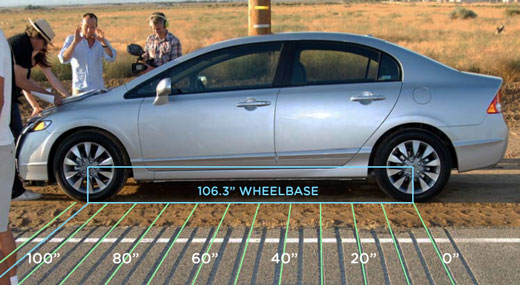
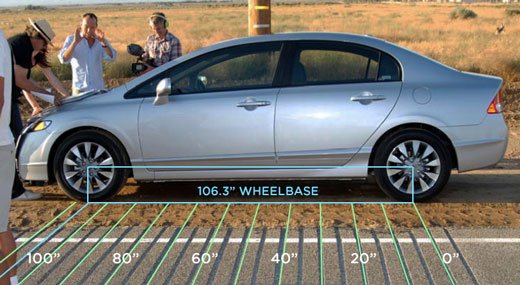
Based on the Civic’s 106.3 inch wheelbase, we can see from
this picture that s+g is about 5 inches. Honda says the
lowest note has a 4 inch spacing, so that’s consistent
with 1 inch grooves.
The width that really matters is the total width of the
spacing plus groove (s+g). That’s the distance over which
the road pattern repeats, so that’s the distance over which
the car completes one vibration.5
Suppose you didn’t know this, and only changed the spacing,
from s = 4in to s’ = 3/4 × 4in = 3in. Then the
frequency ratio is (s+g)/(s’+g) = (4+1)/(3+1) = 5/4, a major
3rd, not a perfect 4th. What about the octave above the
starting note? An octave is a frequency ratio of 2/1, but
if you only changed the spacing to s’ = 1/2 × 4in =
2in, you’d get an actual ratio of (s+g)/(s’+g) = (4+1)/(2+1)
= 5/3, a major 6th, not an octave.
Oops.

making an octave, incorrectly
There are two ways you could correct this problem:
-
Adjust the groove width g as well as the spacing s. For
instance, to make an octave, use a spacing s’ = 2in and a
groove g’ = .5in, giving a fequency ratio (s+g)/(s’+g’) =
5/2.5 = 2/1. This is probably hard with typical cutting
tools. Also, the engineers may have found that they need
to make the grooves bigger than some minimum width to get
a good sound. So on to method 2… -
Over-adjust the groove spacing so that the total g+s is
correct. For instance, to make an octave, adjust the
groove spacing to s’ = 1.5in, so you get a frequency ratio
of (s+g)/(s’+g) = 5/2.5 = 2/1.

making an octave, correctly
The Coverup
Armed with this theory for why the musical road sounds so
bad, I crunched some numbers in Mathematica, and was able to
reproduce Honda’s result, sort of…
Here’s Mathematica playing the correct William Tell Overture:
And here’s Mathematica programmed to make the mistake I
think Honda’s engineers made:
And here’s honda’s commercial version again:
Notice that a few notes in the commercial sound different
from Mathematica’s version. Particularly at the end.
Honda’s last few notes are sort of… in tune! Turns out
that’s a bit of Hollywood magic. Here’s a recording I stole
from
a different
video of someone driving down the Musical Road:6
What happened to the ending? It’s all funky again. Go back and listen to the Mathematica version that mimics Honda’s mistake. Same funky ending.7 Whoever put together the Honda commercial must have edited over the ending, assuming that as long as the last few notes were correct, no one would notice anything wrong.8
What I don’t understand is: if they were going to doctor the
sound, why didn’t they just correct the whole thing? It’s
not that hard. My dad did this version in about 20 minutes:
Aftermath
I learned something else kind of ridiculous from this
analysis: if Honda didn’t doctor the overall pitch of the
melody in their commercial, then they were speeding. The
opening frequency is about 238Hz, which corresponds to a
speed of about 67mph if the road pattern repeats over 5in.
But they mention in one of the videos that the speed limit
is 55! Crap.
In fact, in this
youtube video, where they explicitly state they’re
going 55mph, the melody starts a minor third below the
Honda commercial. A minor third is a frequency ratio
of 6/5, so this is consistent with Honda’s driver
doing 6/5 × 55mph = more than 10mph over
the speed limit…
Another funny point is that some of the intervals you get
from Honda’s miscalculation are pretty bizarre. The D, a
major 6th above the starting F, should have a frequency
ratio of 5/3 above the starting frequency.
Instead, it has a ratio 5/(4 × 3/5+1) =
25/17. This isn’t really in the western scale. It’s
about 2/3rds of the way between an augmented 4th and a pure
5th. Microtonal composers
like Easley
Blackwood might have found a use for it, but I don’t
think it’s what Honda was after.
If I were them, I’d seriously consider paving over the road.
In fact, it seems like some local
residents might
do it for them. There is another option, though. If
they bring in the bulldozers, and shuffle around a few
chunks of asphalt at the end of the road, they might get a
decent rendition of “When The Saints Go Marching In.”
Update [12/30/08]: Added picture comparing grooves to Civic wheelbase
Update [5/2/11]: I am both sorry and delighted to hear that
they rebuilt the musical road (see,
e.g., here),
and they fixed nothing. Here it is on April 28, 2011:
Just… wow.
Update [4/15/18]: This post was recently featured on Tom
Scott’s Youtube Channel “Amazing Places.” As of today, the
video currently has about 5 million views. It was also
mentioned
in The
New York Times.