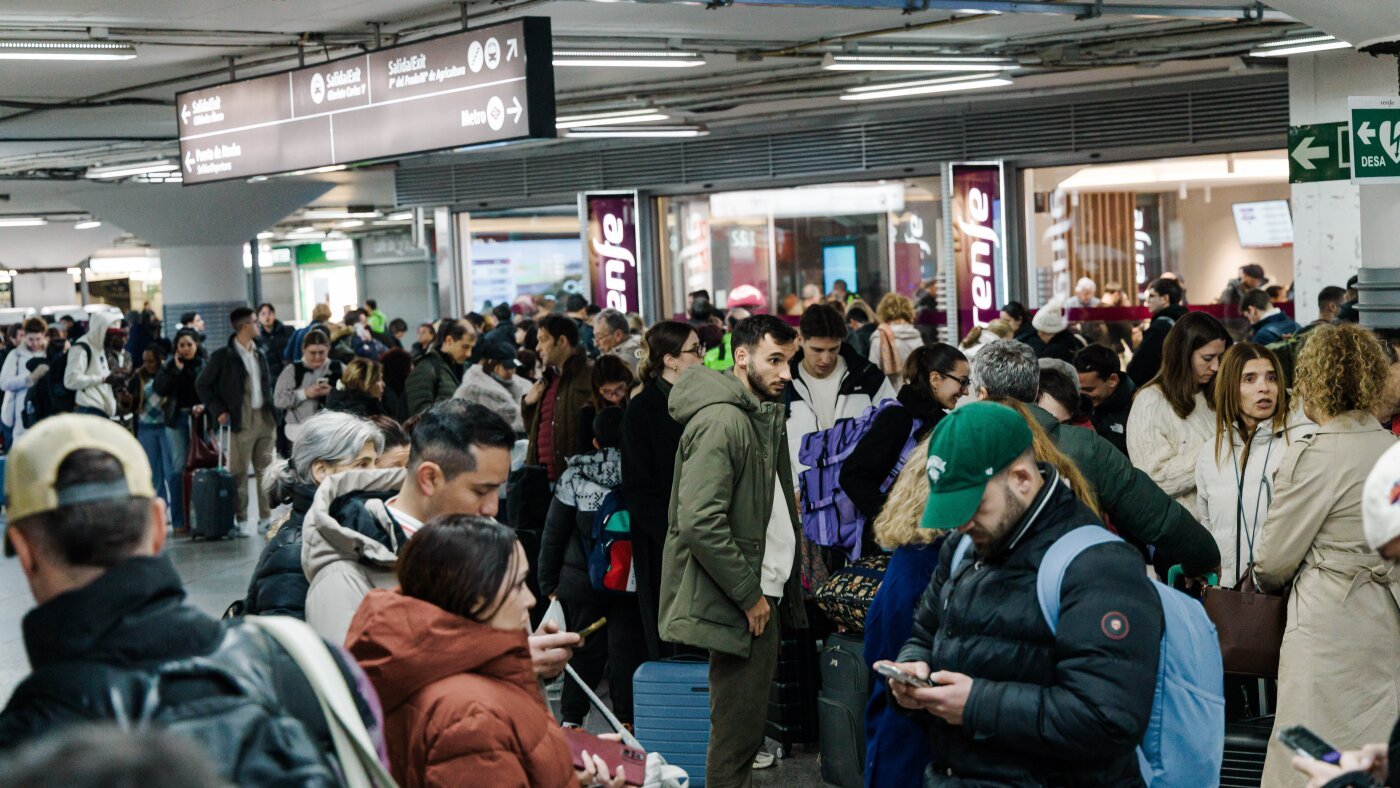

Passengers wait in the hall of a Madrid train station on Sunday after the suspension of service was announced due to a train collision.
Carlos Lujan/Europa Press via AP
hide caption
toggle caption
Carlos Lujan/Europa Press via AP
BARCELONA, Spain — A high-speed train derailed in southern Spain on Sunday, jumped onto tracks in the opposite direction and collided with an oncoming train, killing at least 21 people and injuring dozens of others, the country’s transport minister said.
The rear of an evening train with about 300 passengers between Málaga and Madrid derailed near Córdoba at 7:45 p.m. local time and collided with a train with about 200 passengers traveling from Madrid to Huelva, another southern Spanish city, according to rail operator Adif.
Spain’s Transport Minister Oscar Puente put the death toll at 21 just after midnight when he said all survivors had been evacuated. But Puente said more victims had yet to be confirmed.
Puente said the cause of the crash is unknown. He called it “a really strange” incident because it occurred on a flat section of track that had been renovated in May. He also said that the train that derailed was less than four years old. That train belonged to the private company Ireo, while the second train which suffered the consequences was Spain’s public train company Renfe.
Ierio issued a statement saying it was “deeply saddened by what has happened” and that it was working with authorities to manage the situation.
According to Puente, the rear of the first train derailed and collided with the second train, causing its first two bogies to derail and fall down a four-metre (13-foot) slope. He said the most damage was caused to the front part of the Renfe train.
When reporters asked him how long it might take to investigate the cause of the accident, he said it could take a month.
Antonio Sanz, Andalusia’s regional health chief, said 73 injured passengers were taken to six different hospitals.
Cordoba fire chief Francisco Carmona told Spanish national radio RNE that one of the trains was badly damaged and at least four wagons were derailed.
The situation at the crash site is “very serious,” Sanz said. “We have a very difficult night ahead of us.”
Salvador Jimenez, a journalist for Spanish broadcaster RTVE, was aboard one of the derailed trains and told the network by phone that “there was a moment when it felt as if there had been an earthquake and the train had actually derailed.”
He said passengers used emergency hammers to break windows, and some walked away without serious injuries. Videos from people at the site showed some people crawling out of windows to escape the debris and vehicles tilted at an angle.
The incident occurred in the evening and hundreds of survivors had to be rescued in the dark.
Regional civil protection chief María Belen Moya Rojas told Canal Sur that the accident occurred in an area that is difficult to access.
He said local people were taking blankets and water to the spot to help the victims.
High-speed trains running on an extensive national network are a popular way to travel in Spain.
Spain’s military emergency relief units joined the deployment of other rescue units. The Red Cross also provided assistance to health care officials.
European Commission President Ursula von der Leyen said in a post on Twitter that she was following the “terrible news” from Cordoba.
“You are in my thoughts tonight,” he wrote in Spanish.
ADIF said train services between Madrid and cities in Andalusia would not run on Monday.
<a href