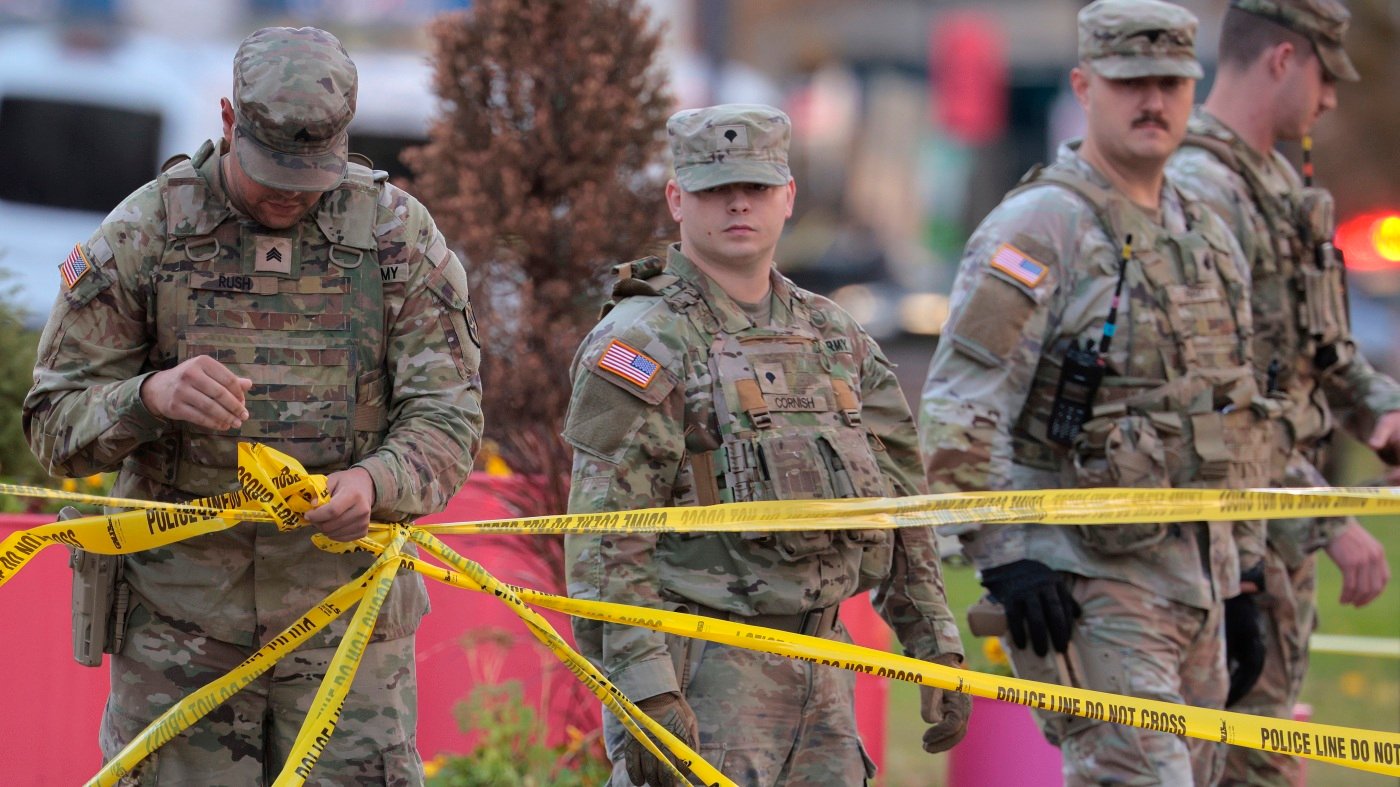

National Guard members responded to the shooting of two West Virginia Guard members near the White House on Wednesday.
Chip Somodevilla/Getty Images
hide caption
toggle caption
Chip Somodevilla/Getty Images
Two members of the West Virginia National Guard, deployed to Washington, D.C., are in critical condition after being shot while on patrol Wednesday afternoon, a short distance from the White House.
CIA Director John Ratcliffe said in an email statement Thursday that the shooter involved in the attack, who came to the US from Afghanistan in 2021, was admitted to the US “due to his prior work with the US government, including the CIA.”
The attack comes as President Trump has deployed the National Guard to several cities across the country, including the nation’s capital, in recent months – a pattern that has been controversial, and challenged in the courts.
Here’s what we know so far:
Officials say it was a “targeted” attack
According to Jeffrey Carroll, acting assistant chief of the Metropolitan Police Department, the shooting occurred around 2:15 a.m. Wednesday.
Speaking at a news conference on Wednesday, Carroll said the gunman came around a corner and opened fire on Guard members while they were on patrol.
Nearby guard members then overpowered the gunman, who was shot, and took him into custody. Police said it was not immediately clear who shot the gunman.
DC Mayor Muriel Bowser described it as a “targeted” attack.
Earlier on Wednesday, Trump wrote on Truth Social, “The animal that shot two National Guardsmen… is also seriously injured, but regardless, he will pay a very high price.” The President was in Florida at the time of the shooting.
The suspected shooter came to America from Afghanistan
In a video address posted on White House social media, Trump said the shooter had come to the US from Afghanistan in 2021.
The Department of Homeland Security later identified the shooter as Rahmanullah Lakmal, and said he came to the US as part of a Biden administration program called Operation Ally’s Welcome, which allowed thousands of Afghans to enter the country after the Taliban recaptured power in Afghanistan in 2021. Those people came in on a two-year grant of parole, then later had to apply for other ways, such as asylum, and undergo rigorous screening to stay in the country permanently.
In his statement, the CIA’s Ratcliffe said: “In the wake of the disastrous Biden withdrawal from Afghanistan, the Biden Administration justified bringing the alleged shooter to the United States in September 2021 because of his prior work with the U.S. government, including the CIA, as a member of a partner force in Kandahar, which ended shortly after the chaotic evacuation.”
He added: “This individual – and many others – should never have been allowed to come here. Our citizens and service members deserve far better than to suffer the ongoing consequences of the Biden administration’s disastrous failures.”
Nearly 200,000 Afghan immigrants and refugees came to the US after Kabul fell to the Taliban in August 2021. Some of them have since received green cards or even US citizenship, but many have more tenuous legal status such as humanitarian parole.
The motive for the firing is not yet known.
In a video posted Wednesday, Trump called the attack a “terrorist act” and repeated his anti-immigrant rhetoric.
“We must now, under Biden, re-screen every single foreigner entering our country from Afghanistan and we must take all necessary measures to remove any foreigner from any country who is in trouble or benefits our country,” he said.
Several hours later, US Citizen and Immigration Services announced that it had stopped processing immigration applications from Afghan citizens “pending further review of security and vetting protocols.”
The move will almost certainly affect many Afghans who worked for the US government or NATO forces during the 20-year war in Afghanistan, and who have been largely left in limbo after the Trump administration imposed curbs on immigration.
Trump orders hundreds more troops to DC
In his video statement, Trump doubled the deployment of National Guard troops to the nation’s capital, saying he was ordering an additional 500 troops into the city. Defense Secretary Pete Hegseth later confirmed the request.
More than 2,000 Guard troops from several states, including West Virginia, have been deployed to D.C. since August, when Trump ordered the deployment over concerns about the city’s crime rate.
The deployment was part of a pattern as Trump this summer deployed the National Guard to Democratic-led cities across the country, often against the wishes of local governors and officials. In DC, the President has unique authority to do so because of the city’s relationship with the federal government.
These appointments have been very controversial and have faced legal battles all the way to the Supreme Court. In places like Portland, Ore., or Chicago, federal judges intervened almost immediately and blocked deployment. Who are still stuck in legal troubles.
Last week, a federal judge ruled that the use of troops in DC was unlawful and ordered the deployment to end — but the preliminary injunction had not yet taken effect to give the Trump administration time to appeal.
This is a developing story and will be updated.
<a href