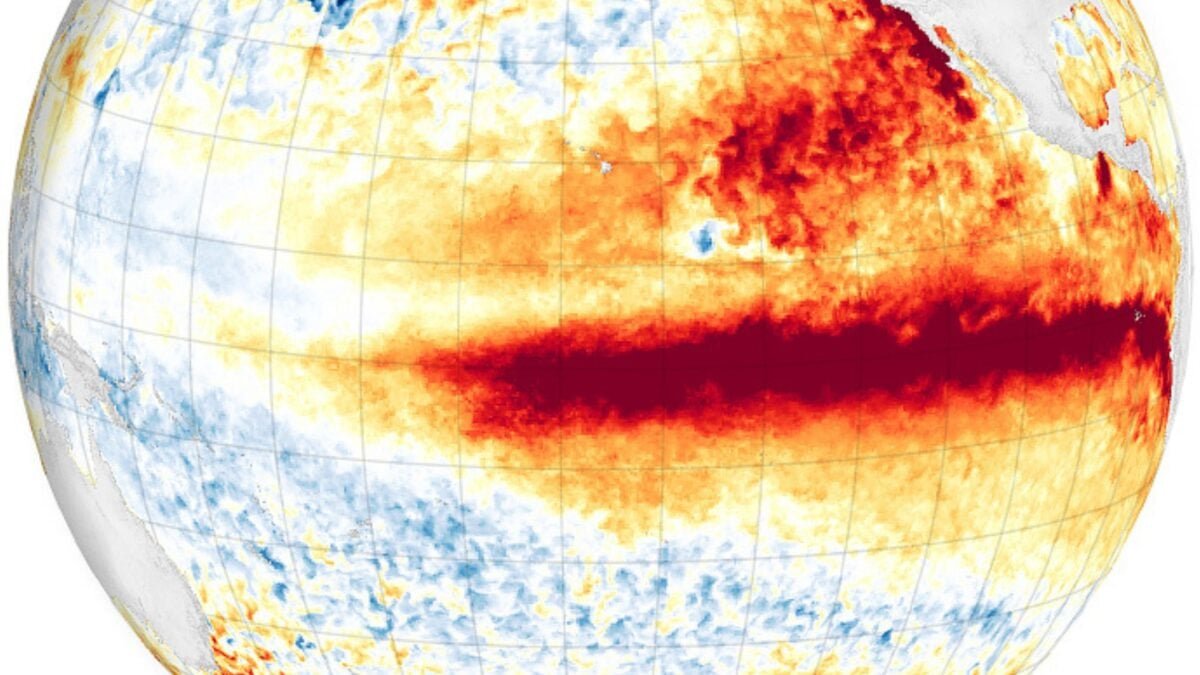
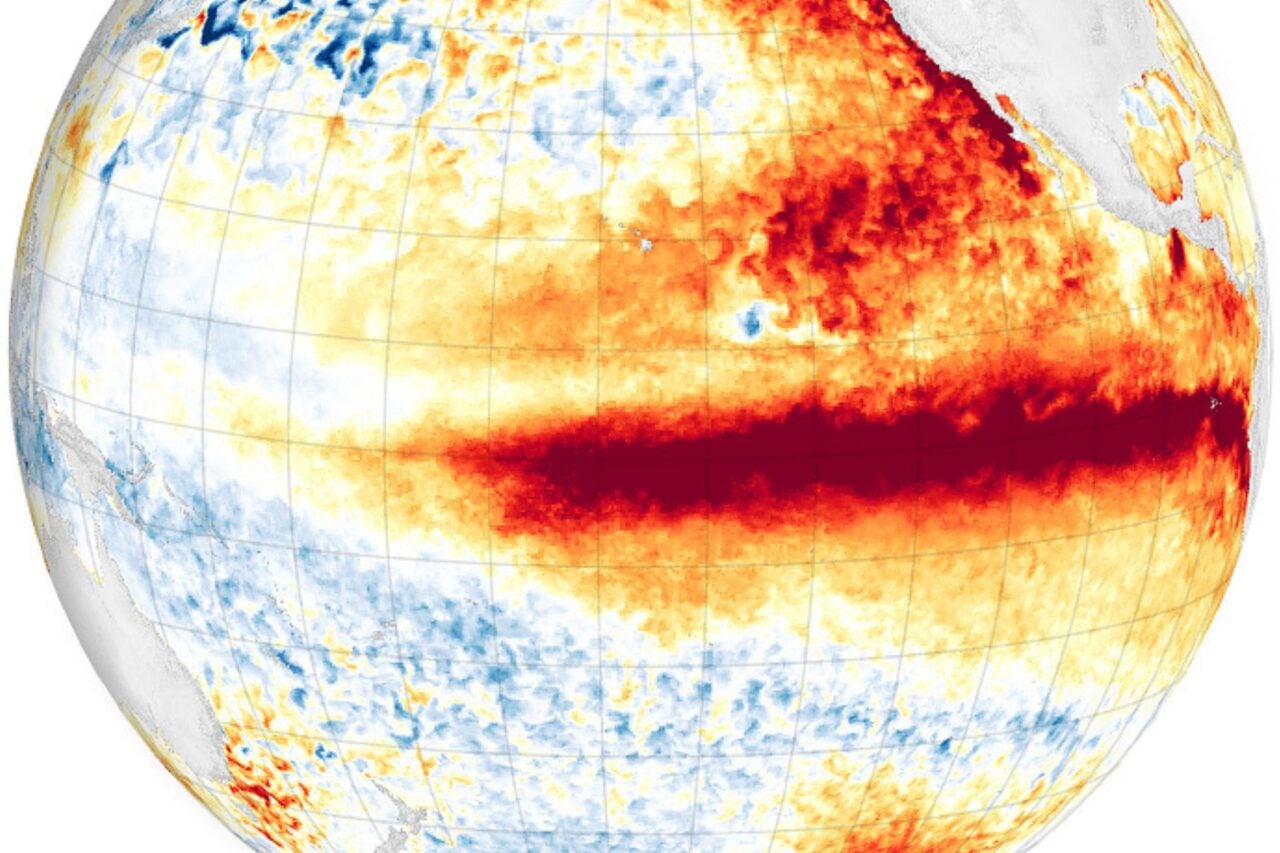
El Niño events are now occurring against the backdrop of human-induced climate change. The relationship between these forces is highly complex, and researchers are still working to understand how they affect each other. But in recent years, it has become clear that El Niño can amplify the warming effects of rising greenhouse gas concentrations, helping to boost global average temperatures into unknown territory.
As humanity continues to pump the atmosphere full of carbon, the effects of El Niño will likely become more severe, and the climate will have difficulty recovering from these cyclical temperature increases. Let’s find out what this means and how an extreme El Niño could potentially affect our rapidly warming world.
Understanding El Nino
The El Niño–Southern Oscillation (ENSO) is a recurring climate pattern that cycles between cool (La Niña) and warm (El Niño) sea surface temperatures in the central and eastern tropical Pacific. According to the National Oceanic and Atmospheric Administration (NOAA), this cycle is irregular, with El Niño and La Niña events occurring on average every two to seven years.
ENSO is the largest year-to-year climate variation on the planet. “This is the 800-pound gorilla in the climate zoo,” Michael McFadden, a senior scientist at NOAA, told Gizmodo. This cycle alters atmospheric circulation, which in turn affects temperature and precipitation around the world.
During El Niño, sea surface temperatures in the central and eastern tropical Pacific rise above average, spreading excess heat into the atmosphere and shifting the Pacific jet stream southward. As a result, global temperatures rise and weather patterns in different regions of the world change significantly. In many places, El Niño exacerbates extreme weather events that are already becoming more frequent and severe due to human-induced climate change.
“We have terrestrial heat waves that are very deadly, significant threats to public health, we have intensified hurricanes, we have more severe droughts,” McFadden explained. “These are caused by a combination of El Niño and climate change in a particular period.”
mixed heating
A strong El Niño that developed in 2023 played a key role in making 2024 the hottest year on record. When La Niña took hold in 2025, global average temperatures fell, but did not return to 2022 levels. In fact, 2025 became the third-warmest year on record, behind 2023 and 2024. That’s because more greenhouse gases had accumulated in the atmosphere, essentially counteracting the global cooling effect of La Niña, McFadden explained.
This dynamics is reflected in unusual regional-scale weather patterns. “Earlier this year, when it was still La Niña, we had a massive heat wave in Australia, although usually La Niña means Australia is cooler. So the anthropogenic impact actually offset the effects of [La Niña],” Friederike Otto, a professor of climate science at Imperial College London, told Gizmodo.
This pattern is also visible in historical temperature records. “La Niña years in the 21st century are warmer than El Niño years in the 20th century because of the accumulation of greenhouse gases,” McFadden said.
This underlines why the historical temperature record looks more like a rising staircase than a smooth slope. In a 2023 article for The Conversation, Kevin Trenberth, a distinguished scholar at the National Center for Atmospheric Research, explained that global warming follows a step-like progression that is strongly influenced by ENSO variability. El Niño years cause global average temperatures to rise, followed by the cooler La Niña. But due to increasing concentrations of greenhouse gases in the atmosphere, the net long-term effect is still warming.
According to the most severe model projections, this year’s El Niño could be even stronger than the 2023 event. Experts Gizmodo spoke to for this story expressed confidence that a Super El Niño could cause global temperatures to rise more than 2.7 degrees Fahrenheit (1.5 degrees Celsius) above pre-industrial levels in 2026 and 2027. It is the benchmark set by the Paris Climate Agreement to limit the worst effects of climate change.
“It’s possible that a very large El Niño event right now could essentially push us to a point where we rarely – if ever – get back below that 1.5-degree Celsius [2.7-degree F] level,” Daniel Swain, a climate scientist at the University of California Agriculture and Natural Resources, told Gizmodo.
But perhaps more importantly, the extreme weather we experience during a Super El Niño will be a preview of the world we will live in permanently in just five or 10 years, according to Swain. “As a climate scientist, this is an extremely worrying realization,” he said.
More frequent Super El Niños?
It is clear that El Niño plays an influential role in global temperature rise, but whether the reverse is true remains an open question. That said, there is some evidence to suggest that human-induced climate change may lead to a higher frequency of strong El Niño events.
“They occur so infrequently that it is impossible to get a statistically significant sample size from observations at this point, but the data suggest that we may see more extreme El Niño events in the last four or five decades than previously thought, and this would be consistent with model-based predictions that we will begin to see more frequent extreme El Niño events this century,” Swain explained.
McFadden agrees and believes this year may provide more data to support that hypothesis. “If this event actually proves to be very strong, it would be unusual, as the last very strong event occurred only 10 years ago,” he said. “The typical return rate for really strong events is 15 to 20 years.”
If Super El Niños are becoming more common in a warming world, the reason may be related to their role in the global climate system. This phase of the ENSO cycle essentially acts as a stored-energy release mechanism, flushing excess heat out of the tropical Pacific. But as the global atmosphere warms, the ocean absorbs more heat, thus releasing more heat during an El Niño year.
This points to a possible feedback loop. If global warming increases the occurrence of strong El Niño events, those events could amplify the near-term impacts of global warming.
It will take a long time before climatologists have the records needed to fully examine that relationship, but it is clear that El Niño and human-driven climate change are not separate forces. Resolving them will be crucial to understanding our warming world.
<a href