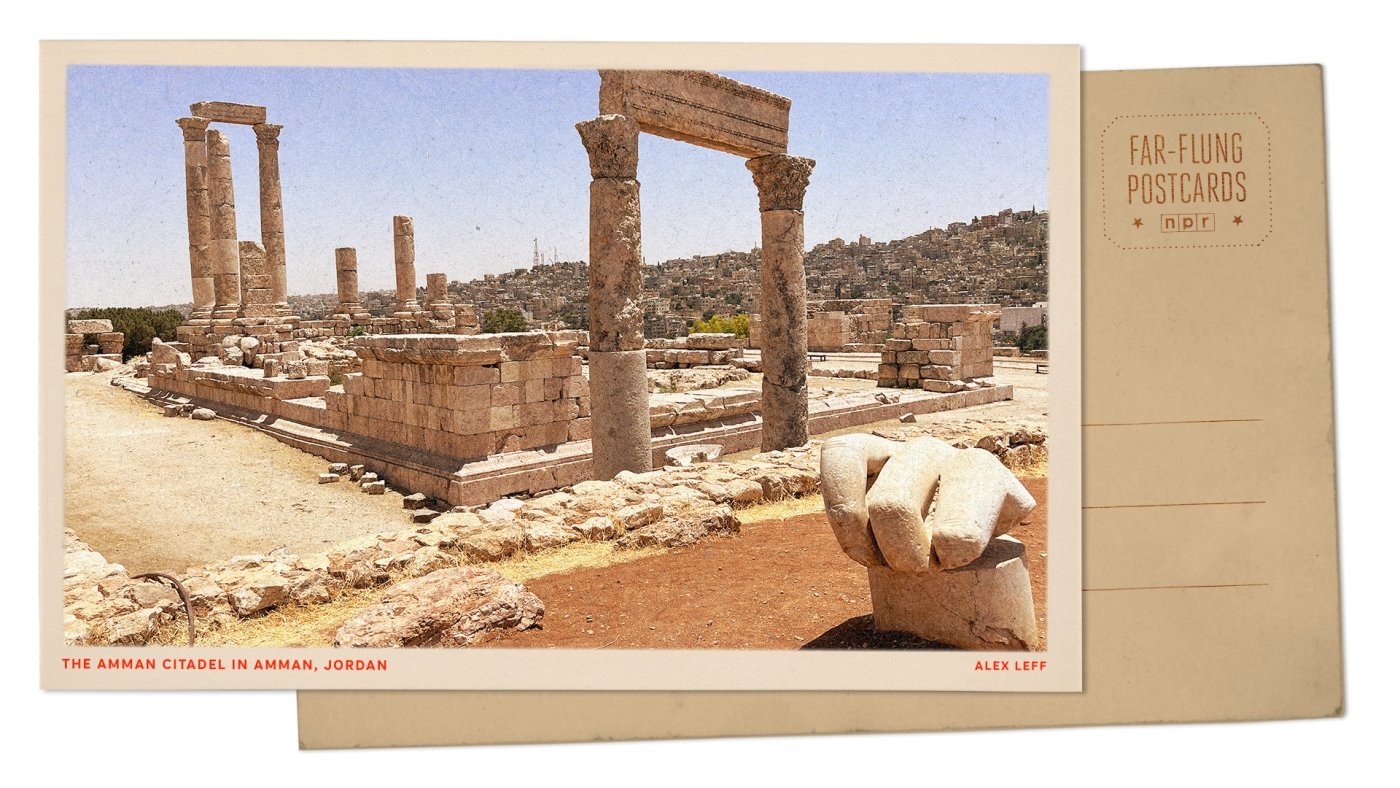

Far-Flung Postcards is a weekly series in which NPR’s international team shares moments from their lives and work around the world.
It was a quiet day in Amman, the capital of Jordan. The city endured nearly two weeks of continuous civil defense sirens, announcing missiles crossing Jordanian airspace during the Israel–Iran war in June.
Since the ceasefire was in effect, I took time off from my post coordinating Middle East coverage to see some local sightseeing. My colleague, correspondent Zane Arraf, suggested some main attractions to visit, and I chose the closest: the Amman Citadel.
I never imagined what a sacred historical place it would be.
Perched atop one of seven hills overlooking the city, the site is like an archaeological mosaic where fragments of Paganism, Christianity and Islam from different eras and empires co-exist. And I had almost the entire place to myself, except for the staff and a few other visitors wandering quietly around the grounds.
One of the stunning exhibits is this giant hand sitting near the ruins of an ancient Roman temple, dating back to the 2nd century. Researchers believe this hand belonged to a giant statue of Hercules. Nearby are the remains of a Byzantine church and an Umayyad palace. Walking these sacred grounds, each monument contains its own unique architecture and symbolism, each bringing its own meaning to the mosaic.
See more photos from around the world:
<a href