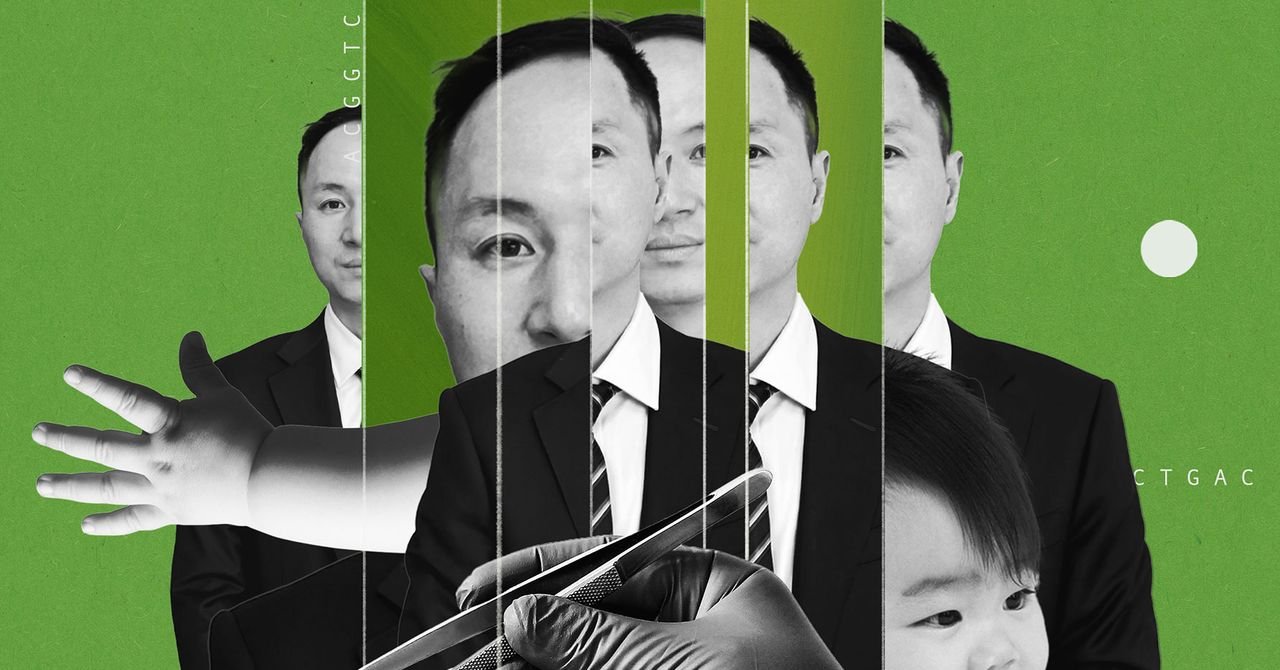
Three little girls were born with modifications to their genomes intended to protect them from HIV. The changes they made to their DNA were permanent and heritable, meaning they could be passed on to future generations.
A Chinese court sent him to prison for three years, and the Chinese government banned genome editing for reproductive purposes. Now he is trying to re-establish himself as the man who changed history.
Since his release in 2022, he says, he has worked on gene therapy for boys with Duchenne muscular dystrophy. He has not yet published or shared any results publicly, but he claims that a pharmaceutical company has taken over his Duchenne research and that funders are eager to help him continue his work. And he, who has set up an independent laboratory in south Beijing, has recently started talking again about human embryo editing – this time to prevent Alzheimer’s. With germline editing banned in almost every country, including the United States, their path forward is unclear.
Through it all, he has documented his life on social media. He has posted about his failed romance with self-proclaimed “biotech Barbie” Kathy Tye, a Canadian former Thiel partner and co-founder of a human embryo editing startup. A stipulation of this interview was that WIRED refer to him as a “pioneer of gene editing,” but he has more colorfully referred to himself on X as the “Chinese Darwin,” “Oppenheimer in China,” and “China’s Frankenstein.”
He often posts photos of himself posing alone near scientific equipment, wearing a crisp lab coat. An apparently empty lab shot comes with the text “I didn’t violate ethics, I turned it around.” Just recently he ditched his tough look and posted a photo of himself sitting on a giant throne with prehistoric animals at his feet, a rainbow shining on his crown, and a double helix adorning his purple robes.
WIRED talked to him about designer babies — those that have already been born and those he hopes to eventually create. This interview has been edited for length and clarity.
Emily Mullin: The scientific consensus in 2018 was that gene editing was not a mature technology. Do you think it has matured now?
He Jiankui: Whoever is first in the world cannot be called mature. Were the Wright brothers who made the first flight mature? Of course not, but he made history.
I was lucky that Lulu, Nana and the third girl were healthy; They are normal. We’ve seen them for seven, eight years now. So I think now is the time to move on to hundreds of gene-edited babies. We should probably test 300 now.
Do you keep in touch with the parents of all three children?
Yes, we keep in touch regularly.
And everything seems fine?
Yes, they go to primary school. His family is very happy with this.
Have their parents told them they were gene-edited?
No.
What is your new lab focusing on?
The new lab is doing germline gene editing—fetal gene editing—and it’s focusing on trying to prevent Alzheimer’s disease.
What gene are you working on?
APP-A673T mutation. This mutation was identified in the Icelandic population. People with this mutation are free from Alzheimer’s and also live longer. They are healthy and normal. So we want to introduce the mutation to the next generation, so that they have the same mutation as the Icelanders and they become free from Alzheimer’s.
Are you currently working with human embryos?
<a href