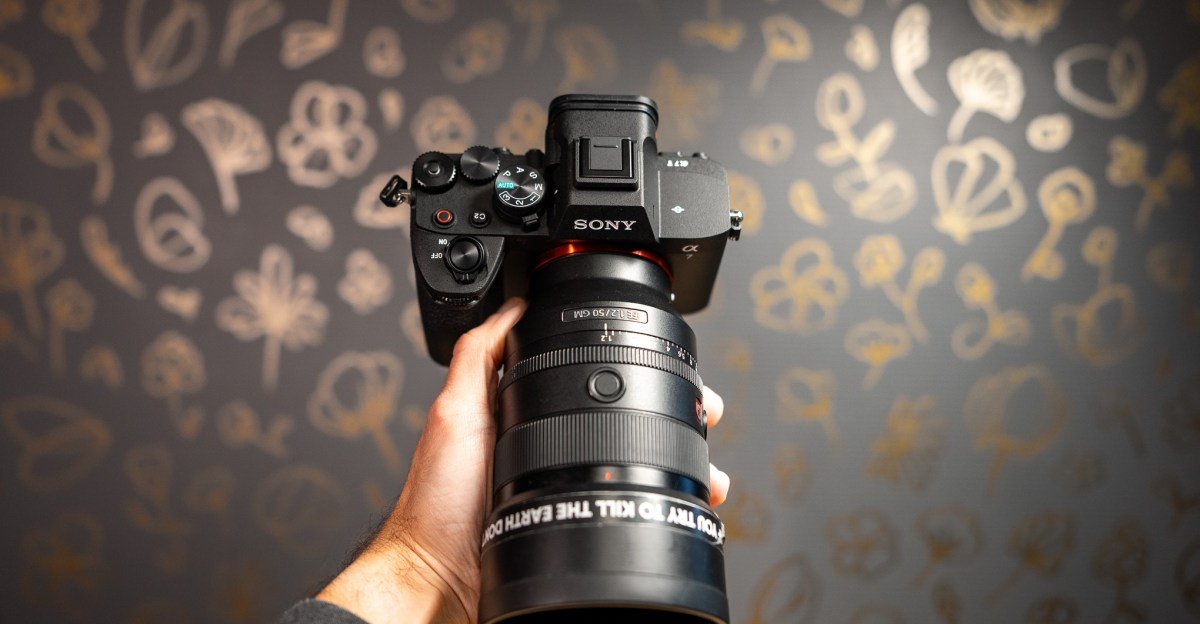
Sony is announcing the A7 V, its first camera with a partially stacked sensor and various features borrowed from the expensive Alpha model. It will be available in late December for $2,899 body-only, and a kit including a new 28-70mm f/3.5-5.6 OSS II lens is coming in February.
The A7 V is one of Sony’s most versatile all-purpose full-frame cameras for enthusiasts and professionals who don’t want to spend nearly $7,000 on the A1 II. The new A7 retains the same 33-megapixel sensor as the earlier A7 IV, but with a partially stacked design like Nikon’s Z6 III. Thanks to this technology, the A7 V can be used full-time with its electronic shutter for completely silent shooting and blackout-free 30fps continuous bursts. While the Nikon Z6 III, as great as it is, had some controversy over the low dynamic range of its partially stacked sensor, Sony claims the A7 V’s sensor has 16 stops of latitude.

Other features on the A7 V include a new Bionz XR2 processor with a dedicated AI chip for tracking autofocus and subject detection (like the A7R V), a new tilt screen (also first introduced on the A7R V), improved five-axis image stabilization (rated up to 7.5 stops), up to one second of pre-capture in continuous burst shooting, and a Speed Boost button that allows faster shooting on-the-fly. (borrowed from A9 III). The A7 V’s OLED electronic viewfinder has the same 3.68-million dot resolution as its predecessor, but it now supports a faster 120fps, and the Live View feed switches more quickly than the LCD when you keep your eye on it. Sony also managed to squeeze a little more life out of the new model by using the same NP-FZ100 battery – rated for an estimated 630 shots using the EVF or 750 with the LCD (increases of 110 and 170 compared to the previous generation).
The A7 V is designed as a hybrid for both stills and video, and its video chops are a significant improvement over the A7 IV. The new model records in oversampled 7K resolution to achieve 4K 60p full-frame video, fixing one of the biggest issues and mistakes of the A7 IV. The previous generation model relied on a 1.5x crop for its 4K 60p footage, while the A7 V now only crops to hit high-speed 4K 120p for slow motion work.
1,7
As someone who owned and used an A7 IV professionally for almost two years (before selling it to upgrade to another model), the A7 V does everything I want a camera to do for me. I got a chance to use it for a very brief period, and like my other cameras being able to shoot silently in most situations is incredibly helpful for shooting independently in a quiet environment – such as a wedding ceremony. My biggest problem with my A7 IV was the delay while waiting for live view to switch from the LCD to the EVF. The second moment of temporary blindness wasn’t very long, but the A7 V’s fast switching brings it closer to the super-speed experience of the Pro A1 and A9 III cameras. I know I’m spoiled, but once you adjust to it you won’t want to go back to the slow reaction times every time you pull up your other body.
The A7 V’s new screen and ergonomic improvements are also welcome changes. I still don’t love the grip feel of Sony’s, even though they are my cameras of choice, but Sony makes the best articulating screens, offering the best of both worlds for photos and video. Until now, these excellent screens have been reserved for pricier models, and I’m excited for more people to have access to them.

It’s easy for this to seem like a ho-hum update to the Sony A7 V. Last year’s A1 II upgrade was for professionals. But Sony did a good job focusing on refining and improving all the basic features of the base A7. It is a greatest hits album of several recent new features from Sony. It’s a shame that this line continues to get more expensive, as it launches at $500 more than the A7 IV’s original price and $200 more than the IV’s current tariff-increased price, but the new sensor technology is expensive sensor technology.
Sony has been quick to innovate and iterate on its Alpha cameras over the years, giving it a huge lead over Canon, Nikon and others in the mirrorless world. But it feels like innovation has stagnated a bit in recent models. Now that Sony has played all its latest cards in its current crop and given the A7 V samples of its latest technology, we have to see if Sony’s next generation of cameras can make any big leaps forward from what is already known.
Photography Antonio G. By Di Benedetto/The Verge
<a href