
 getty images
UK government borrowing was £2 billion more than expected last month, according to the latest official figures.
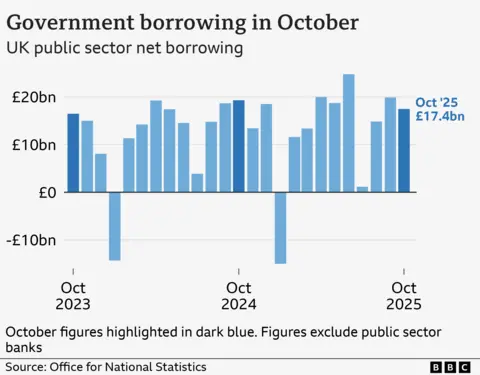
The Office for National Statistics (ONS) said borrowing – the difference between public spending and tax income – was £17.4 billion in October, up from £19.2 billion in the same month last year.
Analysts had expected the figure to be £15bn, slightly higher than the Office for Budget Responsibility (OBR)’s March forecast of £14.4bn.
ONS chief economist Grant Fitzner said borrowing had declined compared with the same month last year, yet it was “the third highest October figure on record in terms of cash”.
“Although spending on public services and benefits increased in October last year, this was more than offset by increased receipts from taxes and national insurance contributions,” he said.
In the financial year to October, borrowing stood at £116.8 billion, £9 billion more than the same seven-month period in 2024. This was the second-highest borrowing for April to October in 2020 since records began in 1993.
The borrowing figures come less than a week before Chancellor Rachel Reeves is due to present her budget, and she has already confirmed that both tax rises and spending cuts are on the table.
James Murray, Chief Secretary to the Treasury, said that £1 in every £10 of taxpayers’ money is currently spent on interest on the national debt.
“That money should be given to our schools, hospitals, police and armed forces,” he said.
“That is why we are set to achieve the largest primary deficit reduction in both the G7 and G20 over the next five years – to bring down borrowing costs.”
Shadow Chancellor Sir Mel Stride said borrowing so far this financial year was the highest on record barring the pandemic.
He said, “If Labor had any spine, they would control spending to avoid a tax rise next week.”
James Smith of investment bank ING said the Chancellor would not welcome the figures ahead of her Budget, but her fiscal rules are about what will happen at the end of the decade rather than today.
“So today’s data is not helpful, it shows the government is borrowing more than expected, but it won’t necessarily change decisions next week,” he told the BBC’s Today programme.
Separate ONS data showed retail sales fell by 1.1% in October – the first monthly decline since May.
“Sales at supermarkets, clothing stores and online retailers remained slow, with some retailers responding to consumers looking forward to November’s Black Friday deals,” Mr Fitzner said.
Ruth Gregory, deputy chief UK economist at Capital Economics, said the latest government borrowing and retail sales data together painted a “very grim picture” of the economy.
He said higher local authority spending had been “a major source of excess” in government borrowing for seven months of the financial year, but slower growth in tax receipts had also contributed.
“This underlines the generally poor fiscal picture facing the Chancellor as he prepares to tighten fiscal policy in the upcoming Budget,” Ms Gregory said.
However, he said the monthly decline in retail sales was “not as bad as it looks” as it came after four consecutive months of growth, but added that consumer confidence had declined, which “suggests that consumers are not at all despondent at the moment”.