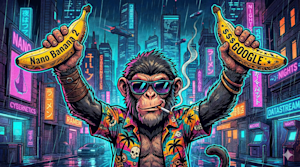
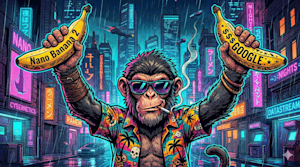
For the past six months, enterprises wishing to deploy high-quality AI image generation at scale have faced an uncomfortable trade-off: pay premium prices for Google’s Nano Banana Pro models, or settle for cheap (sometimes free), fast, but noticeably inferior alternatives – especially in terms of enterprise needs like embedded precise text, slides, diagrams, and other non-aesthetic information.
Today, Google is attempting to close that gap with the launch of DeepMind Nano Banana 2 (formally Gemini 3.1 Flash Image) – a model that brings Pro level logic, text rendering and creative control up to Flash-level speed and pricing.
This release comes just sixteen days after Alibaba’s Quen team dropped the 7 billion parameter open-source challenger Quen-Image-2.0, which many developers argued matched the quality of the Nano Banana Pro at a fraction of the already anticipated cost.
For IT leaders evaluating image creation pipelines, Nano Create 2 reframes the decision matrix. The question is no longer whether AI image models are good enough for production – the question is which vendor’s cost curve best fits the workflow.
The production cost problem: why the Nano Banana Pro stayed in the sandbox
When Google released the Nano Banana Pro built on the Gemini 3 Pro backbone in November 2025, the developer community was impressed by its visual fidelity and logic capabilities.
The model can render accurate text in images, maintain character consistency in multi-turn conversations, and follow complex creative instructions – all capabilities that previous image generators struggled with.
But Pro-tier pricing hindered large-scale deployment. According to Google’s API pricing page, Nano Banana Pro’s image output costs $120 per million tokens, which is approximately $0.134 per generated image at 1K pixel resolution.
For applications that generate thousands of images per day – think e-commerce product visualizations, marketing asset pipelines, or localized content creation – their costs add up quickly.
The Nano Banana 2, built on the Gemini 3.1 flash backbone, dramatically reduces that price. Flash-tier image output costs $60 per million tokens, about $0.067 per 1K image – about 50% cheaper than the Pro model. For enterprises running high-volume image production workflows, this is the difference between proof of concept and production deployment.
What does the Nano Banana 2 actually offer
This model is not the only cheap Nano Banana Pro. According to Google DeepMind’s announcement, Nano Banana 2 brings many capabilities that were previously exclusive to the Pro tier, while introducing new features of its own.
Title correction is text rendering and translation. The model can generate images with precise, legible text – a historically weak point for AI image generators – and then translate that text into different languages within the same image editing workflow.
Theme compatibility has also improved significantly. Nano Banana 2 can maintain character similarity for up to five characters and preserve the fidelity of up to 14 reference objects in a single generation workflow.
This enables storyboarding, product photography with multiple SKUs, and brand asset creation where visual continuity matters. Google’s documentation highlights the ability to provide up to 14 different reference images as input, allowing the model to compose scenes incorporating many different objects or characters from different sources.
On the technical specifications side, the model supports full aspect ratio control, resolutions ranging from 512 pixels to 4K, and two thinking levels that let developers balance quality against latency.
One notable additional feature Nano Banana Pro lacks is an image search tool – the model can perform image searches and use retrieved images as grounding reference for generation, expanding its usefulness for workflows that require visual reference material.
The quan-image-2.0 factor: Why Google needs to move fast
Google’s timing is not a coincidence. On February 10, Alibaba’s Quen team released Quen-Image-2.0, an integrated image creation and editing model that immediately drew comparisons to the Nano Banana Pro – but with a dramatically smaller footprint.
Quen-Image-2.0 runs on only 7 billion parameters, down from its predecessor’s 20 billion, while unifying text-to-image generation and image editing into a single architecture.
The model generates natively at 2K resolution (2048×2048 pixels), supports up to 1,000 tokens for complex layouts, and ranks at or near the top of AI Arena’s blind human evaluation leaderboard for both generation and editing tasks.
For enterprise buyers, competitive dynamics are important. QUEN-Image-2.0’s 7B parameter calculation means significantly lower estimation costs when self-hosted – an important consideration for organizations with data residency requirements or high-volume workloads.
The Quen team’s previous model, quen-image v1, was released under Apache 2.0 about a month after the initial announcement, and the developer community widely expects a similar trajectory for v2.0. If OpenVET materializes, organizations could run Nano Banana Pro-competitive image models on their own infrastructure without per-image API fees.
The model’s integrated generation-and-edit architecture also simplifies deployment. Instead of creating a series of separate models for creation and modification – the current industry norm – Quen-Image-2.0 handles both tasks in a single pass, reducing latency and quality degradation that occurs when outputs are passed between different systems.
Where Quen-Image-2.0 is currently pursuing ecosystem integration. Google’s Nano Banana 2 launches today on Gemini apps, Google Search (AI mode and Lens), AI Studio, Gemini API, Google AntiGravity, Vertex AI, Google Cloud, and Flow – where it becomes the default image generation model at zero credit cost. That breadth of distribution is difficult for any challenger to replicate, especially one whose API access is currently limited to Alibaba Cloud’s platform.
What this means for enterprise AI image strategies
The simultaneous availability of Nano Banana 2 and Quen-Image-2.0 creates a decision framework that IT leaders in the image generation space did not previously have.
For organizations already in Google’s cloud ecosystem, Nano Banana 2 is clearly the first evaluation. The reduction in cost from Pro pricing, combined with native integration onto Google’s product surface, creates a path of least resistance for teams who need production-quality image generation without rearranging their stack. The model’s text rendering capabilities make it particularly suitable for marketing asset creation, localization workflows, and any application where legible in-image text is a requirement.
For organizations with data sovereignty concerns, high-volume workloads that make per-image API pricing prohibitive, or have a strategic preference for an open-weight model, quen-image-2.0 presents an attractive alternative – provided Alibaba adheres to open-weight availability. The model’s small parameter count translates to low GPU requirements for self-hosting, and its integrated generation-edit architecture reduces pipeline complexity.
The wild card is the Nano Banana Pro, which is not going away. Google AI Pro and Ultra customers retain access to the Pro model for special functions, accessible through the regeneration menu in the Gemini app. For use cases demanding maximum visual fidelity and creative logic – think high-end creative campaigns or applications where each image needs to look special – the Pro ceiling remains.
The provenance layer: a quiet but important enterprise differentiator
Hidden in Google’s announcement is a detail that may matter more to enterprise legal and compliance teams than any quality benchmark: provenance tooling. The Nano Banana 2 comes with SynthID watermarking – Google’s AI-generated content identification technology – combined with C2PA content credentials, the cross-industry standard for content authenticity metadata.
Google reports that since launching SynthID verification in the Gemini app last November, the feature has been used more than 20 million times to identify AI-generated images, video, and audio. C2PA verification is also coming soon to the Gemini app.
For enterprises operating in regulated industries or jurisdictions with emerging AI transparency requirements, baked-in provenance is no longer optional. This is a compliance checkbox – and self-hosted open-web options like quan-image-2.0 don’t natively provide that.
bottom line
The Nano Banana 2 does not represent a generational leap in image production quality. What this represents is the maturation of AI image generation from a creative novelty into a production-ready infrastructure component. By reducing the cost and speed gap between Flash and Pro tiers while maintaining the logic and text rendering capabilities that make these models useful for real business workflows, Google is making a calculated bet: The next wave of enterprise AI image adoption will not be driven by models that generate the most beautiful images, but by models that generate good enough images fast enough and cheap enough to deploy at scale.
Moving from the quan-image-2.0 open-weight flank and maintaining the Nano Banana Pro quality edge, the Nano Banana 2 is exactly at the middle ground where most enterprise workloads actually reside. For IT decision-makers who were waiting for the cost curve to bend, it happened.
<a href