Google is incorporating artificial intelligence into almost every part of how people shop online — including an AI tool that calls local stores on behalf of a human and automatically purchases items.
Starting Thursday (and ahead of the holiday shopping season), Google users in the US will have access to several new AI shopping features that will target tasks like searching for products, comparing similar items, tracking prices, and finally checking out. Some features were teased at Google I/O in May.
First, Google is adding Conversational Shopping to Search’s AI mode, allowing users to describe in detail what they’re looking for: An initial search of “women’s sweaters that can be worn with pants or dresses” can be modified by a follow-up to “more options in gray shades” rather than clicking through filters and adding keywords to queries. The AI-powered response is pulled from Google’s 50 billion product catalog and tailored to the specific request: a side-by-side chart if the user is asking for a comparison of specific items, or a stream of product image cards if they’re looking for general recommendations. Users can click on items, visit retailers’ sites, view historical pricing data, and track price changes with AI mode, and the results will contain sponsored listings (i.e., ads). Google is also adding a shopping feature to the Gemini app for US users.
AI tools will also be deployed for purchasing tasks that can be extremely manual. Google is adding a so-called agentic AI feature called “Let Google Call,” which users can call local stores to ask about products, what’s in stock, and whether there are sales or promotions. When an AI agent calls, it tells the store that it is an AI caller; If merchants don’t want robots to ask about sales they will be able to opt out of it. After the call, the human user will receive a text or email with the collected information. The agentic calling option will launch across a few categories, starting with toys, health and beauty and electronics.
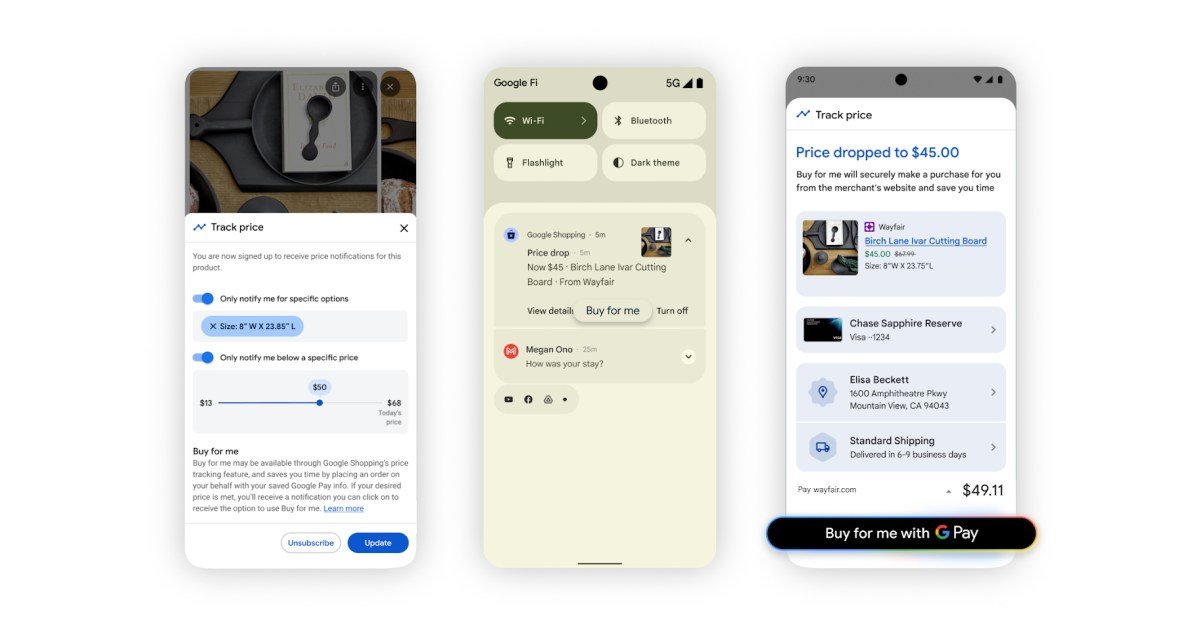
Eventually, users will be able to task AI agents with actually purchasing items. Shoppers will be able to select items and specifications, like color or size, and name the price they want to spend — if the item drops below that, Google’s Agentic Checkout will ping the buyer, confirm they want to purchase it, then use Google Pay to complete the transaction. The feature will roll out to merchants including Wayfair, Chewy, Quince, and some Shopify sellers.
Google created the features as a way to automate the tedious parts of shopping while also giving buyers control, especially over things like price. But the shift to AI-powered shopping could upend all the existing ways consumers currently find things: browsing in stores, buying guilds and reviews, and of course from influencers.
One of the example queries demonstrated by Google during a press briefing was an AI mode shopping search for moisturizer for dry winter skin. The tool quickly yielded a comparison of products as well as some recommendations. I found this very interesting – just a week ago, I made essentially the same discovery, only on TikTok, which is widely used as a product recommendations and reviews platform.
Usually I can find an item to purchase through a beauty influencer or a site like that strategistIn Google’s new shopping ecosystem, I can choose what to buy, track the price, and buy it from Google, consolidating the entire experience. AI-generated shopping responses sometimes also pull content from platforms like TikTok or Reddit, meaning all those human recommendations and reviews eventually reach Google’s automated system as well. Will buyers abandon influencer recommendations for AI chatbots altogether? Probably not. But it’s hard not to see all of these AI-powered tools as effectively a built-in personal shopper — and creators ranging from Instagram influencers to product review sites will likely feel the competition.