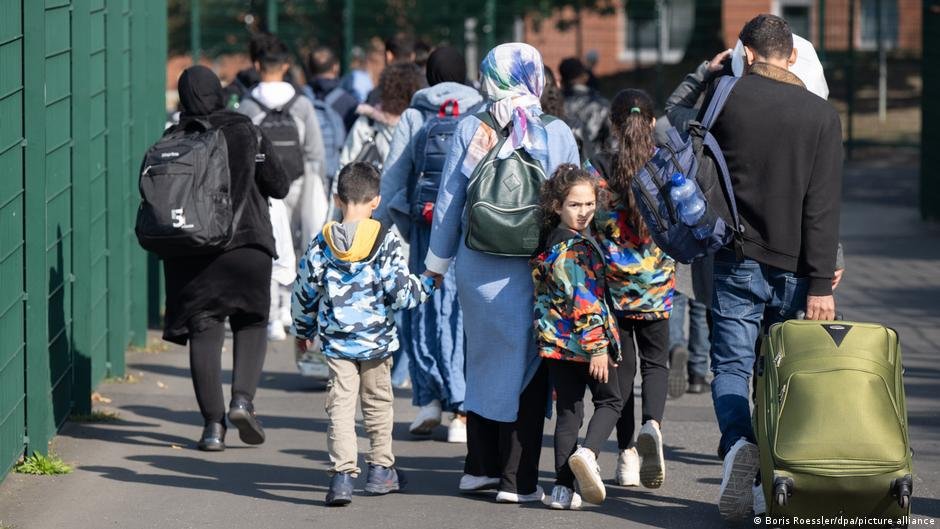
“Emergency mode” has become a term used to describe the situation of overextended cities and municipalities, a topic that is constantly in the news.
The survey of nearly 900 municipalities now shows some improvement. “The proportion of municipalities that see themselves in a state of emergency and that describe themselves as overburdened has clearly declined to 11%,” said Boris Kuhn of the Migration Policy Research Group at Hildesheim University.
“However, more than 70% of municipalities continue to say that the situation is challenging. So it would not be correct to talk about a comfortable situation across the board,” he said.
Decline in number of asylum applications in Germany
This improvement is mainly due to the decline in the number of arrivals. The number of people applying for asylum in Germany has fallen significantly since autumn 2023.
In 2023, 330,000 applications were made. A year later, there were 230,000 first-time applications. And in 2025, it will drop to about 97,000 people.
“Just under 50 percent of local authorities say housing conditions have improved in the past year – a similar trend is being seen in all federal states,” says Kuhn.
However, Klaus Rietgen of the German County Association (DLT) warned that it would be wrong to conclude that all is now well at the municipal level. He said more than 4 million people had fled Germany in the past decade: 1.3 million fled the war in Ukraine, as well as refugees from other countries. Many people have no economic prospects, Rietgen said.
“If we want to talk about easing the situation, the ‘challenging’ category should no longer exist. The falling number of refugees is giving local authorities a sigh of relief for the time being.” According to Rittgen, it would be absolutely wrong to conclude from the survey results that municipalities are now ready to take in large numbers of refugees again. “In our view, we have reached the limits of our capacity to accept and integrate refugees.”
Immigration officers are particularly under extreme stress
A major problem remains that municipalities in Germany are not receiving sufficient financial support from the federal and state governments for the integration of refugees. According to the Federal Statistics Office, municipal debt will reach €170 billion ($197 billion) in 2024. A district county in the western state of Rhineland-Palatinate responded to the study that municipalities were having to cut some services that were important for people’s integration because they had too many other things to pay for from their budgets.
In particular, the budgetary and staffing resources of immigration authorities remain a major problem: “Sixty percent of major cities say our immigration authorities are in emergency mode, and this affects huge numbers of people,” said migration expert Boris Kuhn.
In contrast, according to Kuhn, the outlook for daycare centers is encouraging. In the last survey, 44% of local officials reported that they were in emergency mode. Now this figure is a little more than 20 percent.
Ukrainians are waiting for the apartment
Miriam Koch has a wealth of insight into how local authorities have mastered the integration of refugees over the past ten years. She was the first Refugee Commissioner of the city of Düsseldorf, then took over the city’s Office for Migration and Integration and has been head of the Department for Culture and Integration since 2022. The biggest challenge so far has been the large influx of Ukrainians into the city, which has the largest Ukrainian community in North Rhine-Westphalia.
Koch told DW that Düsseldorf is not in a crisis situation. But he added: “In 2022, we actually took as many people from Ukraine within six months as we took from all other countries in 2015, 2016 and 2017. People were put in hotels because they had not yet fully returned and were not working due to the impact of the COVID pandemic.” He said about 1,700 Ukrainians still have not received their housing and are being kept in the city.
Decentralized housing as a recipe for success in integration
According to Koch, Düsseldorf can still rely on the broad social coalition of associations, churches and charities formed in 2015 to help integrate refugees. A lesson from then: There are no more massive inflatable emergency shelters. Düsseldorf is now planning decentralized housing for refugees.
Integration experts would like to see a more fact-based discussion on the integration of refugees. “The social environment always has a big impact on integration. I get angry when I hear about the shortage of skilled workers in the news and then in the next report irregular migration is defined as the problem of our age.” Koch said it’s important to help integrate those who are already here and become more attractive to people who want to come. “There’s something really paradoxical going on right now,” Koch suggested.
This article was originally written in German.
While you’re here: Every Tuesday, DW editors provide insight into what’s happening in German politics and society. You can sign up for the weekly email newsletter, Berlin Briefing, here.
<a href