Chinese export controls, particularly on rare earths, have highlighted the German economy’s heavy dependence on China. For example, the German automotive industry has felt its effects as it faces shortages of critical parts.
The visit is coming six months into the tenure of the current government and is part of the “Financial Dialogue” bilateral talks held regularly every two years.
Foreign Minister Johan Wadfulhad had planned to visit China in late October to address trade issues and other tough topics such as China’s support for Russia in the war against Ukraine. The purpose of his visit was to prepare the ground for the visit of Chancellor Friedrich Merz.
But when it became clear that he would not meet any other high-ranking interlocutor other than his Chinese counterpart Wang Yi, the foreign minister canceled the visit at short notice.
Earlier, Wadeful had criticized China’s Indo-Pacific policy as increasingly aggressive. A Chinese Foreign Ministry spokesman also criticized Germany’s position on Taiwan, which Beijing views as a rebel province, and noted Wadefull’s refusal to explicitly disavow the island’s independence activities. However, it is unclear whether China’s decision to confirm only one meeting was directly linked to Germany’s stance on Taiwan.
The Chinese were angered by the cancellation, but later insisted they were still interested in an exchange with the German government.
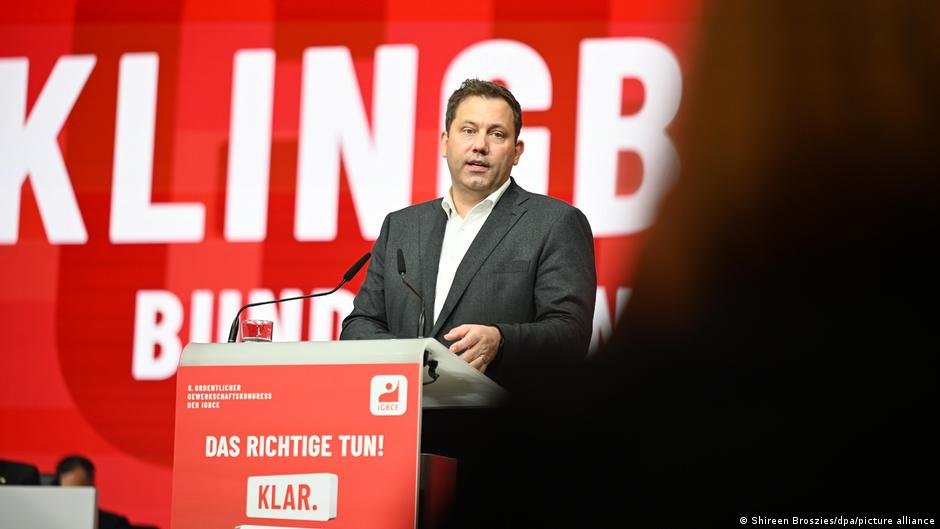
Vice Chancellor Lars Klingbeil met with one of President Xi Jinping’s closest confidants in China. Wang Huning is considered a major ideologue of the Communist Party. He also met Liu Haixing, head of the CPC’s international department, who is also considered a confidant and senior adviser to President and party leader Xi Jinping.
“We have open political discussions during the party dialogue,” said Klingbiel, co-chairman of the centre-left Social Democratic Party (SPD).
Party dialogue between the SPD and the CPC was initiated in 1984 by then-SPD chairman Willy Brandt and Chinese reformer Deng Xiaoping. According to the SPD, this was the CPC’s first international party relationship outside the Communist Bloc during the Cold War. Today, the Communist Party of China has political ties with all parties represented in the Bundestag.
“I think it is important to hold talks with CPC leaders,” the SPD leader said. “We won’t always agree, but it’s good to talk about things,” Klingbeil said.
Critics accused the SPD of adopting a shady foreign policy after the cancellation of Wadful, which Klingbeil rejected. From the Green Party’s point of view, the federal government is in any case sending contradictory signals to Beijing, which appears to be “completely haphazard” in terms of foreign policy, as Green Party leader Franziska Brantner told Redaktionsnetzwerk Deutschland.
“Whether as party leader, chancellor, or finance minister, I always strongly represent German and European interests and values,” Klingbeil stressed.
Berlin is still working on China strategy
The new German government is launching a commission to formulate a new China strategy. The previous centre-left government led by Chancellor Olaf Scholz had set itself the goal of reducing risk, that is, reducing risk and dependence on China. However, little progress was made in this direction.
The outcome of Klingbiel’s visit will ultimately determine whether the German Chancellor will visit China in the near future. Merz’s frequent early visits to European allies and the United States earned him a reputation as a chancellor who makes his presence felt at almost every international forum.
But six months after assuming office, his first visit to China and India is still pending.
This article was originally written in German. It was first published ahead of Klingbeil’s visit and updated with details of the talks in Beijing.
While you’re here: Every Tuesday, DW editors provide insight into what’s happening in German politics and society. You can sign up for the weekly email newsletter, Berlin Briefing, here.
<a href