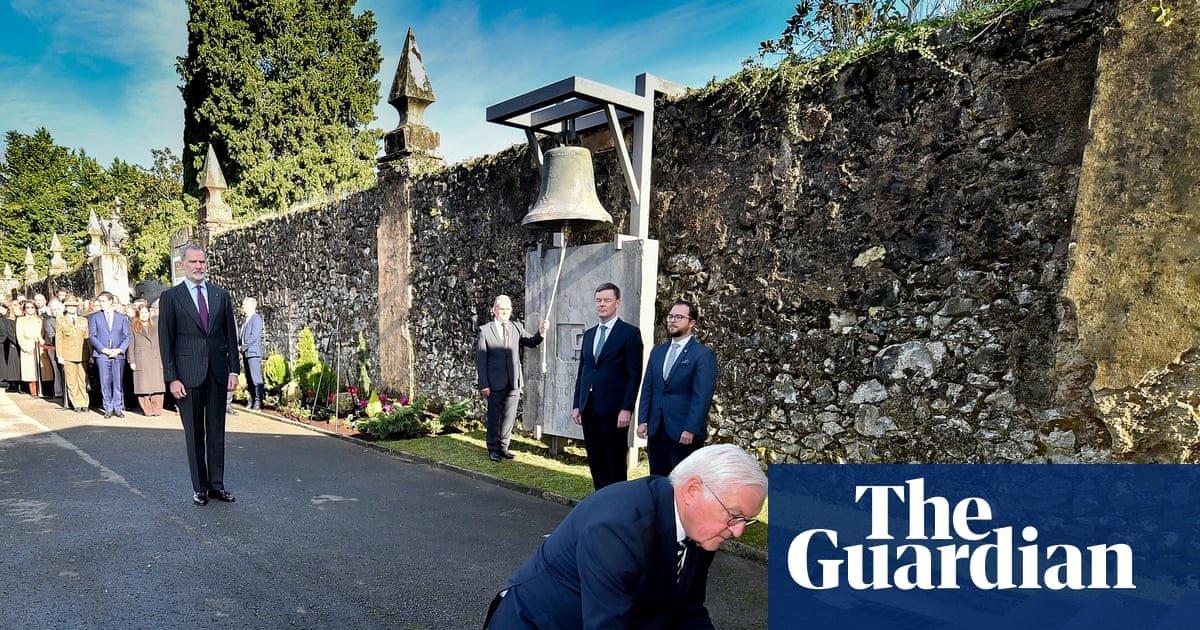
Eighty-eight years after Luftwaffe pilots took part in the most infamous atrocity of the Spanish Civil War, Germany’s president has visited the Basque town of Guernica to honor the victims of the Nazi bombing and urge that the “horrible crimes” committed there will never be forgotten.
Hundreds of civilians were killed and hundreds more injured on 26 April 1937 when German Condor Legion aircraft, working with aircraft from Fascist Italy, bombed Guernica for hours on market day. Adolf Hitler lent the Luftwaffe unit to help General Francisco Franco’s Nationalist forces stage a coup against the Republican government and to allow Nazi Germany pilots to practice blitzkrieg tactics, which they would later use in the Second World War.
The destruction of Guernica, which became a model of aerial bombardment of civilians, was immortalized by Pablo Picasso in a huge monochrome canvas on which the city’s name is inscribed.
On Friday, Frank-Walter Steinmeier became the first German head of state to visit Guernica, where he joined Spain’s King Felipe VI at a memorial ceremony held at a cemetery in the city and laid a wreath for the victims. The couple then visited the Peace Museum in Guernica, where they met Crusita Atxabay and María del Carmen Aguirre, two survivors of the attack.
Photograph: Basque Country Government/Reuters
Steinmeier, who is on a state visit to Spain, used a speech earlier this week to address the bombing and its legacy.
“The Germans committed terrible crimes at Guernica,” the president told guests at a banquet in Madrid on Wednesday.
“On 26 April 1937, the feared Condor Legion bombed the city and razed it to the ground. Hundreds of helpless children, women and men lost their lives in a terrible, agonizing way. The terror, pain and sorrow are still felt today by many Basque families.”
Steinmeier, who visited the Reina Sofia Museum in Madrid to see Picasso’s Guernica, said the artist’s warning against remaining indifferent in the face of conflict and suffering “has lost none of its urgency”.
He added: “It is very important for me, and I am consciously addressing this sentence to my compatriots in Germany, that we do not forget what happened then. This crime was committed by Germans. Guernica serves as a warning – a call to stand up for peace, freedom and the protection of human rights. We want to live up to that now and in the future.”
His words came three decades after Germany’s then-President Roman Herzog said he wanted to “confront the past and … clearly acknowledge the culpable involvement of the German pilots”.
The mayor of Guernica, José María Gorono, who hailed the visit as “a day that will be recorded in the history of the city”, used the occasion to reiterate his demand for Picasso’s masterpiece to be moved from the Reina Sofía to the place that had inspired it.
In an interview with Cadena Ser radio on Thursday, Gorono said the Spanish state owed a “moral debt to the victims of the bombing”, adding: “Picasso’s Guernica must come to Guernica. It is a worldwide peace symbol. The victims need this tribute.”
Meanwhile, Basque regional president Imanol Pradals has called on the Spanish state to follow Germany’s lead in confronting its role in the Guernica bombing.
“Nobody has any doubt that the current Spanish state is very different from that,” he told the Basque parliament last week. “It is simply about affirming truth and justice, and its actions must arise from a commitment to freedom and democracy. We are asking for nothing more and nothing less from the Spanish state than what the German president is doing.”
<a href