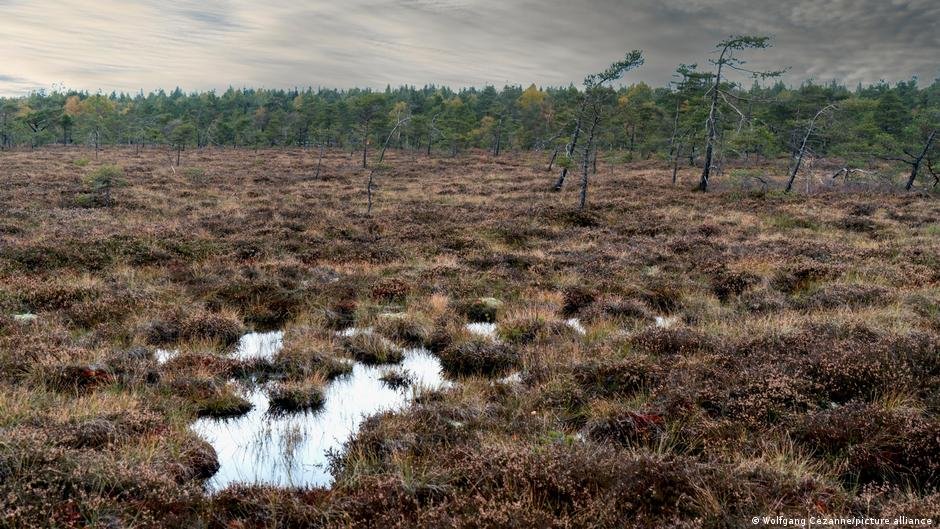
Anyone visiting farmer Henning Voigt’s operation near Germany’s Baltic Sea coast has a good chance of getting their feet wet. About 25 years ago, his father began re-wetting the once-dried peatlands. “We have been an organic farm since 1996 and currently manage 350 hectares (864 acres) of grassland. Most of it is very wet,” says Voigt.
Speaking to DW, Voigt explains that the hay they cut from these wet fields is burned in a power plant to produce district heating. Animal husbandry is not possible there because the nutritional value of peatland plants is very low.
“Cows will starve to death with full stomachs,” he says, which is why he has steadily reduced his herd of lactating cows.
Peatlands store more CO2 than all the world’s forests combined
Voigt and his father were among the pioneers in peatland farming in Germany. Over the centuries, the peatlands in the country dried up, leaving today only about 2% of the original area in almost natural state.
“Germany is one of the countries that has drained peatlands the most,” says Franziska Tanenberger of the Greifswald Moor Center in Germany.
This is a serious problem. Although former peat soils make up only 7% of Germany’s agricultural land, they account for about 40% of agricultural greenhouse gas emissions, he told DW.
Peatlands contain a vast carbon store beneath the wet surface, making them an important lever for climate protection. Although peatlands cover only about 3% of Earth’s land area, they hold about one-third of the carbon in the world’s soils – twice as much as all the planet’s forests combined.
Dried peatlands are the climate culprit
When peatlands are drained, the stored carbon is exposed to oxygen, forming CO2 which escapes into the atmosphere. Instead of protecting the climate, former peatlands accelerate global warming – and that’s exactly what is happening: drained peatlands now emit more CO2 than global aviation.
“Fortunately, about 85% of the world’s peatlands are still in good, natural, wet conditions,” Tanenberger said. But that could change, he said, as about half a million hectares of peatland is lost every year.
For the climate, the best solution would be to protect intact peatlands and re-wet drained peatlands. But this is easier said than done.
Tanenberger points out that in tropical regions, peatlands are still being drained for agricultural use, often because local communities lack awareness of their ecological value.
However, most drained peatlands are found in Europe, where rewetting is now the focus of attention. Yet many of these areas are used for farming, forestry or even settlements, making it difficult to restore them to their original condition.
For farmers, this issue is deeply related to their livelihood.
Carsten Padeken of the Lower Saxony Farmers’ Association argues that it makes no sense for farmers to re-wet peatlands because “there is no way to earn a living from it.”
Padeken’s 500 cattle graze on fields in the Wesermarsh region of northern Germany, some of which were once peatlands.
Padeken, who chairs the association’s peat farmers’ working group, says paludiculture – farming adapted to wet peatlands – is not yet a realistic way of life.
“I listen to the farmers and what they have to say. Most of them want nothing to do with it,” he told DW.
What are the possibilities in paludiculture?
There are lots of ideas for how paludiculture could work. Some projects focus on using peatland plants for energy – for example, to produce biogas or heat, as on Voigt’s farm.
Others are testing construction and insulation materials made from reed, cattail or sedge. Such products, prototypes and services are listed in the “Paludiculture Catalogue” published earlier this year.
Padeken still sees paludiculture as a niche market. “It’s not ready to be done at scale yet,” he said. “Not even on a small scale.”
Indeed, most of the projects in the catalog are still in the testing phase, and only a few have reached the market.
It’s a classic chicken-and-egg problem: without a large supply of paludiculture products, there is little demand. But without demand, there is no point in producing them.
And even if demand increases, farmers who have not rewetted their land cannot meet the high demand immediately – it takes years for rewetted fields to produce crops.
Farmer Voigt expects long-term demand from Germany’s largest mail-order company, Otto Group, which has promised to include paludiculture plants as raw material for its cardboard packaging.
“They’re running a small project now, then a medium optimization phase, and then they’ll need to rapidly scale up,” Voigt said. Otherwise, Otto may look elsewhere, which won’t be a problem for him. “I have certified peatland areas and I can deliver biomass.”
subsidy is necessary
For Voigt, paludiculture already provides some income, but he is still heavily dependent on EU subsidies. “This is the main component of my earnings,” he said – a tricky business model, since farm subsidies are only guaranteed for five years.
“Now go to the bank and tell them your income is protected only for five years. They still consider me a high-risk operation,” he said.
Yet paludiculture also requires investment – for example, special machinery that can work on wet soils.
Additional financial support may soon be available for farmers restoring peatlands. According to Tannenberger, Germany’s Environment Ministry and the Agricultural Development Bank are working on a comprehensive financing program.
“The trend is clear,” he adds, “in the future, those who prepare and learn how wetland farming can work will be better off in the medium and long term.”
A 2021 agreement between Germany’s 16 federal states and the central government in Berlin already stipulates that by 2050, all peatland areas should be managed as wet as possible.
Denmark has gone a step further and plans to put a price on agricultural greenhouse gas emissions. If Germany were to do the same, CO2 emissions from dried peatlands would become costly for farmers. Conversely, paying farmers to avoid emissions may induce them to re-wet their land.
Making wetland farming more attractive
To solve the chicken and egg problem, Tanenberger suggests that the government commit to purchasing a certain amount of palluculture products from farmers. Anything that offers long-term prospects will help, he said.
Padeken, meanwhile, wants more financial support – and more flexibility to experiment. Currently, once land is re-wetted it cannot be re-drained.
“If it was allowed, I would be more willing to experiment on parts of my land,” he said.
However, at the moment, every farmer thinks very carefully before taking the risk of going into peatland farming.
This article was originally written in German.
<a href