 |
In just 12 months, Sage Geosystems and San Miguel Electric Cooperative built the world’s first pressurized geothermal system. It is now ready to provide long-term, dispatchable storage for the Electric Reliability Council of Texas (ERCOT) as variable generation and data center demand increases.
In Christine, Texas – a town with a population of just 365 people per hour just south of San Antonio – San Miguel Electric Cooperative Inc. (SMECI) is driving a change that will redefine rural generation. Inspired by efforts to bring reliable, affordable electricity to the neglected farm fields and small towns of South Texas, the member-owned cooperative built and commissioned a 391-MW mine-mouth lignite power plant at the Atascosa County site, tapping deposits from its own San Miguel mine. For more than 40 years, that plant, the unit’s sole utility, provided baseload electricity to 47 counties through a wholesale contract with member-customer South Texas Electric Cooperative (STEC), and served as a critical anchor in the Electric Reliability Council of Texas (ERCOT) South Load Zone.
While coal, fueled by locally mined lignite, has long been SMECI’s backbone, the cooperative is working to ensure it can maintain its baseload responsibility while transitioning to clean resources, facilitating the early retirement of the lignite plant before the expiration of STEC’s 2037 contract. “Unlike investor-owned utilities, we are operated by and for the people of South Texas in predominantly rural areas – areas that have historically been ignored,” the co-op writes on its website. “We have a simple goal: reliable electricity, not profit.”
That mission led to two historic efforts last year: a first-of-its-kind geothermal partnership with Sage Geosystems to launch a pressurized geothermal pilot and an application to the U.S. Department of Agriculture’s New Empowering Rural America (New ERA) program — which secured more than $1.4 billion in grants and low-interest loans in December — to replace the lignite unit with 400 MW of solar and 200 MW of battery storage by 2027.
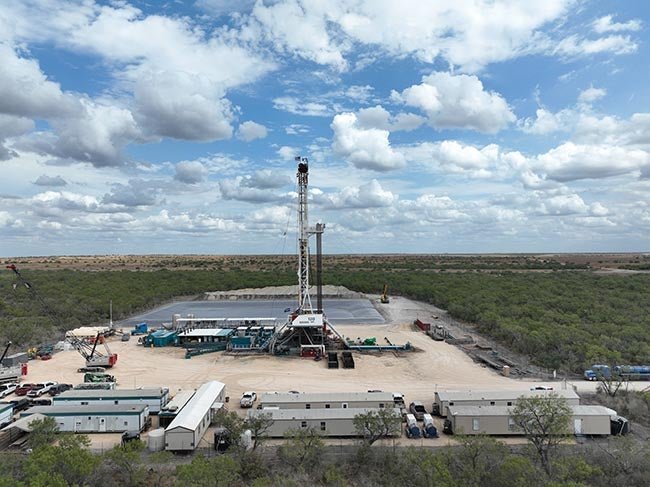
The geothermal pilot, SMECI Well #1, is the first part of realizing that vision. Moving from funding approval to “ready for storage” in just 12 months, SAGE completed drilling, fracture stimulation, surface-facility installation and commissioning by August 2025. Leveraging innovative design, existing oilfield expertise and streamlined permitting, the 3-MW/4-6-hour system has transformed a pioneering underground energy storage concept into a fully constructed asset in record time. While the project is still awaiting grid interconnection – currently scheduled for December 2025 – the pioneering project has demonstrated a new model for firm, dispatchable capacity in ERCOT’s evolving grid, and it is well-deserved. PowerTop Plant Award.
First of its kind geothermal energy storage
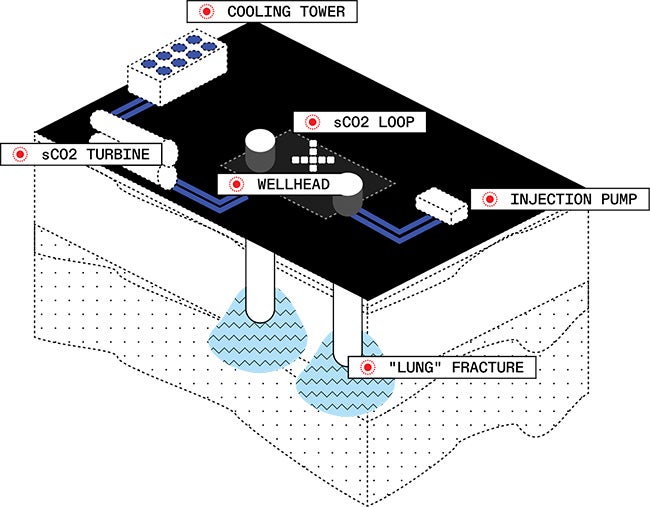
For Sage, the project marks the first commercial-scale deployment of its proprietary Pressure Geothermal System (GGS), a technology that the company has been developing since its inception in 2020 by a team with more than 150 years of combined oil and gas experience. The system is built on lessons learned from the 2023 demonstration well in Starr County, Texas, which delivered up to 17 hours of discharge with minimal water loss and round-trip efficiency of 70-75%, proving the concept’s ability to provide long-term, dispatchable capacity (Figure 1), explained Brianna Byrd, operations engineer at Sage Geosystems. Power,
 |
|
1. This graphic shows Sage Geosystems’ pressure geothermal system, which uses a deep engineered “lung” fracture – a subsurface reservoir created in low permeability rock – to store and release energy using, in this case, a supercritical carbon dioxide (SCO)2) Power system. Courtesy: Sage Geosystems |
“SAGE’s proprietary energy storage technology works like pumped-storage hydropower (PSH), but in reverse, with the ‘top reservoir’ located deep underground rather than on top of a mountain,” Bird explains. “We create a vertical fracture system in low-permeability rock that acts as an artificial reservoir.” To charge the system, water is pumped from surface storage into the fractures below the wellbore, causing the water to be “inflated” under pressure like a balloon. And to discharge it, the pump is turned off, and the pressurized fracture system pushes the water back into the wellbore. “At the surface, it drives a Pelton turbine and generator. A choke system controls the flow when pressure drops, ensuring stable power output until a predetermined amount of water comes out of the well,” she said.
For pressurized geothermal power generation, “the same principles apply, but the pressurized water is also heated by the surrounding hot rock,” Bird said. The heat is then converted to electricity using either a conventional Organic Rankine Cycle (ORC) or Sage’s proprietary supercritical carbon dioxide (SCO). 2) Power system. Water used to extract heat from the Earth is kept separate from CO 2Which remains in a closed-loop system in the power plant.
These innovations have resulted in higher efficiency and long-term flexibility. “Round-trip efficiency (RTE) for SAGE’s energy storage system is expected to be 70-75% because we keep the fractures open with pressure, reducing friction and energy losses,” Bird said. “This efficiency will not degrade over time.” This performance is equivalent to pumped storage hydropower but without the geographical constraints. He said lithium-ion batteries can achieve a high RTE of 85-90%, but degrade over time due to repeated cycling and exposure to high ambient temperatures.
Bird also emphasized that Sage’s energy storage technology is not intended to compete with lithium-ion batteries for short discharge periods. “However, for periods longer than five hours, when lithium-ion systems have to be stacked and costs increase, our levelized cost of storage (LCOS) is estimated to be significantly lower,” she said. “Additionally, Sage’s solution eliminates the fire hazards associated with batteries and avoids the raw material supply chain and recycling challenges associated with lithium-ion batteries, providing a lower lifecycle impact.”
In another benefit for drought-prone areas like Atascosa County, the design minimizes water loss by keeping the fractures sealed and pressurized throughout operation – less than 2% in field testing. “The surface facility is designed to operate within a defined pressure window between fracture opening and fracture expansion pressure, to avoid uncontrolled fracture growth,” Bird said. “We continuously monitor pressure, flow rate and volume in real time. This data is integrated into an automated control system that adjusts pumping parameters to keep the system within safe operating limits.”
A strategic match at the heart of ERCOT
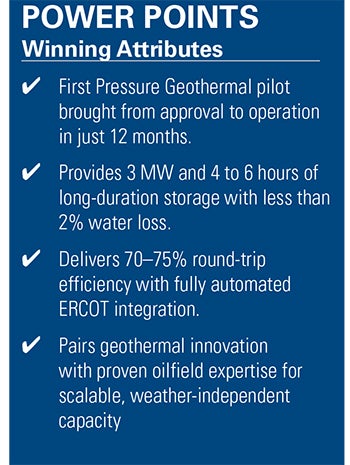 Notably, the project is fully digitally automated to integrate seamlessly with ERCOT, a feature that is a growing imperative in a fast-moving market that faces extreme weather, renewable fluctuations, and increasing demand stress from data centers and cryptocurrency mining. SAGE plans to operate SMECI Well #1 as a trader, buying and selling power in ERCOT’s South Load Zone. “It uses advanced control systems to manage charge and discharge cycles in real time, responding to grid signals and demand fluctuations,” Bird said. “These smart grid and digital automation layers ensure efficient synchronization with the broader energy network, enabling faster response times, remote monitoring and dynamic participation in grid dispatch.”
For Sage, delivering its first commercial pilot in Texas also meant taking advantage of a favorable policy and favorable environment. “Texas clarified through legislation in 2023 that geothermal heat belongs to landowners, which provides certainty for operators,” she said. “In addition, the Texas Railroad Commission, which is responsible for permitting geothermal wells, has over 100 years of expertise in oil and gas permitting and can permit geothermal wells in weeks rather than months or years.”
The company credits its project implementation speed from partnership to “store ready” in just 12 months to the combination of proven oil and gas expertise, intentionally streamlined design and Texas’ uniquely favorable permitting environment. Pressure is based on the full spectrum of geothermal oil and gas expertise: geology for the evaluation and characterization of subsurface rock formations; engineering and operations for design, execution, project management and cost control; and service providers for drilling, completions and fracturing from established oil field companies, Byrd explained.
“The majority of the Sage Geosystems team comes directly from the oil and gas industry. The founders alone bring over 120 years of combined experience. Leveraging these proven technologies, equipment and skills allows Sage to scale immediately without retooling equipment or retraining a new workforce, which is critical for the next generation of geothermal and energy storage,” Bird said.
Following grid interconnection of the SMECI energy storage system in December 2025, SEZ plans to focus on drilling wells and building its second energy storage facility with a major utility. Meanwhile work is underway on its first commercial power generation facility as part of META Phase I, with a partnership announced in August 2024 to deliver up to 150 MW of new geothermal baseload power for the social media company’s expanding US data centers. The project is scheduled to come online in 2027. “We are continuing to pursue partnerships with large technology hyperscalers, utilities, and the U.S. Department of Defense,” Bird said.
Ultimately, Sage sees three clear use cases for its technology—energy storage, power generation and district heating. “In the near term, we are prioritizing energy storage and power generation,” he said. “Energy storage can be deployed quickly, as demonstrated in our SMECI facility, which was built in approximately 12 months and directly enhances the performance and value of solar and wind assets. There is a high demand for clean baseload capacity, particularly from data centers and military installations, power generation with AI. [artificial intelligence] Due to the explosive growth in data center demand, this need will only increase.” For now, “district heating is a largely European opportunity, where piping infrastructure is already in place and coal/biomass heat sources are being phased out. “However, the permitting timeline is long, so we are hopeful that these projects will move forward over the next few years.”
,Sonal Patel is a power senior editor (@sonalcpatel, @POWERmagazine,
<a href