
 Nurfoto via Getty Images
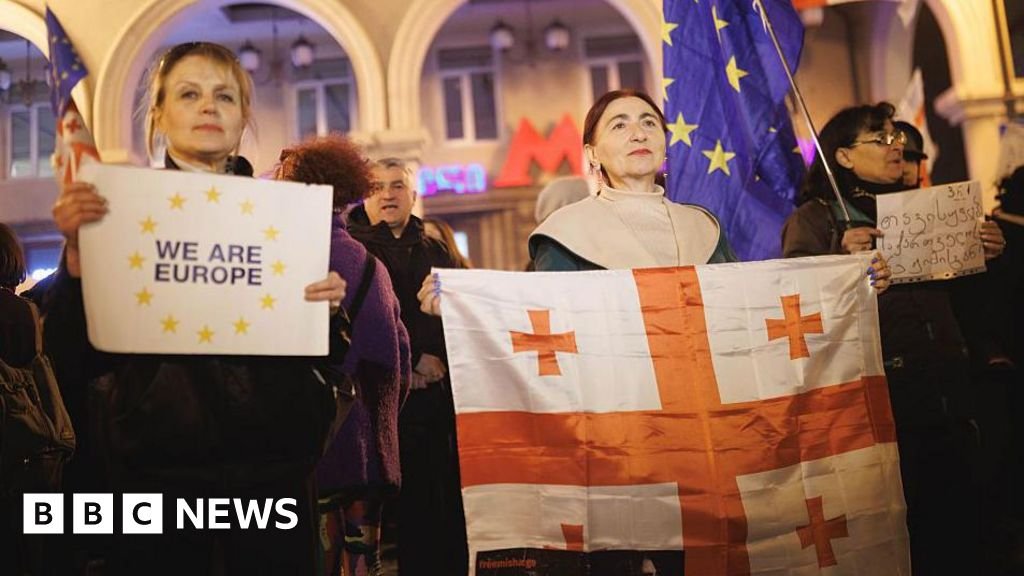
“I stand up for the future of this country,” says Giorgi Arabuli, who has taken part in protests on the streets of Georgia’s capital, Tbilisi, almost every night since they began a year ago.
Thousands of Georgians, angered by Prime Minister Irakli Kobakhidze’s decision to put a four-year moratorium on steps towards joining the European Union on 28 November 2024, responded to the mass demonstrations with violent police action.
“I am from the 1990s generation. I saw that dark time after the civil war,” Giorgi said. “Much of it was because of Russian influence in the post-Soviet country. We don’t want to go back there.”
Since then Georgians have seen, in the words of governments across Europe, “the demise of democracy”, and this has prompted accusations of Russian-style governance.
Street protests have turned into a fierce war.
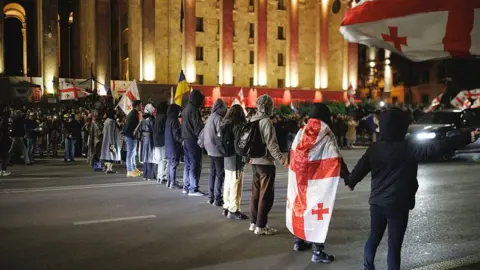
For months, Tbilisi’s main Rustaveli Avenue was blocked for a few hours every evening. The new laws and heavy police presence forced protesters to adapt, marching through adjacent streets and facing arrests at night.
 Nurfoto via Getty Images
The Georgian Dream government has imposed massive fines for blocking roads, charged youth protesters with criminal charges and recently pushed legislation allowing up to 14 days in prison for a first offense of blocking traffic, with repeat violators facing up to a year in prison.
A large banner carried toward the nearby Supreme Court read, “Freedom for prisoners of the regime.”
“They have used every means possible to crush the opposition… but the truth is that they have not been able to do it,” says Nata Koridze. Her husband, Zura Japaridze, is one of six prominent opposition figures jailed after refusing to testify before a parliamentary commission into alleged crimes by the previous government.
Six were jailed for up to eight months and banned from holding public office for two years.
Prosecutors have announced new charges against eight opposition leaders, including Japaridze. He could now face up to 15 years in prison for alleged subversion and aiding foreign powers.
Nata Koridze’s husband is due to be released on December 22, but says he has to appear in court again three days later.
He has been accused of communicating with Western partners about government abuses – standard democratic practice – as evidence of betrayal of state interests.
Like all jailed politicians, Japaridze is kept in solitary confinement.
“Zura hasn’t seen anyone except a doctor and a guard,” she says.
Georgia’s path to EU membership, once a cornerstone of its post-Soviet identity, is now further away than ever.
Earlier this month, its ambassador to Georgia made “devastating” findings in the EU’s annual enlargement report, concluding that it is now considered an EU candidate “in name only”.
Rejecting the government’s pledge to ensure membership by 2030, Pavel Herzinsky said, “Georgia is not on track to become an EU member state, neither in 2030 nor later.”
The BBC contacted the head of the parliamentary committee on European integration and other Georgian Dream MPs for comment, but none were available.
The government’s public reaction towards its foreign critics has been increasing.
Parliamentary speaker Shalva Papuashvili has accused the EU of giving “ideological and political dictates”, telling pro-government TV this month that “today’s Brussels does not want a Georgia that is like us”.
“They want a country standing on one foot,” he complained. “The policies and attitudes in Brussels must be changed. For them, the Georgian people and their choices mean nothing, zero.”
Georgian Dream, in power since 2012, won 54% of the vote in last year’s disputed parliamentary elections, which Europe’s OSCE Security Mission monitors said were marred by shortcomings including intimidation, coercion and coercion of voters, particularly public sector workers.
Since then all opposition parties have boycotted Parliament, leaving it completely in the hands of the government. This means that increasingly repressive legislation is passed unopposed.
Along with heavy fines for protesters blocking roads, a restrictive broadcasting law and a law on foreign funding have been enacted, requiring all foreign funding for civil society and media to be approved by a government commission.
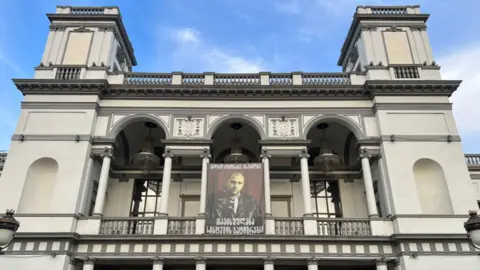
Hundreds of protesters were fined and dozens were jailed, among them famous actor Andro Chichinadze, who was given a two-year sentence for allegedly organizing protests.
His theater – once the most visited in Tbilisi – has closed in solidarity.
There is a widespread belief among pro-Europeans here that the Georgian government is working in Russia’s interests.
They point to the ruling party’s billionaire founder, Bidzina Ivanishvili, who made his fortune in Russia in the 1990s; legislation mirroring Russian laws targeting civil society; The government’s refusal to impose sanctions on Moscow over Ukraine and increasingly hostile anti-Western rhetoric.
Georgia’s leaders rejected that portrayal, describing their approach toward Russia as “pragmatic” and maintaining peace with their northern neighbor as their primary duty.
“Where are the facts?” Prime Minister Irakli Kobakhidze denied any pro-Russian bias during a recent TV interview. The government, he said, is “responsible to the Georgian society which wants to maintain peace in the country”.
 batumlebi
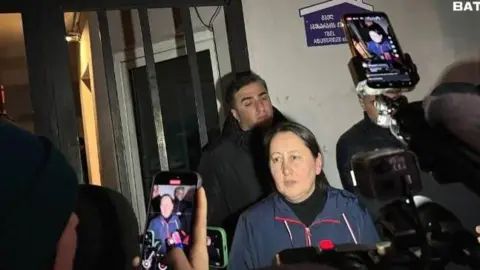
This is not the view of Maziya Amaglobeli, one of Georgia’s most respected journalists, who was jailed for two years for slapping a police officer.
“Russia is conquering us without a war. An oligarchy is ruling our country, depriving us of a European future and legitimizing autocratic, dictatorial regimes. We need the support of the democratic world,” he told the BBC in a handwritten letter from prison.
Amaglobeli, who will be awarded the European Parliament’s Sakharov Prize for Freedom of Thought next month, says he has lost the vision in one eye and that his remaining vision is deteriorating in solitary confinement: “I have difficulty reading even 10-15 minutes at a time.”
Georgia’s democratic decline had already accelerated before last year’s elections, with a June 2024 Russian-style law on foreign influence targeting civil society and independent media.
Students played a large role in the protests at the time and the government has responded with sweeping education reforms planned for next February. Georgia’s 19 state universities will be required to focus on a single academic discipline under the slogan “one city, one faculty.”
The reforms will tackle perceived problems including excessive concentration of universities in Tbilisi, duplication of programs and inadequate state funding.
The Prime Minister argues that funding should be “focused on carrying out the functions of the state”. Leading figures at Georgia’s leading research institution, Illia State University, say the reform is about imposing political control and eliminating free space.
“After political parties, media and NGOs, pressure should be put on universities,” says Nina Doborzginidze, rector of Ilya State University. “If students are removed from the capital, they are also removed from the political scene.”
“This is not about the quality of education, this is a political project,” says vice-rector Georgy Gwalia. “This is an abrupt shift in Georgia’s foreign policy from one of the most pro-European countries in the region to one of the toughest partners of the West and more autocratic great powers like Russia and especially China.”
On Rustaveli Avenue, teacher Rusudan Lomidze, who attends protests every day, says Georgia’s fate is inextricably linked to Ukraine.
“If Ukraine is forced to sign a surrender agreement, it would be a complete disaster for us. Our boys are fighting in Ukraine, and they are fighting for both Ukraine and Georgia.”
Crowds are smaller than a year ago, but several hundred protesters still gather each night despite the risks.
Reflecting on her years working towards EU and NATO integration as a diplomat, Nata Koridze now believes that “all that has collapsed”.
“But a protest symbolizes an idea. And ideas survive for decades, even centuries.”
<a href