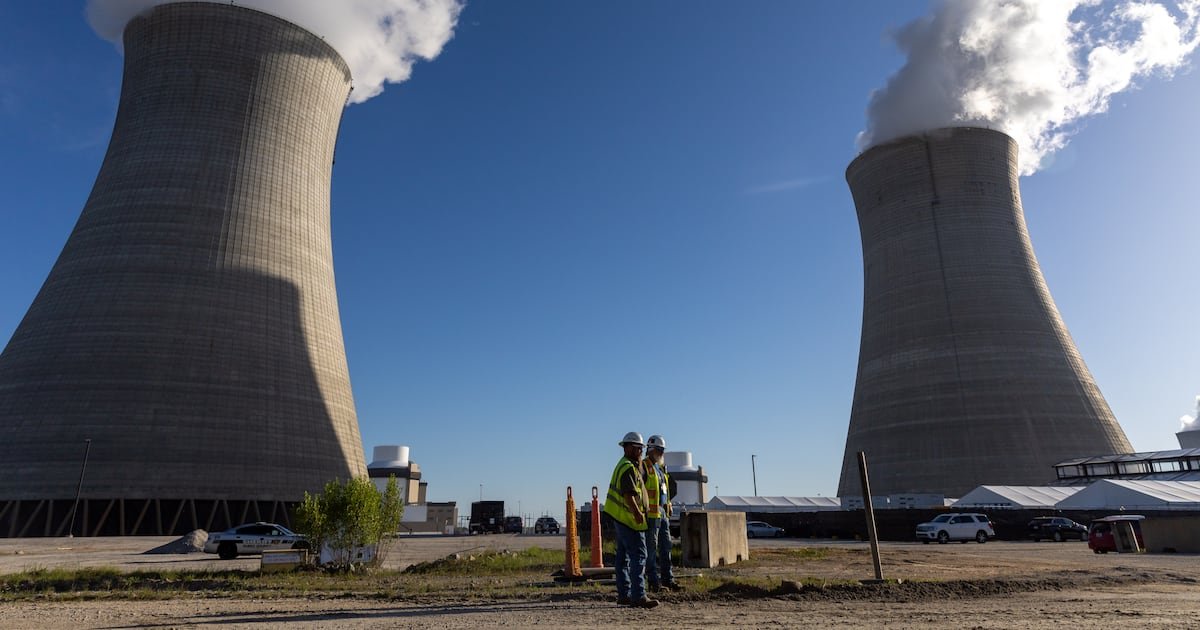

Cooling towers for Units 4 and 3 are seen at Plant Vogtle, operated by Georgia Power Company, in Berks County in eastern Georgia, near Waynesboro, on Wednesday, May 29, 2024. (Arvin Temker/AJC)
Staff analysts at the Georgia Public Service Commission have a stark warning in new written testimony: Georgia Power residential customers could see monthly bills rise by $20 or more if the PSC allows the utility to complete a historic electric fleet expansion, including what it has proposed to support the influx of data centers.
Instead, PSC staff recommend in the filing that right now, the commission should approve only a third of the new power plants and batteries proposed by the company. To date, analysts say only a fraction of what the company said it will build is supported by signed contracts.
“The rest is speculation and puts customers at risk of stranded costs if expected load is not met,” PSC Electric Section Director Robert Troicki and outside consultants wrote in their joint testimony.
The comments relate to the company’s request to add 10,000 megawatts to its power generation fleet over the next five years. For comparison, each of the four nuclear reactors at Plant Vogtle near Augusta provides about 1,100 megawatts.
Environmental and consumer advocacy groups say the scale at which the company has asked the PSC to approve the buildout is unprecedented.
“I think this is the largest single request in the history of the state in terms of how much power they want to make and buy — and how expensive it is — in terms of how much power they want to make and buy,” said Bob Scherrier, a staff attorney at the Southern Environmental Law Center.
The staff statements come after the historic defeats of two Republican outgoing PSC commissioners in elections earlier this month in which customer frustration over rising utility bills was the central issue. The two commissioners who lost, Fitz Johnson and Tim Echols, will have a chance to cast a vote on this important matter just days before leaving office.
The PSC will decide on Dec. 19 whether to approve some or all of the company’s proposed buildout, less than two weeks before the two Democrats elected to replace them take office.
It is unlikely that customers will feel any bill increases from data center expansion before 2029. This summer, the PSC voted to keep Georgia Power’s base rates stable through 2028. However, next year the commission will decide whether the utility can charge customers for storm repairs and fuel costs, both of which could increase bills.
Georgia Power disagrees that the demand is speculative. A company spokesperson pointed to a document filed Friday that said the “portfolio” of large customers that have “committed” to receive electric service from the utility has grown to 11,000 megawatts.
The utility will file additional testimony next week, a company spokesperson said in an email.
“Power demand is based on the company’s load forecast, which is based on large load customer commitments and additional organic growth,” the spokesperson said.
‘No Guarantee’ Customers Will Not Pay
Georgia is one of the fastest-growing markets in the country for new data centers, artificial intelligence and warehouses filled with the servers that power our digital lives. The Georgia power and data center industries say they need more electricity to serve them – equivalent to the needs of many large cities.
But as data center operators say they need these buildings, many are canceling contracts or moving to other states. Staff said this has already happened in Georgia and there is a high risk it will continue.
Additionally, PSC staff said the evidence shows that, to date, Georgia Power’s aggressive forecasts have overestimated power demand from data centers.
If this trend continues, Georgia Power could end up overbuilding for electrons that have nowhere to go.
That could make it difficult for existing customers to pay for those power plants, power contracts and grid upgrades, whether the power is needed or not, staff said.
For its part, Georgia Power said there are options if these scenarios play out. These include adding new contracts, delaying the construction of planned power supplies or changing upcoming power targets.
Earlier this year, Georgia Power and the PSC agreed to new billing terms that both parties said would save non-data center customers from paying the costs of serving huge server farms. But in their testimony, PSC staff analysts said those protections and assurances are not enough.
Employees say most of the contracts the company has signed so far with data centers were made before the new “large load” billing rules took effect.
“Without contracts executed under the new large load framework, there is no guarantee that those costs will not be passed on to existing customers,” Troicki and two outside advisers wrote.
Meanwhile, if the expansion is approved, Georgia Power would benefit “tremendously” from it, PSC staff wrote. All told, staff noted that the power plant the utility wants to add would nearly double the company’s “rate base,” a key factor in determining its earnings.
Employees said Georgia Power will likely ask customers to charge for the extensive costs for the data centers, whether they are built or not. That plus the steep costs of upgrading and maintaining the power grid means Georgia Power will lose money from customers in the long run, he said.
warning of rising costs
The staff said the PSC should sign off on 3,100 MW, or a third of the total, and approve another 4,200 MW with conditions.
Staff said commissioners should not allow Georgia Power to add the remaining 2,400 megawatts.
Employees said those power projects were the most expensive.
Georgia Power has been criticized by environmental and consumer advocates for turning to mostly gas-fired power plants to provide 10,000 megawatts, but PSC staff emphasized both fossil fuel and carbon-free energy sources – in this case, solar and battery storage.
Employees also took aim at Georgia Power’s ability to complete projects on time and on budget, a prime example of which is its nuclear expansion project at Plant Vogtle. The twin reactors, the first reactors to be built from scratch in the United States in nearly three decades, took an additional seven years to complete and more than doubled their original forecast budget of $14 billion.
Although these proposed power plants are different from giant nuclear reactors, the economic consequences of a delay for customers could be just as great.
“… (G)iven the magnitude of the company’s proposed construction program and the current hyperinflationary environment for generating equipment and labor costs, staff are concerned that a significant change could lead to delays and cost overruns in these projects,” Tom Newsome, utility finance director for the PSC, and outside consultants wrote in joint testimony.
Many other power companies in the United States are also considering building gas-fired power plants, driving up costs – and creating a backlog for gas turbines. Staff said the proposed battery storage projects are in their early stages, increasing the potential for delays and cost overruns, and Georgia Power has selected contractors who have never built these types of projects before.
A note of disclosure
This coverage is supported by the Green South Foundation and in partnership with Journalism Funding Partners. You can learn more and support our climate reporting by donating here AJC.com/donate/climate,

Christy Swartz is an AJC contributing writer covering climate change and related issues. She writes about how climate change affects people’s lives, from extreme weather hits in some parts of the state to higher electricity bills, insurance premiums and health care expenses.

Drew Kann is a reporter covering climate change and environmental issues for The Atlanta Journal-Constitution. His passion is for stories that tell how humans are responding to a changing environment. He is a proud graduate of the University of Georgia and Northwestern University, and before joining AJC, he held various roles at CNN.
<a href=