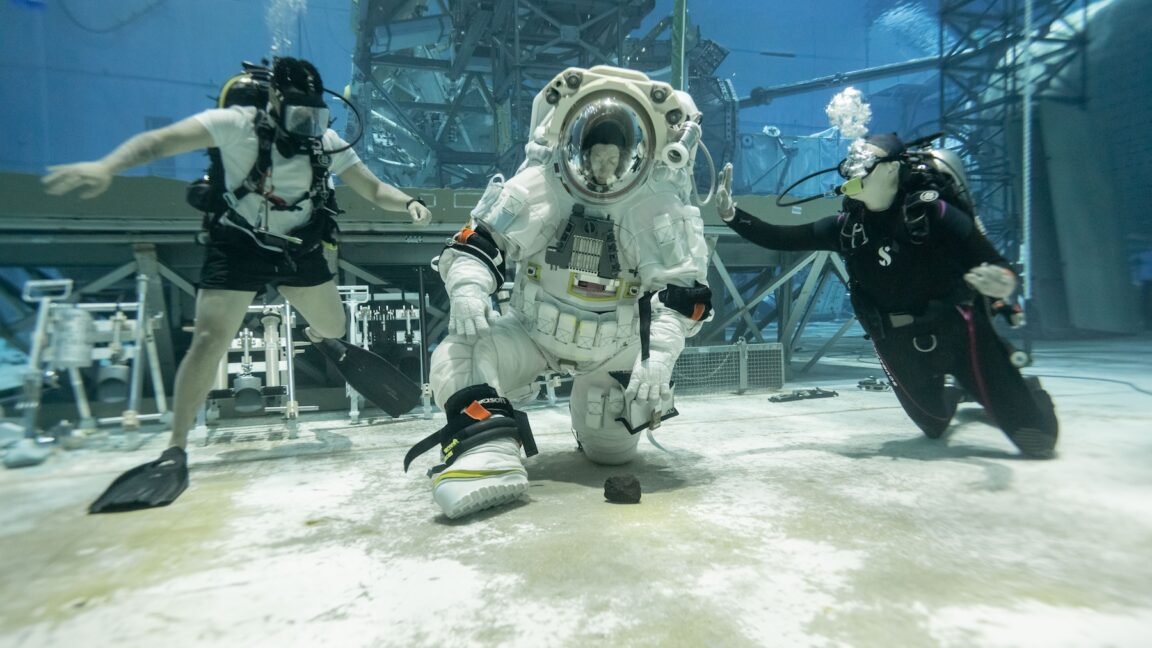
“The suits we have are certainly much better than Apollo,” Rubins said in the interview. “They were just big bags of air. The joints weren’t there, so it was hard to move them. What they had going for them was that they were very, very light compared to our current spacesuits. We’ve added a lot of the joints back, and that gives us some mobility. But at the end of the day, the suits are still pretty heavy.”
You can divide the weight of the suit by six to get an idea of what it would feel like to carry it on the surface of the Moon. Although it won’t feel like 300 pounds, astronauts will still have to account for its mass and momentum.
Rubins explained:
Instead of floating in microgravity and moving our mass around with our hands and our arms, we are now walking around. We are walking with our feet. There is going to be more pressure on your knees and hips. Your hamstrings, your calves and your glutes are going to be used more.
I think, overall, it might be a better fit for humans physically because if you ask someone to do a task, I’m going to be much better at that task if I can use my legs and I’m walking. Then I have to pull myself up with my arms… We’re not really built to do that, but we are built to run and go long distances. Our legs are a very powerful force.
So I think there are a lot of things that will make the physiology easier. Then there are things that are going to be different because we are now in a partial gravity environment. We’re bending, we’re turning, we’re doing different things.
This is an incredibly difficult engineering challenge. You have to keep a human being alive in a complete vacuum, kept warm at temperatures that you know can go down to 40 Kelvin (minus 388 degrees Fahrenheit). We have never sent humans anywhere in this cold before. They are also going to be very hot. They will be cooking food in the sun. You got radiation. If you put it all together, it’s a huge amount of material suitable for human physiology and keeping the human body intact.
Then our challenge is ‘How do you make that mobile?’ It is very difficult to bend and pick up a rock. You have to manage that center of gravity because you’re wearing that big life support system on your back, a big pack that has a lot of mass, causing your center of gravity to be higher than you’re used to on Earth and a little bit backwards.
When you move around, it’s like wearing a really heavy backpack that has weight but doesn’t weigh down, so it’s going to tip you back. You can do some things by putting weight on the front of the suit to try to move that center of gravity forward, but it’s still up high, and it’s not exactly over your center of mass like you used to be on Earth. On Earth, we have a center of our mass related to gravity, and nobody ever thinks about it, and you don’t think about it until it’s gone somewhere else, and then it makes all your natural motion very difficult.
These are some of the challenges we are facing from an engineering perspective. I think the new suits have gone a long way toward addressing this, but it’s still a difficult engineering challenge. And I’m not talking about any specific suit. I can’t speak to the details of the provider’s suite. This is the NASA xEMU and all the lunar suits I have tested over the years. This includes the Mark III suite, Axiom suite. They have similar issues. So it’s not really anything about any specific vendor. These are just the difficulties of designing a spacesuit for the lunar environment.
NASA astronauts train for spacewalks in the Neutral Buoyancy Laboratory, a giant pool in Houston that is used to simulate weightlessness. They also use a gravity-offloading device to practice the basics of spacewalking. The optimal testing environment, according to Rubins, will be on parabolic flights, short of space atmosphere, where suit developers and astronauts can get the best feel for the suit’s motion.
<a href