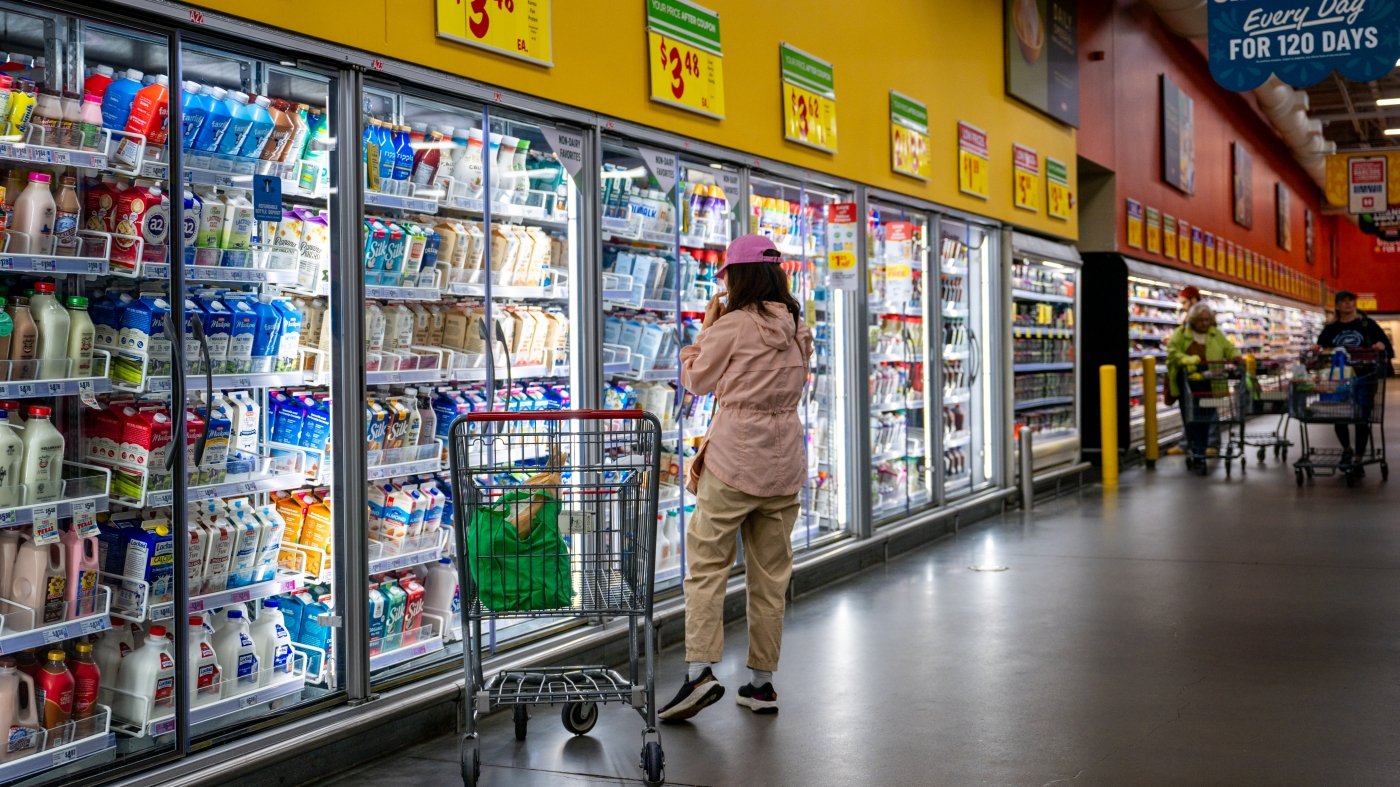

A customer purchases goods from an HEB grocery store in Austin, Texas, earlier this year. Many buyers are cutting back on purchases due to high costs.
Brandon Bell/Getty Images
hide caption
toggle caption
Brandon Bell/Getty Images
Many families across the country expect the holidays to be more expensive this year, leaving them less focused on family and food this season.
“Oh my God, is it different this year!” Steve Posey said while looking at the dairy case at an Aldi supermarket in Medford, Mass., this week. “With inflation and the price of eggs and cheese and all that other stuff, it’s pretty ridiculous.”
He and his wife, India, came to the store to shop, but not for themselves. She recently picked up a second job at Instacart to help cover her rising costs.
Despite Posey’s job as a case manager at a veterans organization and his wife’s job in child care, they still cannot make ends meet. For their Thanksgiving dinner, they got a turkey and some canned goods from the food pantry. They’ve been eating their leftovers together, but Posey said it’s affected their holiday spirit.

“It kind of takes away the fun,” he said. “I don’t feel like that this year. To be honest, I’m just trying to stay above water.”
Posey has also seen how much the veterans he works with are struggling. Many people have seen their federal SNAP food assistance disrupted during the government shutdown this month, and still haven’t been able to make up for it. The tension has now started showing, he said.
“We’re starting to see a lot more people frustrated, a lot more people angry,” he said. “You’re starting to see an increase in violence, especially domestic violence, and a lot of substance use, because they’re in such high quantities.”

Steve and India Posey say rising costs and increased stress are keeping them from enjoying the holidays this year and feeling like they’re “just trying to stay above water.”
Tovia Smith/NPR
hide caption
toggle caption
Tovia Smith/NPR
In New York City, Queens resident Rosetta Savannah is facing her own challenges. She’s one of those people who saw their SNAP payments interrupted during the government shutdown and is still waiting for this month’s benefits. So far, he has received only half the amount he would normally receive, and he also has additional medical bills.
Her family’s Thanksgiving dinner will also be lighter than usual.
“We’re making mostly chicken because chicken is cheap,” Savannah said. “I usually make cakes and pies but this year I’m not doing that.”

She also relies on the local food pantry for a small ham and some sides, but she knows there’s no guarantee there will be anything left.
“You have to get up very early to at least be the 30th person, and then you just wait and see,” she said.
Savannah is cutting down on gifts this year too. Her three children will only receive one small gift each, rather than the many gifts she usually gives them.
There will also be less gifts under the tree at Bonnie Green’s home in Bethlehem, Penn.
“There’s no way I’m cutting back on gifts drastically,” she said. “I can’t stand it.”
Green, a 60-year-old professional and homeowner, has always considered himself upper-middle class. She loves shopping on Black Friday and had planned to buy several new outfits for her children and her first granddaughter’s first Christmas. She also usually threw an elaborate and hearty holiday feast.
“I get older,” she said.

This year, Bonnie Green is using one of her mother’s favorite books, which offers ways to celebrate the holidays on a budget. Despite being forced to make huge cutbacks after the federal government eliminated jobs, Green is determined to keep smiling and focus on happiness, “even in the midst of austerity.”
Jacob Schippel
hide caption
toggle caption
Jacob Schippel
But earlier this year, his job with the National Science Foundation was one of several jobs eliminated by the Department of Government Efficiency, which President Trump created by executive order on his first day in office. He is still employed as a professor at East Stroudsburg University in Pennsylvania, but his net income is now half what it was before.
“That’s a lot of money that doesn’t exist anymore,” Green said. “It’s really hard.”
This has forced major changes this year. In addition to busting out gifts, she’s not decorating as she usually does, and her holiday menu is far more modest. Her usual seafood chowder will be replaced with chicken soup. And forget the beef Wellington and pecan pie, she said. Instead, she is “leaning” toward dishes she can make with very inexpensive ingredients.

The biggest shock: Her sister won’t be able to come for Christmas. This is not only because of the high airfare, but also because she is feeling stressed and needs to work extra shifts.
“I have friends who say the economy has never been better,” Green said. “I don’t know what economy they live in, but it’s not mine.”
Still, Green says, she feels fortunate compared to others, especially compared to many of the low-income students at her school.
He said the food pantry on campus is reaching almost double its normal volume, and he has heard from students who say they are so stretched financially that they may be forced to drop out of school. They are receiving their diploma, which will jeopardize their future earning potential.
Green, who has spent his career researching how to improve educational outcomes for disadvantaged students, founded a scholarship fund This is to help students who are so close to graduating that they run out of money.
“It would be a tragedy beyond words,” he said. “Without a graduate degree they will never be able to have a seat at the table. They won’t even be invited to the table, and they deserve to be there.”
So far, the foundation has raised enough money to keep one student in school until graduation. But there are dozens more people who have been deemed eligible for the program. Green is helping what she can. Even though she has cut back on her vacation spending, she has extended her vacations to support the foundation.
<a href