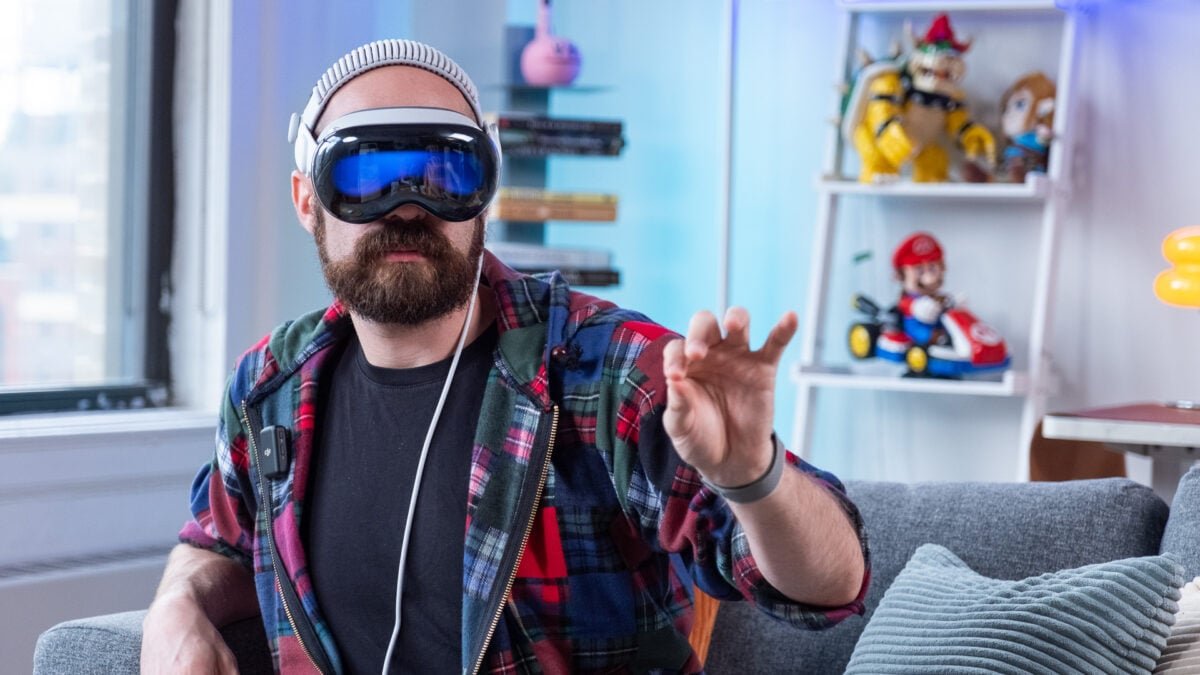
While most people interested in VR/XR don’t want to pay for the Vision Pro, they all probably want something that Apple’s $3,500 has: a premium display. Like the recently released Samsung Galaxy XR, Apple’s Vision Pro includes a Micro OLED screen, one of the biggest selling points of the gadget. For reference, OLED panels have better contrast, blacks, and better performance when it comes to motion clarity than LCD displays in cheaper headsets like the Meta Quest 3. After using the Vision Pro a little and the Quest 3 a lot, I can definitely say it makes a big difference.
Another advantage of OLED is power efficiency. Since each pixel is essentially on or off (black), OLED screens for VR/XR headsets could also bring longer battery life – an area in which the Vision Pro and other similar headsets still need to improve.
There’s just one hitch: Micro OLED is much more expensive than LCD because it’s difficult to manufacture. The result is a premium headset that costs a lot. But OLED may not be cost-prohibitive for long. TCL just showed off a new OLED panel (it’s regular and not the micro OLED in the Vision Pro) that’s made specifically for the XR headset and it’s said to be the densest OLED-on-glass display ever.
There are a few things that could make TCL’s new regular OLED panel a big upgrade compared to LCD, and the biggest of which is resolution. According to TCL, its latest OLED panel has a resolution of 2,560 x 2,740, which is significantly higher than the Quest 3’s 2,064 x 2,208 resolution, though lower than the 3,660 x 3,200 resolution of the micro OLED panel on the Vision Pro.

However, this is not the only benefit. As UploadVR notes, there already exist VR headsets that use regular OLED (the PSVR 2, for example), but in its current iteration, that display technology isn’t suitable for high-end VR lenses. However, TCL’s panel Is Suitable for premium lenses, it has a high pixel density of 1,512 ppi. This means anyone using this panel can opt for a pancake lens as opposed to a Fresnel lens, which in VR-speak means you’ll get less distortion and sharper images.
Ultimately, the benefit here is not only that you’ll get a more performant display than LCD (we already have this in Micro OLED), but that you’ll get VR/XR headsets with better displays than LCD that will theoretically be much cheaper to manufacture and hopefully headsets that will be much more affordable. This could open the door to a whole new world of midrange headsets that look and feel a lot more premium than the Quest 3, but cost a lot less than the Vision Pro. We all like the middle ground, right?
It remains to be seen whether OLED panels actually find their way to headsets. There are still some unanswered questions, like how bright TCL’s new display is (though we know it has a 1,000,000:1 contrast ratio, 120Hz refresh rate, and 110% wide color gamut) or how much it will cost to mass-manufacture, but on the surface, it seems like a step in the right direction. Because, as good as Apple’s Vision Pro is, I think it’s clear that many people aren’t willing to spend several thousand dollars on a “spatial computer.”