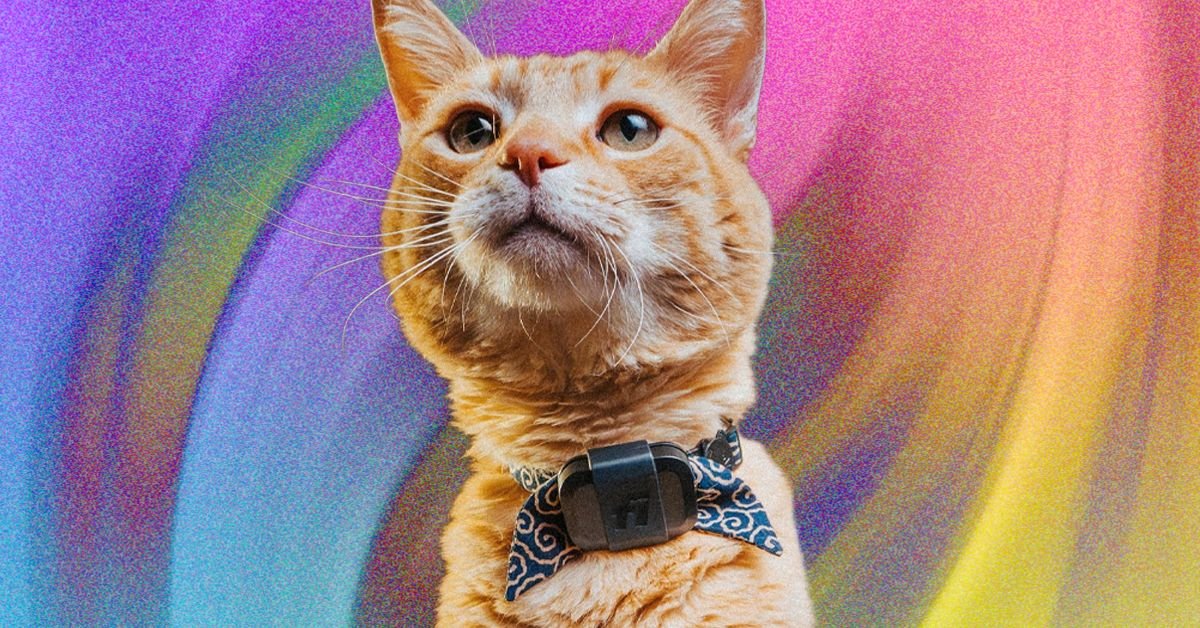
When you open the app, you’ll see a map with live tracking showing where your pet currently is, as well as a notification showing when and where they were last out and about. With the latter, you can pull up stats like a location timeline, showing where they were and when. If you dive in on a day when the tracker left the house, it will recreate the route, following the path and calculating the distance traveled by the pet.
There’s also health-monitoring data from activity and sleep tracking, which is most useful for indoor-only pets like me. Like other health-tracking collars, the sleep and activity statistics aren’t 100 percent accurate, as the app uses GPS to track movement, classifying it as “activity” when the animal is moving and “sleeping” when the pet remains still for long periods of time. This means that if Basil was awake but immobile, the app might mistakenly classify it as sleep.
.png "Fi Mini for Cats Review: Track Your Pets and Monitor Their Activity 2")
Fi Mini App Source Molly Higgins
In the Rest tab, you can see sleep metrics, including a daily summary of deep sleep, naps, and interruptions during nighttime sleep. You can compare it over time, and the app notes how much more or less Basil slept compared to the previous night. It also compares statistics historically, by week, month, and year, so you can track trends and better understand your pet’s normal sleep schedule.
The Activity tab is similar, tracking activity by day, week and month, noting in the day’s timeline when and for how long the pet was active. It also compares activity from the day before. I liked looking at the weekly reports, comparing days during the week, to see when he was most active and if any patterns in activity emerged.
For example, I noticed that his sleep versus activity schedule was very similar to mine, except that he was most active between 4:45 and 6:30 a.m. (while I was still sleeping), because that’s when his automatic feeder goes off for breakfast and my roommate is getting ready to go to work. He was most active in the evenings, when I would feed him dinner, have special playtime, and my roommates were home, so there was more activity to keep him awake. Historical comparisons are a very useful way to find out if your pet is sleeping more or becoming more lethargic – an early warning sign of a major health problem.
Not without its quirks
Since my cat only lives indoors, I did some experiments to track location using GPS on both the Fi Mini Tracker and my phone. I even had a friend take the tracker outside without my phone to see if I would get a ping that “Basil” had moved out of the safe zone.
Although it’s better than no alert at all, the Fi’s GPS has limitations (as did the Tractive tracker I tested). It requires a strong signal to communicate with cell towers for accurate location. If your phone is close to the smart collar (via Bluetooth), it uses that instead of the Fi’s GPS, making it more accurate and quicker to alert. If the pet gets loose and out of range of your phone, it uses the collar’s cellular antenna (in this case, Verizon cell towers). But because Fi’s antenna isn’t as strong as a phone’s, location accuracy is lower, and the connection can be very poor, especially if your pet is out in the country or in an area where cell towers are far away.
<a href