fastknn Provides a function to perform feature extraction using KNN. it produces k * c New features, where c is the number of class labels. New features are calculated from observations and the distance between them k The nearest neighbors within each class are:
- The first test feature consists of the distance between each test example and its nearest neighbor inside the first class.
- The second test feature consists of the sum of the distances between each test example and its 2 nearest neighbors inside the first class.
- The third test feature consists of the sum of the distances between each test example and its 3 nearest neighbors inside the first class.
- And so on.
This process is repeated for each class label, generating k * c new features. Then, to avoid overfitting, new training features are generated using the n-fold CV approach. Parallelization is available. You can specify the number of threads through nthread Parameters.
feature extraction The technique proposed here is based on the ideas presented in the winning solution to the Otto Group product classification challenge kagal,
The following example shows that KNN features Keep information about the original data that cannot be extracted by a linear learner like a GLM model:
library("mlbench")
library("caTools")
library("fastknn")
library("glmnet")

#### Load data
data("Ionosphere", package = "mlbench")
x <- data.matrix(subset(Ionosphere, select = -Class))
y <- Ionosphere$Class

#### Remove near zero variance columns
x <- x[, -c(1,2)]

#### Split data
set.seed(123)
tr.idx <- which(sample.split(Y = y, SplitRatio = 0.7))
x.tr <- x[tr.idx,]
x.te <- x[-tr.idx,]
y.tr <- y[tr.idx]
y.te <- y[-tr.idx]

#### GLM with original features
glm <- glmnet(x = x.tr, y = y.tr, family = "binomial", lambda = 0)
yhat <- drop(predict(glm, x.te, type = "class"))
yhat1 <- factor(yhat, levels = levels(y.tr))

#### Generate KNN features
set.seed(123)
new.data <- knnExtract(xtr = x.tr, ytr = y.tr, xte = x.te, k = 3)

#### GLM with KNN features
glm <- glmnet(x = new.data$new.tr, y = y.tr, family = "binomial", lambda = 0)
yhat <- drop(predict(glm, new.data$new.te, type = "class"))
yhat2 <- factor(yhat, levels = levels(y.tr))

#### Performance
sprintf("Accuracy with original features: %.2f", 100 * (1 - classLoss(actual = y.te, predicted = yhat1)))
sprintf("Accuracy with KNN features: %.2f", 100 * (1 - classLoss(actual = y.te, predicted = yhat2)))
## [1] "Accuracy with original features: 83.81"## [1] "Accuracy with KNN features: 95.24"For a more complete example, take a look at this Kaggle kernel that shows how knnExtract() Works on a large dataset.
Understanding KNN Features
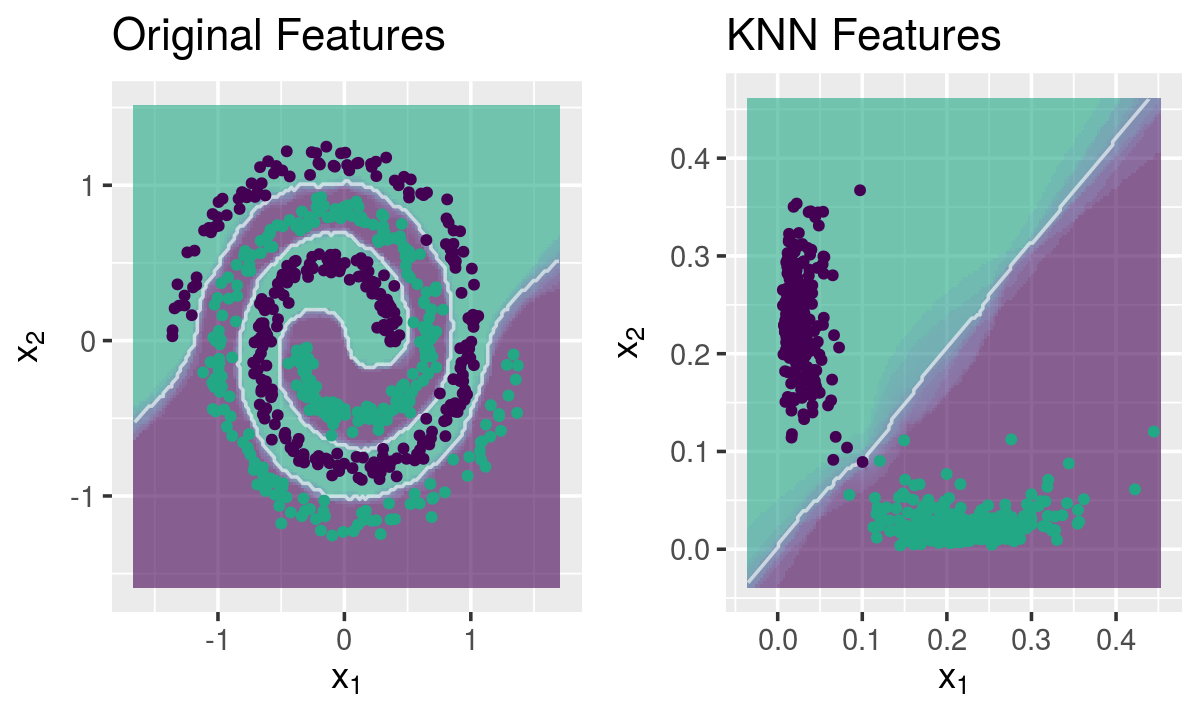
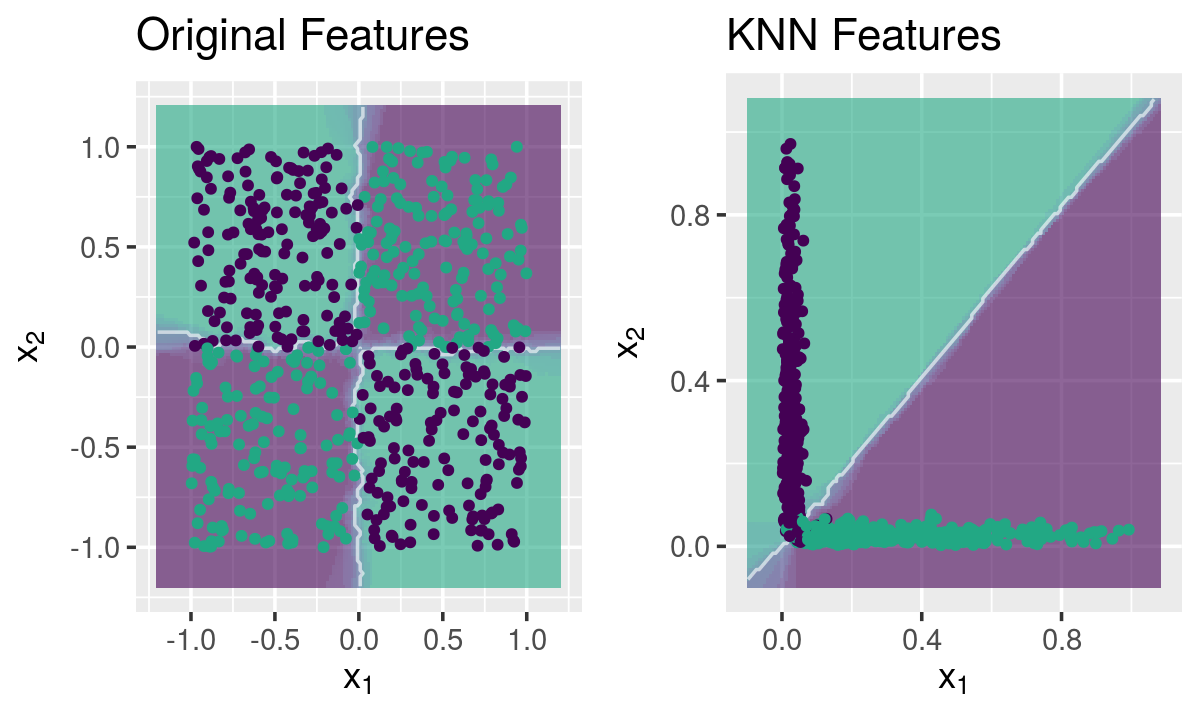
KNN takes a nonlinear mapping of the original space and projects it into a linear one, in which the classes are linearly separated.
mapping chess dataset
library("caTools")
library("fastknn")
library("ggplot2")
library("gridExtra")

## Load data
data("chess")
x <- data.matrix(chess$x)
y <- chess$y

## Split data
set.seed(123)
tr.idx <- which(sample.split(Y = y, SplitRatio = 0.7))
x.tr <- x[tr.idx,]
x.te <- x[-tr.idx,]
y.tr <- y[tr.idx]
y.te <- y[-tr.idx]

## Feature extraction with KNN
set.seed(123)
new.data <- knnExtract(x.tr, y.tr, x.te, k = 1)

## Decision boundaries
g1 <- knnDecision(x.tr, y.tr, x.te, y.te, k = 10) +
   labs(title = "Original Features")
g2 <- knnDecision(new.data$new.tr, y.tr, new.data$new.te, y.te, k = 10) +
   labs(title = "KNN Features")
grid.arrange(g1, g2, ncol = 2)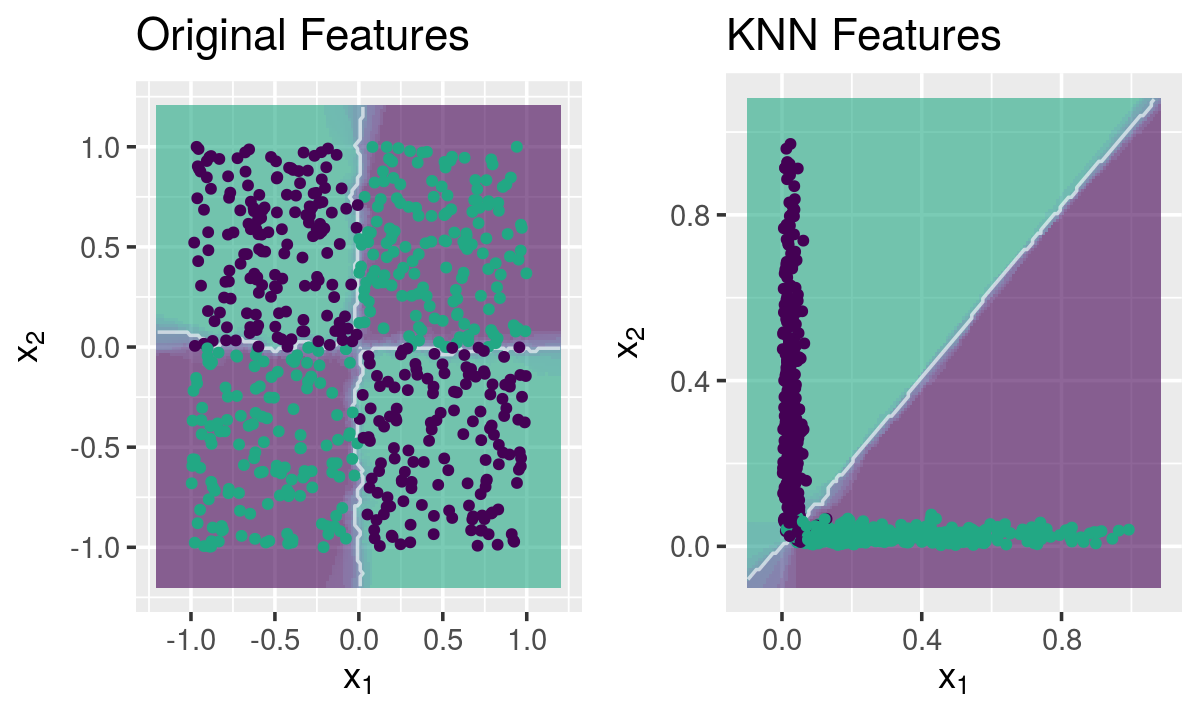
mapping spiral dataset
## Load data
data("spirals")
x <- data.matrix(spirals$x)
y <- spirals$y

## Split data
set.seed(123)
tr.idx <- which(sample.split(Y = y, SplitRatio = 0.7))
x.tr <- x[tr.idx,]
x.te <- x[-tr.idx,]
y.tr <- y[tr.idx]
y.te <- y[-tr.idx]

## Feature extraction with KNN
set.seed(123)
new.data <- knnExtract(x.tr, y.tr, x.te, k = 1)

## Decision boundaries
g1 <- knnDecision(x.tr, y.tr, x.te, y.te, k = 10) +
   labs(title = "Original Features")
g2 <- knnDecision(new.data$new.tr, y.tr, new.data$new.te, y.te, k = 10) +
   labs(title = "KNN Features")
grid.arrange(g1, g2, ncol = 2)