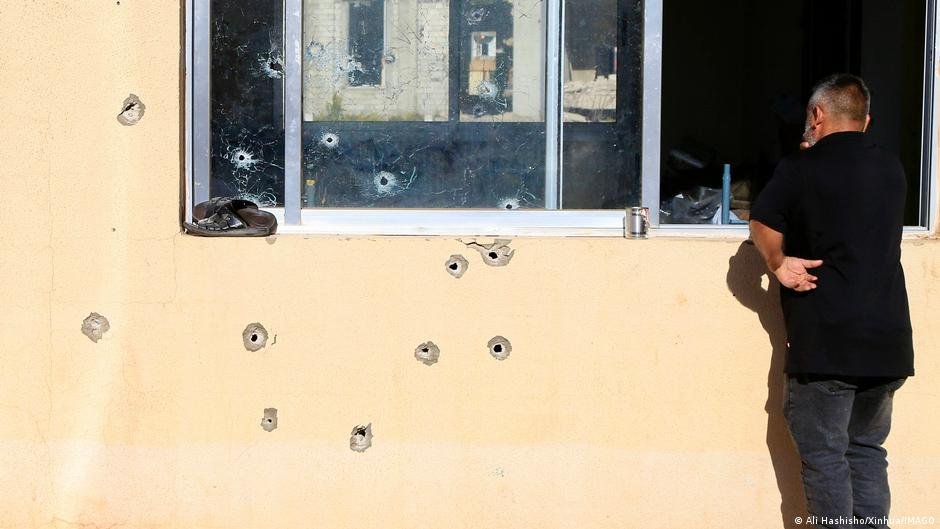
Lebanese Prime Minister Nawaf Salaam has repeatedly said that his country will not intervene in foreign disputes. Earlier this week, he urged Hezbollah not to drag Lebanon into “another adventure.”
However, Naim Qassem, secretary general of the Iran-backed Hezbollah group, had said earlier in January that any US attack on Iran would be considered an attack on Hezbollah in Lebanon. “When the time comes for a stance, we will not hesitate,” he said in a televised speech.
In turn, Israel, America’s main ally in the region, has warned Beirut that if Hezbollah gets involved in a potential US-Iran war it would hit the country hard and target civilian infrastructure. This was confirmed by two Lebanese officials this week.
“If a US-Iran war were to arise, Iran would expect Hezbollah to contribute, possibly by putting pressure on Israel,” Bercu Ozcelik, senior research fellow on Middle East security at the London-based Royal United Services Institute, or RUSI, told DW.
However, in his view, Hezbollah is also dealing with an increasingly complex domestic environment.
“Lebanese President Joseph Aoun’s integrationist pressure and the organization’s stake in Lebanon’s political future as a national actor outweigh the costs of a large, open-ended war,” Ozcelik said.
disintegration of hezbollah
Hezbollah, whose military wing is classified as a terrorist organization by the US, Germany and other countries, began targeting Israel for supporting Hamas on October 7, 2023, a day after the organization’s attack on Israel.
In November 2024, a ceasefire between Israel and Hezbollah ended 11 months of clashes and two months of full-scale war between Hezbollah and Israel. During this period, Israel killed most of Hezbollah’s leadership and destroyed large parts of the group’s infrastructure and weapons arsenal, as well as large parts of southern Lebanon and Beirut. About 4,000 people died and the World Bank estimates that reconstruction will cost around $11 billion (€9.5 billion).
While the ceasefire stipulated the disarmament of the group, Hezbollah has so far only abandoned its weapons south of the Litani River. The group refused to fully disarm, citing the need to be able to defend the country against ongoing Israeli attacks and Israel’s military occupation of five points along the joint border.
On the other hand, Israel has repeatedly said that it will not stop targeting Hezbollah as long as it continues to pose a threat. Hezbollah, as part of the Iran-led ‘Axis of Resistance’ – which also includes Hamas in Gaza, the Houthis in Yemen and various Iraqi paramilitary factions – considers the United States and Israel as enemies.
This week Lebanese Prime Minister Salam told Lebanese news outlet Naharnet said the kingdom continues its efforts to disarm the group beyond Phase 1, which refers to the area between the border and the Litani River. Disarming Hezbollah was an “irreversible sovereign choice”, he said.
However, he was more cautious on the implementation of Phase 2 – North of the Litani River, saying it “depends on a number of factors, including the outcomes of the conference in support of the Lebanese Army.” A conference is scheduled for March 5, 2026 in Paris with participants from the US, Saudi Arabia, Qatar, Egypt and France.
The US-based Institute for the Study of War has written in a report It said this week that a delay in disarming Hezbollah would make disarmament harder because the organization is meanwhile reorganizing its forces. However, Mohanad Hage Ali, deputy director of research at the Malcolm H. Kerr Carnegie Middle East Center in Beirut, pointed out that Hezbollah still lacked the strength it had before the war.
“The group is much weaker and more fragmented, making decision-making even more fragmented,” he said.
He said Hezbollah’s military wing opposes disarmament, but the political wing, which has a strong hold in the country’s parliament and its social network of hospitals and social services, is more open to discussing disarmament.
“The part of the group that is against disarmament can still attack, but if I look at the reality on the ground, the Lebanese Shia community (political wing) is more important in the sense that they have more involvement in politics,” Hej Ali said.
Furthermore, RUSI’s Ozcelik says that if tensions between the US and Iran escalate, some symbolic involvement of Hezbollah would be a plausible outcome. “This could be a limited, carefully calibrated set of strikes against Israeli targets designed to show solidarity and satisfy Tehran, while staying below a threshold that could trigger a massive Israeli retaliation,” he said, adding that the changing dynamics of the conflict or direct Israeli action would force a different response.
‘I feel depressed’
There is little hope for the Lebanese population, which has borne the brunt of the economic and political crises since 2019, as well as the devastating Beirut port explosion in August 2020 and the conflict between Hezbollah and Israel in 2023 and 2024. People are not optimistic about international reconstruction efforts that depend on the disarmament of Hezbollah.
“I feel hopeless,” Nadim El Riz, a 35-year-old videographer who lives near Saida in southern Lebanon, told DW. “I expect a major and deadly war between Iran and its proxies on the one hand, and the US and Israel on the other,” he said.
Apart from this, Raymond Khouri, a fitness trainer in Beirut, is also worried. “I’m afraid that my country will be dragged into a war because Hezbollah is directly linked to Iran and if something happens, we will also get involved,” the 38-year-old told DW.
For now, 27-year-old Beirut resident Fatima Naim says she lives her daily life in a state of denial.
“I try not to think about what to do in case of stress because I can’t control the situation,” she told DW. Until the situation changes, she “prefers to focus on her life in a ‘Landland mood’ rather than living in constant fear and panic.”
Edited by: Jess Smee
<a href