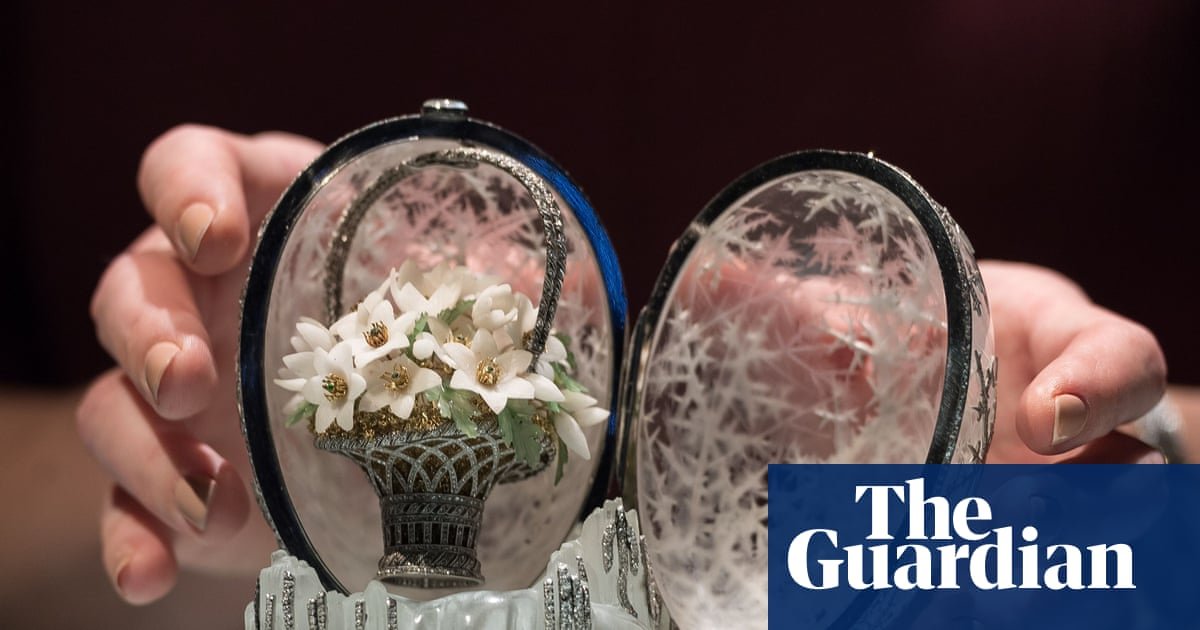
An ancient gem-encrusted Faberge egg belonging to the mother of Russia’s last emperor has been sold in London for a record £22.9 million.
The Winter Egg was commissioned in 1913 by Emperor Nicholas II as an Easter gift for his mother, Dowager Empress Maria Feodorovna, and has been described as one of the grandest of Fabergé’s imperial creations.
Peter Carl Fabergé is considered the greatest Russian jeweler of the late 19th and early 20th centuries. The Imperial Collection of works were personal gifts owned by the Russian, Danish and British royal families.
The Winter Egg is a rock crystal engraved with a frost design on the inside, while the outside features rose-cut diamond-set platinum snowflake motifs.
On Tuesday it was sold for £22,895,000, breaking the world auction record for a Fabergé. The previous record was set in 2007 when the Rothschild egg was sold for £8.9m.
According to Christie’s, the auction marks the third time the Winter Egg has set a record-breaking price for a Faberge piece. It has been sold several times because its history attracts collectors.
After the Russian Revolution in 1917, the egg was moved from St. Petersburg to the Kremlin Arsenal in Moscow along with other valuable possessions of the imperial family.
In the 1920s the Soviet government began selling art treasures from the Hermitage Museum and other collections, often for a fraction of their value. It was later acquired by Wartsky of London and sold to a British collector in 1934 for £1,500.
The egg was believed to be missing for two decades between 1975 and 1994 before being sold at Christie’s for £6.8 million. Eight years later in 2002 the auction house sold it again for £7.1m.
Margo Oganesian, head of the department of Fabergé and Russian works of art at Christie’s, said: “It is an honor for Christie’s to be entrusted with the sale of the exquisite Winter Egg by Fabergé for the third time in our history.
“Today’s result sets a new world auction record for a work by Fabergé, confirming the enduring importance of this masterpiece and celebrating the rarity and brilliance of what is considered, both technically and artistically, one of Fabergé’s finest creations.
“With only a handful of royal Easter eggs left in private hands, this was an extraordinary and historic opportunity for collectors to acquire a work of unparalleled importance.”
<a href